
Home / Mammals / Rodents / Meadow jumping mouse
Some federal rules applyMeadow jumping mouse
Zapus hudsonius
Mammals › Rodents (Rodentia) › Dipodidae (Jerboas)
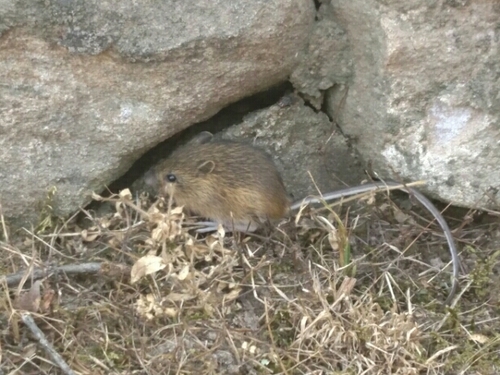
The meadow jumping mouse (Zapus hudsonius) is the most widely distributed mouse in the family Zapodidae.
From Wikipedia: Meadow jumping mouse, CC BY-SA 4.0 (excerpt)
Care at a glance
Species-specific values
Values researched for this exact species. Air, surface and water temperatures are listed separately, and each source is kept as published rather than averaged.
| Minimum enclosure | Routine housing used individual cages 45 × 24 × 16 cm; breeding cages were larger and held pairs. Source: pmc.ncbi.nlm.nih.gov | |
| Warm side air temperature | 68 °F (20 °C) Source: pmc.ncbi.nlm.nih.gov | |
| Diet | Rodent chow and water were offered freely; chow diet was supplemented with small amounts of enrichment foods such as sunflower seeds. Source: pmc.ncbi.nlm.nih.gov | |
| Social housing | Adults were generally housed individually; breeding pairs were kept together briefly, with the male removed after about three days or at incompatibility. Source: pmc.ncbi.nlm.nih.gov | |
| Substrate | Routine cages had corncob bedding and Enviro-dri paper; cotton nestlets were avoided. Source: pmc.ncbi.nlm.nih.gov | |
| Seasonal cooling | 45–68 °F (7–20 °C) Source: pmc.ncbi.nlm.nih.gov |
Warnings
Understanding the animal
About this animal
About this animal
Its range extends from the Atlantic coast in the east to the Great Plains west, and from the arctic tree lines in Canada and Alaska to the north, and Georgia, Alabama, Arizona, and New Mexico to the south. In mid-2014, the New Mexico subspecies of the meadow jumping mouse, Zapus hudsonius luteus, was listed as an endangered species under the federal Endangered Species Act.
From Wikipedia: Meadow jumping mouse, CC BY-SA 4.0 (excerpt)
In the wild
In the wild
| Overview | The meadow jumping mouse (Zapus hudsonius) is the most widely distributed mouse in the family Zapodidae. Its range extends from the Atlantic coast in the east to the Great Plains west, and from the arctic tree lines in Canada and Alaska to the north, and Georgia, Alabama, Arizona, and New Mexico to the south. In mid-2014, the New Mexico subspecies of the meadow jumping mouse, Zapus hudsonius luteus, was listed as an endangered species under the federal Endangered Species Act. — From Wikipedia: Meadow jumping mouse, CC BY-SA 4.0 (excerpt) |
Read about this species in the wild at Animal Diversity Web.
Native climate (measured)
Native climate (measured)
| Warm-season highs | about 80°F (up to 86°F in the hottest sampled areas) |
| Cool-season lows | about 7°F (down to -9°F in the coldest sampled areas) |
| Average temperature | 34–51°F across sampled records |
| Relative humidity | 71–78% on average (driest month about 64%) |
| Rainfall | about 862 mm a year, spread fairly evenly |
| Winters | Cool to cold winters (lows around 7°F) in much of its native range. Seasonal slowdown may be relevant, but species-specific biology determines whether brumation or hibernation occurs. |
Measured at 1385 wild occurrence records sampled against WorldClim 2.1 climate data (1970–2000 averages). Air conditions in the range are ecological context, not enclosure settings: microhabitats such as burrows, leaf litter or basking rocks can be cooler, warmer or more humid.
Data and studies
The numbers
The numbers
Each bar is what one source reports. Where several sources weigh in, the dashed gold band marks their average.
Maximum recorded lifespan
Longest recorded lifespan reported by each database; typical lifespans are usually shorter. The AnAge record comes from an animal in human care.
Typical adult weight
Average adult body mass in each database (FishBase gives the maximum recorded weight).
Litter size
Average per litter or clutch.
Gestation
Female maturity
Veterinary & husbandry research
Veterinary & husbandry research
- Breeding and hibernation of captive meadow jumping mice (Zapus hudsonius) Brem EA et al., PloS one 2021
- Courtship behavior of the meadow jumping mouse (Zapus hudsonius) Brem EA et al., Western North American naturalist 2021
Peer-reviewed papers that mention this species alongside captivity, zoos, veterinary care or aquaculture. Some cover several species or mention it only in passing, so check the abstract. PubMed
Sources for this sheet
- AnAge: The Animal Ageing and Longevity Database (Human Ageing Genomic Resources) (CC BY 3.0) Peer-reviewed researchCurated, referenced longevity and life-history records for thousands of species; maximum lifespans are often from zoo animals.
- Myhrvold et al. (2015). An amniote life-history database. Ecology 96: 3109 Peer-reviewed researchPeer-reviewed compilation of life-history data for over 21,000 birds, mammals and reptiles.
- 50 CFR 17.11: Endangered and threatened wildlife Zoo, university or veterinaryCurrent federal Endangered Species Act list.
- 9 CFR 2.1: Animal Welfare Act licensing (USDA) Zoo, university or veterinaryWho needs a USDA license to breed, sell or exhibit animals.
- Wikipedia (species article) (CC BY-SA 4.0) Community referenceFree encyclopedia; useful overviews with their own citations. Short excerpts are quoted under CC BY-SA 4.0, each credited with a link to its article.
- PubMed (U.S. National Library of Medicine) Peer-reviewed researchIndex of peer-reviewed veterinary, zoo and husbandry research.

