
Home / Invertebrates / Beetles / Megasoma mars
No federal permit to keepMegasoma mars
Megasoma mars
Invertebrates › Beetles (Coleoptera) › Scarabaeidae (Scarab and rhinoceros beetles)
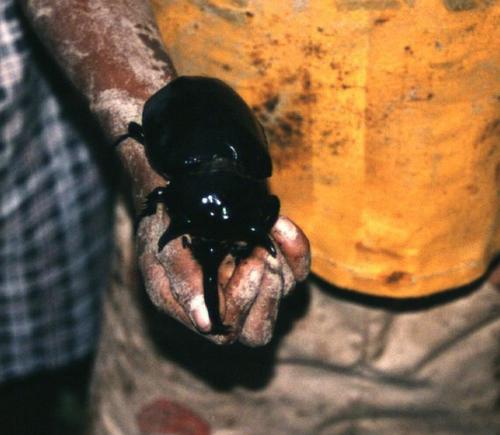
Megasoma mars, also known as the mars beetle or mars rhino beetle, is the largest species in the Megasoma genus.
From Wikipedia: Megasoma mars, CC BY-SA 4.0 (excerpt)
Care at a glance
Species-specific values
Values researched for this exact species. Air, surface and water temperatures are listed separately, and each source is kept as published rather than averaged.
| Warm side air temperature | 64–77 °F (18–25 °C) Source: richardsinverts.com | |
| Diet | Larvae eat decayed wood or leaves from the same tree species; adults can eat beetle jelly or sweet fruits. Source: richardsinverts.com | |
| Feeding frequency | Leave the adults together in the breeding box for 7–10 days to ensure mating. Source: richardsinverts.com | |
| Social housing | Larvae should ideally be reared individually; communal rearing is possible with enough space and substrate. Source: richardsinverts.com | |
| Substrate | Use wood or flake soil for larvae; use a 50 L breeding box filled 70% with substrate for breeding. Source: richardsinverts.com |
Understanding the animal
About this animal
About this animal
It is distributed primarily in the west-central Amazon basin of Brazil, ranging down into Colombia, Paraguay, and Uraguay.
From Wikipedia: Megasoma mars, CC BY-SA 4.0 (excerpt)
In the wild
In the wild
| Overview | Megasoma mars, also known as the mars beetle or mars rhino beetle, is the largest species in the Megasoma genus. It is distributed primarily in the west-central Amazon basin of Brazil, ranging down into Colombia, Paraguay, and Uraguay. — From Wikipedia: Megasoma mars, CC BY-SA 4.0 (excerpt) |
| Wild diet | While there are no recorded observations of M. mars feeding in the wild, in captivity larvae will eat decayed wood and leaves in the families of oak, beech, and chestnut, and adults will eat fruit. — From Wikipedia: Megasoma mars, CC BY-SA 4.0 (excerpt) |
| Appearance and size | Megasoma mars is a large, horned beetle which typically ranges between 80 - 120 mm long, but has been observed to reach up to 140mm long. It is black and has smooth, shiny elytra. A lack of dorsal vestiture, or hairlike scales on its back, sets it apart from similar & related beetles such as M. actaeon. — From Wikipedia: Megasoma mars, CC BY-SA 4.0 (excerpt) |
Native climate (measured)
Native climate (measured)
| Warm-season highs | about 89°F (up to 92°F in the hottest sampled areas) |
| Cool-season lows | about 71°F (down to 69°F in the coldest sampled areas) |
| Average temperature | 79–80°F across sampled records |
| Relative humidity | 82–84% on average (driest month about 80%) |
| Rainfall | about 2770 mm a year, spread fairly evenly |
Measured at 11 wild occurrence records sampled against WorldClim 2.1 climate data (1970–2000 averages). Air conditions in the range are ecological context, not enclosure settings: microhabitats such as burrows, leaf litter or basking rocks can be cooler, warmer or more humid.
Sources for this sheet
- GBIF Backbone Taxonomy (Global Biodiversity Information Facility) (CC BY 4.0) Peer-reviewed researchInternational scientific taxonomy used here for classification. GBIF Secretariat (2023). GBIF Backbone Taxonomy. Checklist dataset https://doi.org/10.15468/39omei, accessed via GBIF.org.
- Wikipedia (species article) (CC BY-SA 4.0) Community referenceFree encyclopedia; useful overviews with their own citations. Short excerpts are quoted under CC BY-SA 4.0, each credited with a link to its article.
- iNaturalist (captive observations) Community referenceCommunity observation platform run by the California Academy of Sciences and National Geographic; observations marked captive show animals living in homes, zoos and aquariums.
More scarab and rhinoceros beetles
Chiron Beetle
Chalcosoma chiron
Pet trade

Eastern Hercules beetle
Dynastes tityus
Pet trade
Goliath beetle
Goliathus goliatus
Pet trade

Hercules beetle
Dynastes hercules
Pet trade

Japanese rhinoceros beetle
Trypoxylus dichotomus
Pet trade

Neptune Beetle
Dynastes neptunus
Pet trade