
Home / Fishes / Carp, barbs, minnows, loaches / Cyprinidae / Melon barb
No federal permit to keepMelon barb
Haludaria fasciata
Fishes › Carp, barbs, minnows, loaches (Cypriniformes) › Cyprinidae (Carps and barbs)
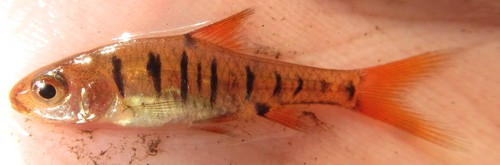
The melon barb (Haludaria fasciata) is a common species of cyprinid fish endemic to rivers of the states of Goa, Karnataka, Kerala and Tamil Nadu in the Western Ghats of South India.

Care at a glance
Species care notes
Read the full care sheet at Seriously Fish: habitat, aquarium size, water conditions, diet, behaviour and breeding.
Understanding the animal
About this animal
About this animal
They live in a tropical climate, and water that they are found in typically has a pH of 6.0—6.5, a hardness of around 5 dGH, and a temperature range of 22–26 °C (72–79 °F). The melon barb can grow to a length of 6 centimetres (2.4 in), and may be found in the aquarium trade.
From Wikipedia: Melon barb, CC BY-SA 4.0 (excerpt)
In the wild
In the wild
From this species’ own FishBase record (habitat, bottom type, water and breeding data), not its family. Wild conditions are context, not enclosure settings.1
| Where it lives | Lives in freshwater, in rivers and streams. Uses both the bottom and open water. |
| Climate | Tropical climate. |
Data and studies
The numbers
The numbers
Each bar is what one source reports. Where several sources weigh in, the dashed gold band marks their average.
Adult length
Sources for this sheet
- Seriously Fish species profiles Experienced keeper or breederLong-running aquarium reference written and peer-checked by experienced fishkeepers and ichthyologists; each profile covers habitat, tank size, water, diet, behaviour and breeding.
- FishBase (Froese & Pauly, eds.), version 24.07 (CC BY-NC 4.0) Peer-reviewed researchThe global scientific database on fishes, maintained by a consortium of research institutions; every value is referenced.
- Wikipedia (species article) (CC BY-SA 4.0) Community referenceFree encyclopedia; useful overviews with their own citations. Short excerpts are quoted under CC BY-SA 4.0, each credited with a link to its article.
- iNaturalist (captive observations) Community referenceCommunity observation platform run by the California Academy of Sciences and National Geographic; observations marked captive show animals living in homes, zoos and aquariums.
More carps and barbs
Acrossocheilus parallens
Acrossocheilus parallens
Aquarium hobby
African banded barb
Enteromius fasciolatus
Aquarium hobby
Arulius barb
Dawkinsia arulius
Aquarium hobby

Bala shark
Balantiocheilos melanopterus
Aquarium hobby

Beardless barb
Cyclocheilichthys apogon
Aquarium hobby

Bigspot barb
Barbodes dunckeri
Aquarium hobby