
Home / Invertebrates / Conchs and cowries / Serpent's-head Cowrie
No federal permit to keepSerpent's-head Cowrie
Monetaria caputserpentis
Also known as Serpent's-head Cowry, Snake's-head Cowry, Snakehead Cowrie, Snakehead Cowry, serpent's head cowrie, serpent's head cowry, snake's head cowrie
Invertebrates › Conchs and cowries (Littorinimorpha) › Cypraeidae (Cowries)
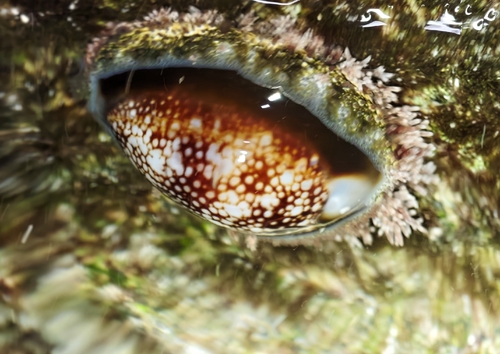
Monetaria caputserpentis, common name the serpent's-head cowry or snakehead cowry, is a species of cowry, a sea snail, a marine gastropod mollusk in the family Cypraeidae, the cowries.
From Wikipedia: Monetaria caputserpentis, CC BY-SA 4.0 (excerpt)
Experience: Intermediate
FamilyCowries
WaterSaltwater
HabitatTropical Indo-West Pacific
Care at a glance
Species-specific values
Values researched for this exact species. Air, surface and water temperatures are listed separately, and each source is kept as published rather than averaged.
| Minimum enclosure | 20 liters (5 gallons) minimum tank size Source: reeflings.com | |
| Diet | Primarily eats algae and biofilm; may be supplemented with algae wafers or blanched spinach and lettuce. Source: reeflings.com | |
| Social housing | Peaceful and suitable for community tanks with other non-predatory species. Source: reeflings.com |
Understanding the animal
In the wild
In the wild
| Overview | Monetaria caputserpentis, common name the serpent's-head cowry or snakehead cowry, is a species of cowry, a sea snail, a marine gastropod mollusk in the family Cypraeidae, the cowries. — From Wikipedia: Monetaria caputserpentis, CC BY-SA 4.0 (excerpt) |
| Appearance and size | The basic color of the shell is reddish-brown, with many whitish dots on the top of the dorsum, which sometimes shows a clear longitudinal line. The underside is light beige. Frequently these shells are sold with a purple top, which is achieved by dipping the dorsum in acid. — From Wikipedia: Monetaria caputserpentis, CC BY-SA 4.0 (excerpt) |
Read about this species in the wild at SeaLifeBase.
Sources for this sheet
- SeaLifeBase (Palomares & Pauly, eds.), version 24.07 (CC BY-NC 4.0) Peer-reviewed researchFishBase's sister database for non-fish marine and freshwater life; values are referenced.
- GBIF Backbone Taxonomy (Global Biodiversity Information Facility) (CC BY 4.0) Peer-reviewed researchInternational scientific taxonomy used here for classification. GBIF Secretariat (2023). GBIF Backbone Taxonomy. Checklist dataset https://doi.org/10.15468/39omei, accessed via GBIF.org.
- Wikipedia (species article) (CC BY-SA 4.0) Community referenceFree encyclopedia; useful overviews with their own citations. Short excerpts are quoted under CC BY-SA 4.0, each credited with a link to its article.
- iNaturalist (captive observations) Community referenceCommunity observation platform run by the California Academy of Sciences and National Geographic; observations marked captive show animals living in homes, zoos and aquariums.
