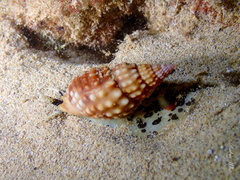
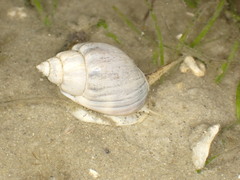
Home / Invertebrates / Nassarius and assassin snails / Cone-shaped nassa
No federal permit to keepCone-shaped nassa
Nassarius conoidalis
Invertebrates › Nassarius and assassin snails (Neogastropoda) › Nassariidae (Nassarius and assassin snails)
Nassarius conoidalis, common name the cone-shaped nassa or the jewelled dog whelk, is a species of sea snail, a marine gastropod mollusc in the family Nassariidae, the nassa mud snails.
From Wikipedia: Nassarius conoidalis, CC BY-SA 4.0 (excerpt)
Care at a glance
Species-specific values
Values researched for this exact species. Air, surface and water temperatures are listed separately, and each source is kept as published rather than averaged.
| Minimum enclosure | Recommended minimum aquarium volume is 20 liters (5.3 gallons). Source: reeflings.com | |
| Water temperature | 75–81 °F (24–27 °C) Source: reeflings.com | |
| Substrate | Use sandy substrate with at least a few centimeters of sand for burrowing. Source: reeflings.com | |
| Diet | Eats decaying organic matter, uneaten food, and detritus; supplement with sinking pellets or chopped shrimp if needed. Source: reeflings.com | |
| Feeding frequency | Feed sparingly; evening feeding may encourage natural behavior. Source: reeflings.com | |
| Social housing | Peaceful and compatible with many fish, corals, and invertebrates; use care with predatory wrasses or crabs. Source: reeflings.com |
Understanding the animal
In the wild
In the wild
| Overview | Nassarius conoidalis, common name the cone-shaped nassa or the jewelled dog whelk, is a species of sea snail, a marine gastropod mollusc in the family Nassariidae, the nassa mud snails. — From Wikipedia: Nassarius conoidalis, CC BY-SA 4.0 (excerpt) |
| Where it lives | This species occurs in the Red Sea, the Gulf of Oman, The Persian Gulf, in the Indian Ocean off East Africa, South Africa and Mozambique; and in the South Chinese Sea off the coast of Vietnam; off Indonesia and Australia (New South Wales, Northern Territory, Queensland, Western Australia). — From Wikipedia: Nassarius conoidalis, CC BY-SA 4.0 (excerpt) |
Read about this species in the wild at SeaLifeBase.
Data and studies
The numbers
The numbers
Each bar is what one source reports. Where several sources weigh in, the dashed gold band marks their average.
Sources for this sheet
- SeaLifeBase (Palomares & Pauly, eds.), version 24.07 (CC BY-NC 4.0) Peer-reviewed researchFishBase's sister database for non-fish marine and freshwater life; values are referenced.
- GBIF Backbone Taxonomy (Global Biodiversity Information Facility) (CC BY 4.0) Peer-reviewed researchInternational scientific taxonomy used here for classification. GBIF Secretariat (2023). GBIF Backbone Taxonomy. Checklist dataset https://doi.org/10.15468/39omei, accessed via GBIF.org.
- Wikipedia (species article) (CC BY-SA 4.0) Community referenceFree encyclopedia; useful overviews with their own citations. Short excerpts are quoted under CC BY-SA 4.0, each credited with a link to its article.
- iNaturalist (captive observations) Community referenceCommunity observation platform run by the California Academy of Sciences and National Geographic; observations marked captive show animals living in homes, zoos and aquariums.