
Home / Invertebrates / Nassarius and assassin snails / Nassarius papillosus
No federal permit to keepNassarius papillosus
Nassarius papillosus
Invertebrates › Nassarius and assassin snails (Neogastropoda) › Nassariidae (Nassarius and assassin snails)
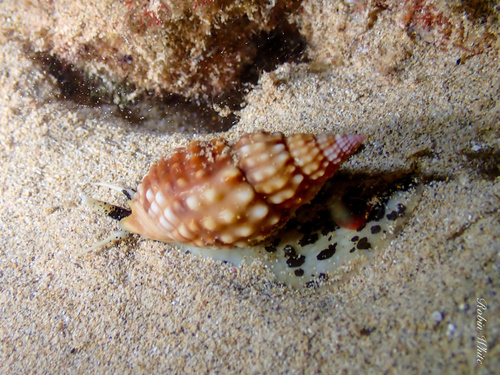
Nassarius papillosus, common name: the pimpled nassa, is a species of sea snail, a marine gastropod mollusc in the family Nassariidae, the nassa mud snails or dog whelks.
From Wikipedia: Nassarius papillosus, CC BY-SA 4.0 (excerpt)
Care at a glance
Species-specific values
Values researched for this exact species. Air, surface and water temperatures are listed separately, and each source is kept as published rather than averaged.
| Minimum enclosure | Minimum tank size 60 L (≈ 15 gallons). Source: fisheee.com | |
| Water temperature | 75–81 °F (24–27 °C) Source: fisheee.com | |
| Diet | Carnivore (scavenger). Source: fisheee.com |
Understanding the animal
In the wild
In the wild
| Overview | Nassarius papillosus, common name: the pimpled nassa, is a species of sea snail, a marine gastropod mollusc in the family Nassariidae, the nassa mud snails or dog whelks. — From Wikipedia: Nassarius papillosus, CC BY-SA 4.0 (excerpt) |
| Appearance and size | The shell size varies between 30 mm and 52 mm The thick shell is ovate and conical. It is composed of eight convex and subcarinated whorls. The whole surface ornamented with small tubercles formed like rounded papillae, eight transverse rows of which appear upon the body whorl, four upon the second, and three only upon those of the spire. — From Wikipedia: Nassarius papillosus, CC BY-SA 4.0 (excerpt) |
Read about this species in the wild at SeaLifeBase.
Sources for this sheet
- SeaLifeBase (Palomares & Pauly, eds.), version 24.07 (CC BY-NC 4.0) Peer-reviewed researchFishBase's sister database for non-fish marine and freshwater life; values are referenced.
- GBIF Backbone Taxonomy (Global Biodiversity Information Facility) (CC BY 4.0) Peer-reviewed researchInternational scientific taxonomy used here for classification. GBIF Secretariat (2023). GBIF Backbone Taxonomy. Checklist dataset https://doi.org/10.15468/39omei, accessed via GBIF.org.
- Wikipedia (species article) (CC BY-SA 4.0) Community referenceFree encyclopedia; useful overviews with their own citations. Short excerpts are quoted under CC BY-SA 4.0, each credited with a link to its article.
- iNaturalist (captive observations) Community referenceCommunity observation platform run by the California Academy of Sciences and National Geographic; observations marked captive show animals living in homes, zoos and aquariums.
More nassarius and assassin snails

Assassin snail
Anentome helena
Aquarium hobby
Snail
Nassarius coronatus
Aquarium hobby
Cone-shaped nassa
Nassarius conoidalis
Aquarium hobby
Nassarius glans
Nassarius glans
Aquarium hobby