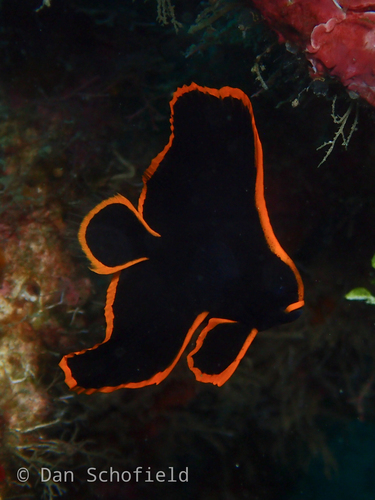
Home / Fishes / Tangs, angelfish, butterflyfish / Orbicular batfish
No federal permit to keepOrbicular batfish
Platax orbicularis
Fishes › Tangs, angelfish, butterflyfish (Acanthuriformes) › Ephippidae (Reef batfish and spadefish)
The orbicular batfish (Platax orbicularis), also known as the cooper batfish, circular batfish, orbiculate batfish, round batfish, narrow-banded batfish or orbic batfish is a species of marine ray-finned fish belonging to the family Ephippidae, the…

Care at a glance
Species-specific values
Values researched for this exact species. Air, surface and water temperatures are listed separately, and each source is kept as published rather than averaged.
| Minimum enclosure | Minimum tank 185 gal 700 L Source: tankbud.com | |
| Water temperature | 75–81 °F Source: tankbud.com | |
| Diet | Offer a varied diet of meaty foods and marine algae. Source: tankbud.com |
Species-specific aquarium care
- Tank: At least 144 in long and 48 in front to back for one adult (adults commonly reach about 23.6 in / 60 cm).
- Water: Marine.
- Temperature: 72–82°F (range recorded for this species).
- Layout: Lives around reefs and rockwork: give caves, overhangs and swimming room along the rock.
- Habitat: Associated with coral reefs: needs stable marine water quality; check reef safety before mixing with corals and invertebrates.
- Diet: A predator: feed meaty foods sized to its mouth (frozen fish, shrimp, worms); it will eat tankmates that fit in its mouth. FishBase classes it as a carnivore.
- Stocking: Schools or shoals in the wild: keep a group (usually 6 or more) rather than a single fish.
Calculated from this species' own FishBase record: tank size from its typical adult length and swimming zone, water values from its recorded ranges. The group guide below fills in general care.
Understanding the animal
About this animal
About this animal
This species is found in the Indo-Pacific but has been recorded outside its native range in the western Atlantic Ocean.
From Wikipedia: Orbicular batfish, CC BY-SA 4.0 (excerpt)
In the wild
In the wild
From this species’ own FishBase record (habitat, bottom type, water and breeding data), not its family. Wild conditions are context, not enclosure settings.1
| Where it lives | Lives in brackish water and the sea, in estuaries, mangroves, coral reefs, seagrass beds. Lives around reefs. |
| Climate | Tropical climate. |
| Social life | Lives in shoals. |
| Wild diet | Hunting macrofauna (predator). |
Data and studies
The numbers
The numbers
Each bar is what one source reports. Where several sources weigh in, the dashed gold band marks their average.
Maximum recorded lifespan
Longest recorded lifespan reported by each database; typical lifespans are usually shorter.
Adult length
Maximum recorded length. Measured as total length. Fish in home aquariums often stay smaller than wild records.
Veterinary & husbandry research
Veterinary & husbandry research
- Megalocytivirus infection in orbiculate batfish Platax orbicularis Sriwanayos P et al., Diseases of aquatic organisms 2013
- First Isolation of Virulent Tenacibaculum maritimum Isolates from Diseased Orbicular Batfish (Platax orbicularis) Farmed in Tahiti Island Lopez P et al., Pathogens (Basel, Switzerland) 2022
- Effects of local Polynesian plants and algae on growth and expression of two immune-related genes in orbicular batfish (Platax orbicularis) Reverter M et al., Fish & shellfish immunology 2016
Peer-reviewed papers that mention this species alongside captivity, zoos, veterinary care or aquaculture. Some cover several species or mention it only in passing, so check the abstract. See all 7 on PubMed → PubMed
Sources for this sheet
- FishBase (Froese & Pauly, eds.), version 24.07 (CC BY-NC 4.0) Peer-reviewed researchThe global scientific database on fishes, maintained by a consortium of research institutions; every value is referenced.
- Wikipedia (species article) (CC BY-SA 4.0) Community referenceFree encyclopedia; useful overviews with their own citations. Short excerpts are quoted under CC BY-SA 4.0, each credited with a link to its article.
- PubMed (U.S. National Library of Medicine) Peer-reviewed researchIndex of peer-reviewed veterinary, zoo and husbandry research.
- iNaturalist (captive observations) Community referenceCommunity observation platform run by the California Academy of Sciences and National Geographic; observations marked captive show animals living in homes, zoos and aquariums.