Home / Amphibians / Frogs and toads / Cranwell's horned frog (pac-man)
No federal permit to keep In-depth sheetCranwell's horned frog (pac-man)
Ceratophrys cranwelli
Amphibians › Frogs and toads (Anura) › Ceratophryidae (Horned and Budgett's frogs)
Pacman (horned) frogs are chunky ambush predators that sit and wait. Clint's Reptiles scores them 4.0/5.
Care at a glance
Species-specific values
Values researched for this exact species. Where they differ from the group guide below, follow these. Air, surface and water temperatures are listed separately, and each source is kept as published rather than averaged.
| Air temperature day | 79–82 °F | 214 |
| Air temperature night | 75 °F | 214 |
| Humidity | approximate: 70 % RH | 214 |
| Substrate depth | 4–6 in Adult burrowing depth | 214 |
| Adult length | 3–4 in Source’s average adult range | 214 |
Care guide
Care
- Simple, small enclosures; buy captive-bred from a good breeder.
- Like all amphibians, they have permeable skin, so wash hands and handle sparingly.
Sources 105
Show the group care guide for horned frogs and budgett's frogs
Horned frogs and Budgett's frogs
Applies to most species in this group. Habitat: South American grassland and seasonal pools. Individual species can differ, so compare with the species numbers above and the linked sources.
Housing & setup
- Ceratophrys need burrowing substrate; active-season Lepidobatrachus laevis need filtered aquatic housing with an accessible dry platform.
- Warm temperatures; keep one frog per enclosure.
Climate & lighting
Starting point only: Terrestrial Ceratophrys air conditions cannot serve as aquatic Lepidobatrachus water temperatures. Check the species-specific values for this animal where shown.
| Warm side / daytime | 78–84°F |
| Cool side | 72–76°F |
| Humidity | 60–80% |
Diet
- Insects and worms; occasional small fish. Avoid feeding mice often (obesity).
Social life
- Solitary; they will eat tankmates.
Health watch
- Obesity, impaction and cannibalism if housed together. Bites are strong.
Understanding the animal
In the wild
In the wild
Researched for this exact species, not its family. Good care copies these conditions.123
| Where it lives | Semiarid Gran Chaco lowlands of Argentina, Bolivia, Paraguay and Brazil. Adults spend long periods underground and emerge around seasonal rains; breeding and larval development occur in temporary ponds. |
| Ground it lives on | Burrowable soil in seasonal Chaco habitat; adults remain buried outside the breeding season. |
| Water it lives in | Freshwater temporary rain-filled ponds are used for breeding and by tadpoles; adults are terrestrial. Water chemistry, clarity and typical temperatures were not established. |
| Climate | Subtropical conditions with a long dry season and summer rainfall. Numeric wild temperature and relative-humidity ranges were not established. |
| Active | Nocturnal surface activity is reported; prolonged underground dry-season dormancy includes a water-conserving cocoon. |
| Wild diet | Adults and metamorphs eat other frogs and terrestrial invertebrates. Wild tadpoles consume aquatic invertebrates, including fairy shrimp, and other tadpoles; cannibalism is documented. |
| Behavior to plan for | Remains buried for prolonged periods and forms a cocoon during dry conditions. Predation on other frogs occurs even immediately after metamorphosis. |
What this means for care
- Provide deep, moisture-retaining burrowing substrate with accessible surface refuges.
- Avoid mixed-species housing and cohabitation with swallowable animals.
- Do not use a deep aquatic enclosure for terrestrial adults.
- Maintain hydration rather than deliberately reproducing harsh dry-season conditions.
Native climate (measured)
Native climate (measured)
| Warm-season highs | about 92°F (up to 95°F in the hottest sampled areas) |
| Cool-season lows | about 48°F (down to 38°F in the coldest sampled areas) |
| Average temperature | 64–77°F across sampled records |
| Relative humidity | 63–71% on average (driest month about 56%) |
| Rainfall | about 893 mm a year |
Measured at 119 wild occurrence records sampled against WorldClim 2.1 climate data (1970–2000 averages). Air conditions in the range are ecological context, not enclosure settings: microhabitats such as burrows, leaf litter or basking rocks can be cooler, warmer or more humid.
From the sources
From the sources
Quoted from the matching sections of reputable sources for this exact species. Specialist databases are used first; Wikipedia (community-edited, CC BY-SA 4.0) only fills gaps. Other sources are short credited quotes.
| Overview | Cranwell's horned frog (Ceratophrys cranwelli), also called commonly the Chacoan horned frog, is a terrestrial frog in the family Ceratophryidae. The species is endemic to the dry Gran Chaco region of Argentina, Bolivia, Paraguay and Brazil. It, like other members of its genus, Ceratophrys, is commonly called the Pac-man frog, because of its resemblance to the video game character of the same name. Most adult specimens range from 8–13 cm long and can weigh up to 0.5 kg. — Wikipedia (community-edited) |
| Wild diet | Cranwell's horned frog is nocturnal and rests with its eyelids open. It is ordinarily carnivorous, feeding mostly on insects and like-sized animals such as rodents, and is known to cannibalize other frogs. Large individuals have bite forces comparable to those of mammalian predators. — Wikipedia (community-edited) |
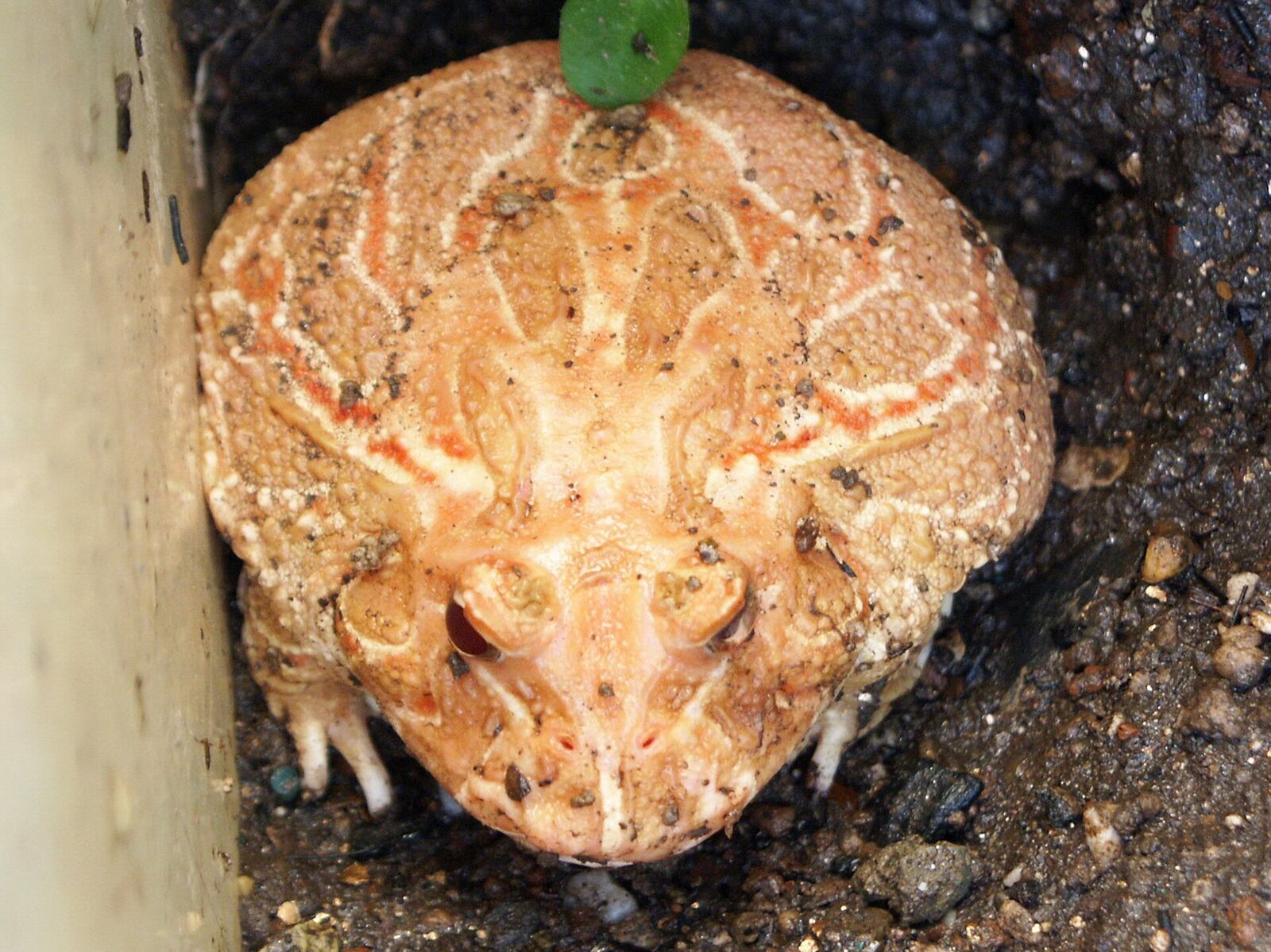
| Appearance and size | The back of C. cranwelli usually has dark green and brown coloration, although albino variants with orange and yellow coloration also exist and are popular in the pet trade. The dark color scheme aids in camouflaging the animal as it burrows and waits for its prey. Though generally inactive, it is an aggressive eater and is capable of leaping for several body lengths to capture prey. — Wikipedia (community-edited) |
| History and naming | The specific name, cranwelli, is in honor of Argentinian herpetologist Jorge A. Cranwell. — Wikipedia (community-edited) |
Data and studies
Researched care notes
Researched care notes
Findings checked against veterinary, zoo, welfare, keeper and peer-reviewed sources. Air, basking-surface and water temperatures are kept separate, and where sources disagree both are shown. “Study” notes report what a paper measured, not a universal rule.
Pac-Man Frog
Researched for this genus; applies to its species unless a species note says otherwise.
- House horned frogs individually because cohabitation can result in territorial conflict and cannibalism.1
- Provide a secure enclosure wider than tall, with space and substrate for burrowing.1
- PetMD gives daytime enclosure temperatures of 75–83°F and nighttime 70–75°F; it does not specify a separate water or measured basking-surface target.1
- PetMD lists 70–80% enclosure relative humidity, monitored with a hygrometer; this is a published guide range, not a species-wide experimental optimum.1
- Offer varied suitably sized insects and worms with feeding tongs, keeping fingers away from the frog's feeding response.1
Veterinary & husbandry research
Veterinary & husbandry research
- Gastrointestinal entamoebiasis in captive anurans in North America Weisbrod TC et al., Diseases of aquatic organisms 2021
- Epidemic nodular facial myxomatous dermatitis in juvenile Cranwell's horned frogs Ceratophrys cranwelli Tamukai K et al., Diseases of aquatic organisms 2019
- Hormonal induction of spawning in 4 species of frogs by coinjection with a gonadotropin-releasing hormone agonist and a dopamine antagonist Trudeau VL et al., Reproductive biology and endocrinology: RB&E 2010
Peer-reviewed papers that mention this species alongside captivity, zoos, veterinary care or aquaculture. Some cover several species or mention it only in passing, so check the abstract. 170
Sources for this sheet
- Clint's Reptiles (YouTube): Pac-man Frog, The Best Pet Amphibian? Expert educator & keeperClint Laidlaw, PhD in Biology Education and MS in Evolutionary Ecology; owner of Clint's Reptile Room and a longtime keeper. Rates each species on handleability, care, hardiness, availability and upfront cost.
- Merck Veterinary Manual: Environment and husbandry for amphibians Zoo, university or veterinaryThe Merck Veterinary Manual: a standard veterinary reference written and reviewed by veterinary specialists.
- Merck Veterinary Manual: Overview of amphibians Zoo, university or veterinaryThe Merck Veterinary Manual: a standard veterinary reference written and reviewed by veterinary specialists.
- Reptiles Magazine: Pac-Man Frog Care and Information — Andrew Tillson-Willis Experienced keeper or breederAdded in the 2026 source-checked care-guide review.
- Andrew Tilson-Willis, Reptiles Magazine: Budgett’s Frogs (2011; updated 2020) Experienced keeper or breederAdded in the 2026 source-checked care-guide review.
- Clint's Reptiles (YouTube): Pac-man Frog, The Best Pet Amphibian? Expert educator & keeperClint Laidlaw, PhD in Biology Education and MS in Evolutionary Ecology; owner of Clint's Reptile Room and a longtime keeper. His "Best Pet?" series reviews each species' care in depth.
- AmphibiaWeb (University of California, Berkeley) Peer-reviewed researchUniversity-hosted database of amphibian biology and conservation.
- GBIF Backbone Taxonomy (Global Biodiversity Information Facility) Peer-reviewed researchInternational scientific taxonomy used here for classification.
- Wikipedia (species article) Community referenceFree encyclopedia; useful overviews with their own citations. Intro text is quoted under CC BY-SA 4.0.
- PubMed (U.S. National Library of Medicine) Peer-reviewed researchIndex of peer-reviewed veterinary, zoo and husbandry research.
- iNaturalist (captive observations) Community referenceCommunity observation platform run by the California Academy of Sciences and National Geographic; observations marked captive show animals living in homes, zoos and aquariums.

