Home / Fishes / Cichlids / Cichlidae / Pantanal eartheater
No federal permit to keepPantanal eartheater
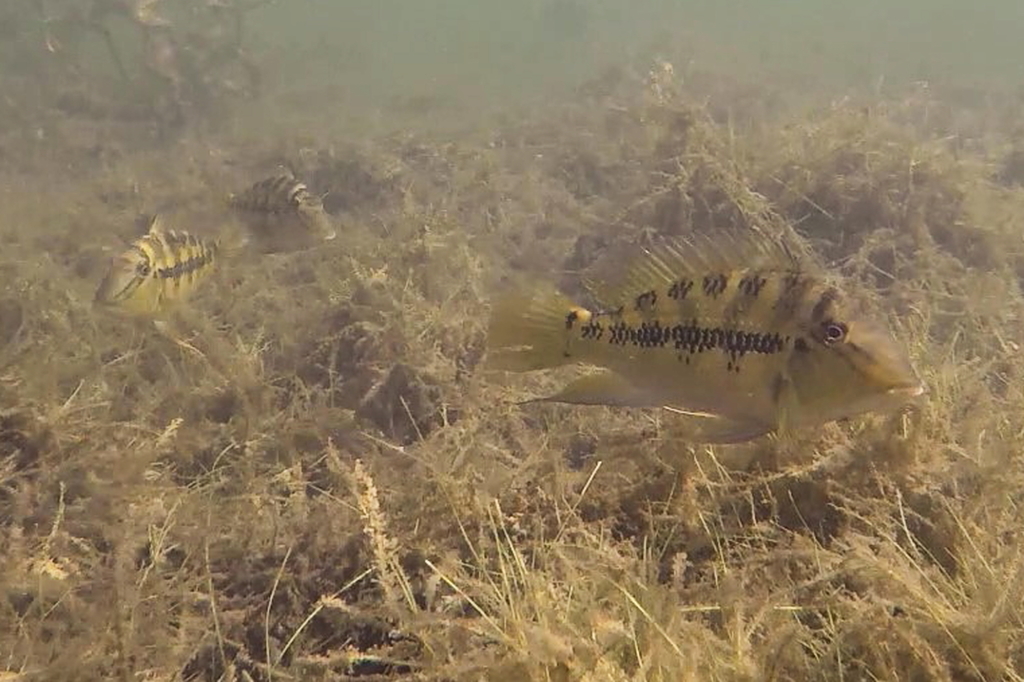
Satanoperca pappaterra
Fishes › Cichlids (Cichliformes) › Cichlidae (Cichlids)
Care follows the oscars, peacock bass, pike cichlids and eartheaters guide below.
Care at a glance
Species-specific aquarium care
- Tank: At least 54 in long and 21 in front to back for one adult (adults commonly reach about 10.6 in / 27 cm).
- Water: Freshwater.
- Temperature: 75–81°F (range recorded for this species).
- Hardness: 0–10 dGH.
- Layout: Uses both the bottom and open water: give open swimming space plus cover near the substrate.
- Diet: FishBase classes it as a omnivore.
- Availability: Rarely or never seen in the aquarium trade; expect to source it from specialists or not at all.
Calculated from this species' own FishBase record: tank size from its typical adult length and swimming zone, water values from its recorded ranges. The group guide below fills in general care.
Care guide
Species care notes
- Tank: a base of at least 83 × 24 in (roughly 200 US gallons); space needed is rated “very large tank”.
- Water: a fairly wide range, from slightly acidic to slightly alkaline, 68–82 °F, pH 5.5–7.5, 2–10 dGH.
- Behaviour: temperament peaceful; a shoaling fish best kept in a group of six or more; not a community fish.
- Difficulty: Moderate (Seriously Fish rating).
Short excerpts from the species profile:
- Setup: “The most essential item of décor is a soft, sandy substrate so that the fish can browse naturally (see 'Diet').”
- Tankmates: “Unless breeding this species is surprisingly peaceful and will not predate on fishes larger than a few millimetres in length.”
- Breeding: “This species is an ovophilous maternal mouthbrooder that has been bred in aquaria.”
From the Seriously Fish profile for this species, which has the full habitat, maintenance, diet, behaviour and breeding write-up 167
Oscars, peacock bass, pike cichlids and eartheaters
Applies to most species in this group. Habitat: Large South American rivers. Individual species can differ, so compare with the species numbers above and the linked sources.
Housing & setup
- For one adult Astronotus ocellatus, plan at least a 150 × 60 cm base according to Seriously Fish; pairs and groups need more space. Use separate adult plans for Cichla and each eartheater species.
- Soft sand for eartheaters (Geophagus, Satanoperca), which sift substrate through their gills.
Climate & lighting
Starting point only: The blanket warm-water interval excludes the subtropical seasonal requirements of G. balzanii; use overrides. Check the species-specific values for this animal where shown.
| Water | 77–84°F |
Diet
- Astronotus ocellatus is an omnivore with a preference for animal foods; offer quality pellets and varied suitable foods rather than feeder-fish dependence. Cichla and substrate-sifting eartheaters require separate feeding plans.
Health watch
- Hole-in-the-head disease and lateral line erosion in poor water; eartheaters suffer on sharp gravel.
Understanding the animal
In the wild
In the wild
From this species’ own FishBase record (habitat, bottom type, water and breeding data), not its family. Good care copies these conditions.1
| Where it lives | Lives in freshwater, in rivers and streams. Uses both the bottom and open water. Inhabits streams and lagoons with sandy to muddy bottom. Forages by plunging its protrusible mouth into the sandy or muddy bottom, filling it with sediment, and sorting out food inside the mouth. The bulk of the mouthful is expelled through the opercular openings and the mouth, producing a cloud of sediment (substrate sifting). This feeding mode leaves a series of pits and mounds on the bottom. Feeds on insect larvae, crustaceans, plant debris and loose scales. |
| Water it lives in | Freshwater, 75–81 °F (24–27 °C), pH 7, hardness 10 dH. |
| Climate | Tropical climate. |
| Behavior to plan for | Breeding: external brooders. |
What this means for care
- Keep water within its wild range, 75–81 °F.
Native climate (measured)
Native climate (measured)
| Warm-season highs | about 89°F (up to 92°F in the hottest sampled areas) |
| Cool-season lows | about 56°F (down to 52°F in the coldest sampled areas) |
| Average temperature | 71–79°F across sampled records |
| Relative humidity | 72–76% on average (driest month about 63%) |
| Rainfall | about 1437 mm a year |
Measured at 111 wild occurrence records sampled against WorldClim 2.1 climate data (1970–2000 averages). Air conditions in the range are ecological context, not enclosure settings: microhabitats such as burrows, leaf litter or basking rocks can be cooler, warmer or more humid.
From the sources
From the sources
Quoted from the matching sections of reputable sources for this exact species. Specialist databases are used first; Wikipedia (community-edited, CC BY-SA 4.0) only fills gaps. Other sources are short credited quotes.
| Where it lives | Home ranges Population dynamics Growth parameters Max. ages / sizes Length-weight rel. Length-frequencies Mass conversion Recruitment Abundance Life cycle Reproduction Maturity Maturity/Gills rel. — FishBase |
| Appearance and size | Maximum length 27.0 cm tl male/unsexed; maximum published weight 383.00 g. — FishBase |
| Biology | Inhabits streams and lagoons with sandy to muddy bottom. Forages by plunging its protrusible mouth into the sandy or muddy bottom, filling it with sediment, and sorting out food inside the mouth. The bulk of the mouthful is expelled through the opercular openings and the mouth, producing a cloud of sediment (substrate sifting). — FishBase |
Data and studies
The numbers
The numbers
Each bar is what one source reports. Where several sources weigh in, the dashed gold band marks their average.
Typical adult weight
Average adult body mass in each database (FishBase gives the maximum recorded weight).
Adult length
Maximum recorded length. Measured as total length. Fish in home aquariums often stay smaller than wild records.
Water temperature
Range the species tolerates in nature; aim for the middle.
pH
Water hardness
Minimum tank footprint
Seriously Fish recommends a tank base of at least 83 × 24 in (about 200 US gallons).
Sources for this sheet
- FishBase (Froese & Pauly, eds.), version 24.07 Peer-reviewed researchThe global scientific database on fishes, maintained by a consortium of research institutions; every value is referenced.
- Seriously Fish species profiles Experienced keeper or breederLong-running aquarium reference written and peer-checked by experienced fishkeepers and ichthyologists; each profile covers habitat, tank size, water, diet, behaviour and breeding.
- Merck Veterinary Manual: Management of aquarium fish Zoo, university or veterinaryThe Merck Veterinary Manual: a standard veterinary reference written and reviewed by veterinary specialists.
- Merck Veterinary Manual: Types and features of aquatic systems Zoo, university or veterinaryThe Merck Veterinary Manual: a standard veterinary reference written and reviewed by veterinary specialists.
- Seriously Fish: Gymnogeophagus balzanii Experienced keeper or breederAdded in the 2026 source-checked care-guide review.
- Seriously Fish — Astronotus ocellatus Zoo, university or veterinaryAdded in the 2026 source-checked care-guide review.
More cichlids

Agassiz's dwarf cichlid
Apistogramma agassizii
Aquarium hobby

Altolamprologus calvus
Altolamprologus calvus
Aquarium hobby

Altum Angel
Pterophyllum altum
Aquarium hobby
Anomalochromis thomasi
Anomalochromis thomasi
Aquarium hobby

Apistogramma eremnopyge
Apistogramma eremnopyge
Aquarium hobby
Argentine humphead
Gymnogeophagus balzanii
Aquarium hobby