
Home / Fishes / Carp, barbs, minnows, loaches / Botiidae / Parabotia kiangsiensis
No federal permit to keepParabotia kiangsiensis
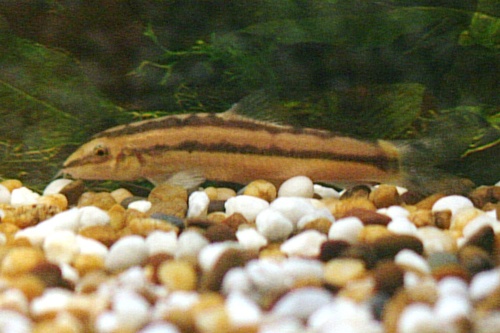
Parabotia kiangsiensis
Fishes › Carp, barbs, minnows, loaches (Cypriniformes) › Botiidae (Clown, yoyo and other loaches)
Care at a glance
Species-specific values
Values researched for this exact species. Air, surface and water temperatures are listed separately, and each source is kept as published rather than averaged.
| Water temperature | 64–75 °F Source: aquaristatlas.com | |
| Diet | Offer sinking pellets and wafers, frozen and live foods, shellfish, earthworms, and occasional blanched vegetables. Source: aquaristatlas.com | |
| Feeding frequency | Add food after lights-out and feed enough for lower-ranking shoal members to get their share. Source: aquaristatlas.com | |
| Social housing | Keep in a group of four to five or more. Source: aquaristatlas.com | |
| Substrate | Use smooth sand, smooth rocks, and driftwood for shelter. Source: aquaristatlas.com |
Species-specific aquarium care
- Water: Freshwater.
- Layout: Lives on or near the bottom: floor space and hiding places matter more than height.
- Availability: Rarely or never seen in the aquarium trade; expect to source it from specialists or not at all.
Calculated from this species' own FishBase record: tank size from its typical adult length and swimming zone, water values from its recorded ranges. The group guide below fills in general care.
Understanding the animal
In the wild
In the wild
From this species’ own FishBase record (habitat, bottom type, water and breeding data), not its family. Wild conditions are context, not enclosure settings.1
| Where it lives | Lives in freshwater. Stays near the bottom. |
| Climate | Tropical climate. |
Sources for this sheet
- FishBase (Froese & Pauly, eds.), version 24.07 (CC BY-NC 4.0) Peer-reviewed researchThe global scientific database on fishes, maintained by a consortium of research institutions; every value is referenced.
- iNaturalist (captive observations) Community referenceCommunity observation platform run by the California Academy of Sciences and National Geographic; observations marked captive show animals living in homes, zoos and aquariums.
More clown, yoyo and other loaches

Bengal loach
Botia dario
Aquarium hobby
Black-lined loach
Ambastaia nigrolineata
Aquarium hobby

Blyth's loach
Syncrossus berdmorei
Aquarium hobby

Burmese border loach
Botia kubotai
Aquarium hobby

Chameleon loach
Syncrossus beauforti
Aquarium hobby

Clown loach
Chromobotia macracanthus
Aquarium hobby