Home / Fishes / Catfish / Clariidae / Walking catfish
Federal restrictions applyWalking catfish
Clarias batrachus
Fishes › Catfish (Siluriformes) › Clariidae (Air-breathing catfish)
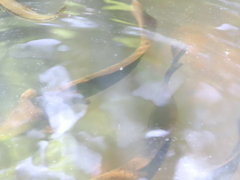
The walking catfish (Clarias batrachus) is a species of freshwater airbreathing catfish native to Southeast Asia.

Care at a glance
Species care notes
Read the full care sheet at Seriously Fish: habitat, aquarium size, water conditions, diet, behaviour and breeding.
Warnings
Understanding the animal
About this animal
About this animal
It is named for its ability to "walk" and wiggle across dry land, to find food or suitable environments. While it does not truly walk as most bipeds or quadrupeds do, it can use its pectoral fins to keep it upright as it makes a wiggling motion with snakelike movements to traverse land.
From Wikipedia: Walking catfish, CC BY-SA 4.0 (excerpt)
In the wild
In the wild
From this species’ own FishBase record (habitat, bottom type, water and breeding data), not its family. Wild conditions are context, not enclosure settings.1
| Where it lives | Lives in freshwater and brackish water, in lakes, rice paddies. Stays near the bottom. |
| Climate | Tropical climate. |
| Wild diet | Hunting macrofauna (predator). |
| Behavior to plan for | Breeding: nesters. |
Data and studies
The numbers
The numbers
Each bar is what one source reports. Where several sources weigh in, the dashed gold band marks their average.
Typical adult weight
Average adult body mass in each database (FishBase gives the maximum recorded weight).
Adult length
Common length to maximum recorded length. Measured as total length. Fish in home aquariums often stay smaller than wild records.
Veterinary & husbandry research
Veterinary & husbandry research
- Investigations of hemato-biochemical and histopathological parameters, and growth performance of walking catfish (Clarias batrachus) exposed to PET and LDPE microplastics Fatema K et al., Environmental toxicology and pharmacology 2023
- Microsatellite Genotyping Corroborated Loss of Genetic Diversity in Clarias batrachus as a Result of Lack of Regulatory Reforms in Aquaculture Tiknaik A et al., Biochemical genetics 2020
Peer-reviewed papers that mention this species alongside captivity, zoos, veterinary care or aquaculture. Some cover several species or mention it only in passing, so check the abstract. See all 21 on PubMed → PubMed
Sources for this sheet
- FishBase (Froese & Pauly, eds.), version 24.07 (CC BY-NC 4.0) Peer-reviewed researchThe global scientific database on fishes, maintained by a consortium of research institutions; every value is referenced.
- Seriously Fish species profiles Experienced keeper or breederLong-running aquarium reference written and peer-checked by experienced fishkeepers and ichthyologists; each profile covers habitat, tank size, water, diet, behaviour and breeding.
- 50 CFR Part 16: Injurious wildlife (Lacey Act) Zoo, university or veterinaryCurrent federal regulation, read from eCFR.
- U.S. Association of Reptile Keepers v. Zinke (D.C. Cir. 2017) Zoo, university or veterinaryAppeals ruling that the Lacey Act's shipping ban does not cover moves between the continental states.
- Wikipedia (species article) (CC BY-SA 4.0) Community referenceFree encyclopedia; useful overviews with their own citations. Short excerpts are quoted under CC BY-SA 4.0, each credited with a link to its article.
- PubMed (U.S. National Library of Medicine) Peer-reviewed researchIndex of peer-reviewed veterinary, zoo and husbandry research.
- iNaturalist (captive observations) Community referenceCommunity observation platform run by the California Academy of Sciences and National Geographic; observations marked captive show animals living in homes, zoos and aquariums.