
Home / Reptiles / Lizards / Agamidae / Philippine sailfin lizard
No federal permit to keepPhilippine sailfin lizard
Hydrosaurus pustulatus
Reptiles › Lizards (Lacertilia) › Agamidae (Agamas and dragons)
Hydrosaurus pustulatus, commonly known as the Philippine sailfin lizard or the Philippine sailfin dragon, is a large semiaquatic agamid lizard endemic to all of the major island groups of the Philippines, with the exception of the Palawan islands.
From Wikipedia: Philippine sailfin lizard, CC BY-SA 4.0 (excerpt)

Care at a glance
Species-specific values
Values researched for this exact species. Air, surface and water temperatures are listed separately, and each source is kept as published rather than averaged.
| Minimum enclosure | Recommended space per adult individual is 200x80x150 cm. Source: bion.com.ua | |
| Basking surface temperature | 95 °F (35 °C) Source: bion.com.ua | |
| Warm side air temperature | 79–82 °F (26–28 °C) Source: bion.com.ua | |
| Night temperature | 75–79 °F (24–26 °C) Source: bion.com.ua | |
| Humidity | 80–100 % Source: bion.com.ua | |
| Uvb lighting | UV lamps are obligatory. Source: bion.com.ua | |
| Diet | Juveniles and adults eat herbs and insects, with seasonal plant changes; adults also get fruit, berries, and vegetables. Source: bion.com.ua | |
| Feeding frequency | Plant food is offered daily and insects every other day. Source: bion.com.ua | |
| Substrate | Bark chips are used; peat, soil mixture, or clean sand can also be suitable. Source: bion.com.ua | |
| Minimum enclosure | Minimum enclosure for one animal is 3 ft 8 in × 3 ft 8 in × 2 ft 4 in (112 × 112 × 70 cm). Source: allanglescreatures.com | |
| Diet | A herbivore’s diet is judged by fibre, calcium-to-phosphorus ratio, and avoiding plants high in oxalates. Source: allanglescreatures.com |
Understanding the animal
About this animal
About this animal
Like other sailfin lizards, they are characterized by large, sail-like dorsal crests on their tails. They can grow to a maximum length around 3 to 4 ft (0.91 to 1.22 m).
From Wikipedia: Philippine sailfin lizard, CC BY-SA 4.0 (excerpt)
In the wild
In the wild
| Overview | Hydrosaurus pustulatus, commonly known as the Philippine sailfin lizard or the Philippine sailfin dragon, is a large semiaquatic agamid lizard endemic to all of the major island groups of the Philippines, with the exception of the Palawan islands. Like other sailfin lizards, they are characterized by large, sail-like dorsal crests on their tails. They can grow to a maximum length around 3 to 4 ft. They are strong swimmers, and smaller juvenile lizards can run briefly on the water surface. — From Wikipedia: Philippine sailfin lizard, CC BY-SA 4.0 (excerpt) |
| Where it lives | The Philippine sailfin lizard is found throughout the Philippine islands with the exception of the Palawan islands. Populations of Philippine sailfin lizards have been documented in Luzon (Aurora, Bicol), Polillo Islands, Samar, Leyte, Dinagat Islands, Camiguin, Bohol, Negros, Panay, Romblon (Romblon Island, Tablas, Sibuyan), Mindoro, and Mindanao (Zamboanga). — From Wikipedia: Philippine sailfin lizard, CC BY-SA 4.0 (excerpt) |
| Wild diet | Philippine sailfin lizards are omnivores. They eat plant leaves and fruits, in addition to insects and crustaceans. Juveniles start out preferring meat more than plants, but the balance comes as they mature. — From Wikipedia: Philippine sailfin lizard, CC BY-SA 4.0 (excerpt) |
| Behavior | Philippine sailfin lizards usually grow to a length between two and three feet, including their tails. Males are larger than females and can grow to between 3 and 4 feet long (91–120 cm). These lizards typically weigh between 3 and 5 pounds (1.4–2.3 kg). — From Wikipedia: Philippine sailfin lizard, CC BY-SA 4.0 (excerpt) |
| Reproduction | Philippine sailfin lizards use their sailfins/scales for territorial displays in the presence of competing males or threats. They only breed once every year with potentially multiple clutches of eggs. For female Philippine sailfin lizards to lay their eggs after mating and birth, they dig relatively shallow holes in soil near their watery habitats, and these eggs then incubate for roughly two months. — From Wikipedia: Philippine sailfin lizard, CC BY-SA 4.0 (excerpt) |
| Conservation | Philippine sailfin lizards are classified as least concern by the IUCN, though they are increasingly becoming vulnerable. Their main threats are habitat loss, being hunted for food, and collection for the pet trade. Habitat loss is particularly critical, as only an estimated 7.5% of the mangrove forests of the Philippines are in protected areas. — From Wikipedia: Philippine sailfin lizard, CC BY-SA 4.0 (excerpt) |
Read about this species in the wild at The Reptile Database.
Native climate (measured)
Native climate (measured)
| Warm-season highs | about 89°F (up to 90°F in the hottest sampled areas) |
| Cool-season lows | about 71°F (down to 68°F in the coldest sampled areas) |
| Average temperature | 78–81°F across sampled records |
| Relative humidity | 83–85% on average (driest month about 81%) |
| Rainfall | about 2280 mm a year, spread fairly evenly |
Measured at 95 wild occurrence records sampled against WorldClim 2.1 climate data (1970–2000 averages). Air conditions in the range are ecological context, not enclosure settings: microhabitats such as burrows, leaf litter or basking rocks can be cooler, warmer or more humid.
Profile
Profile
Researched for this exact species. Sources are listed under In the wild above.
Data and studies
The numbers
The numbers
Each bar is what one source reports. Where several sources weigh in, the dashed gold band marks their average.
Maximum recorded lifespan
Longest recorded lifespan reported by each database; typical lifespans are usually shorter. The AnAge record comes from an animal in human care.
Incubation
Veterinary & husbandry research
Veterinary & husbandry research
- Complete Genome Sequence of Campylobacter fetus subsp. testudinum Strain Pet-3, Isolated from a Lizard (Hydrosaurus pustulatus) Wang CM et al., Genome announcements 2015
Peer-reviewed papers that mention this species alongside captivity, zoos, veterinary care or aquaculture. Some cover several species or mention it only in passing, so check the abstract. PubMed
Sources for this sheet
- AnAge: The Animal Ageing and Longevity Database (Human Ageing Genomic Resources) (CC BY 3.0) Peer-reviewed researchCurated, referenced longevity and life-history records for thousands of species; maximum lifespans are often from zoo animals.
- Myhrvold et al. (2015). An amniote life-history database. Ecology 96: 3109 Peer-reviewed researchPeer-reviewed compilation of life-history data for over 21,000 birds, mammals and reptiles.
- The Reptile Database Peer-reviewed researchScientist-curated catalog of every reptile species, with taxonomy and literature.
- GBIF Backbone Taxonomy (Global Biodiversity Information Facility) (CC BY 4.0) Peer-reviewed researchInternational scientific taxonomy used here for classification. GBIF Secretariat (2023). GBIF Backbone Taxonomy. Checklist dataset https://doi.org/10.15468/39omei, accessed via GBIF.org.
- Wikipedia (species article) (CC BY-SA 4.0) Community referenceFree encyclopedia; useful overviews with their own citations. Short excerpts are quoted under CC BY-SA 4.0, each credited with a link to its article.
- PubMed (U.S. National Library of Medicine) Peer-reviewed researchIndex of peer-reviewed veterinary, zoo and husbandry research.
- iNaturalist (captive observations) Community referenceCommunity observation platform run by the California Academy of Sciences and National Geographic; observations marked captive show animals living in homes, zoos and aquariums.
More agamas and dragons
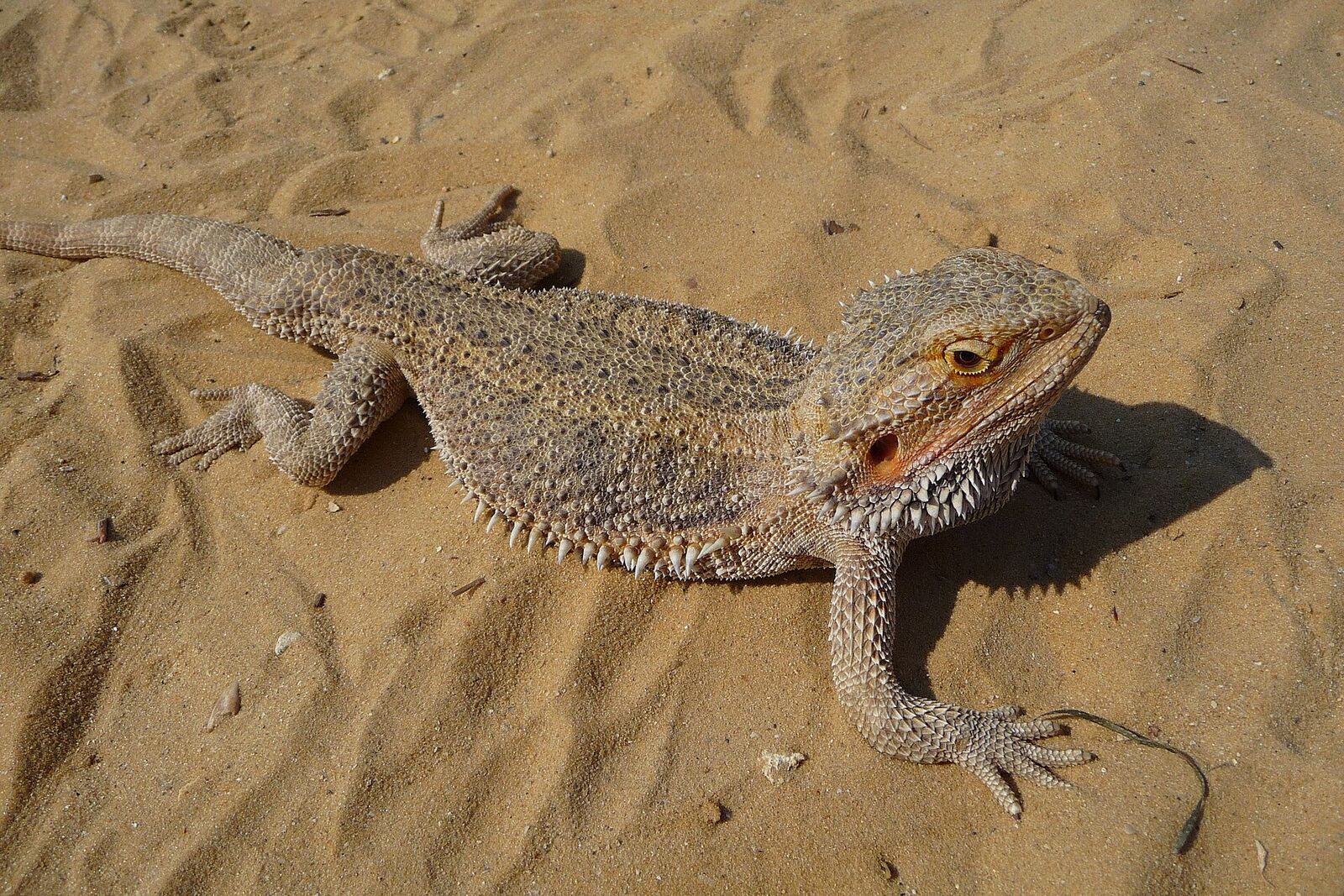
Bearded dragon
Pogona vitticeps
Sun-loving, friendly and endlessly popular.
Pet trade

(Sulawesi) Sailfin Lizard
Hydrosaurus celebensis
Pet trade

(Sulawesi) Sailfin Lizard (Hydrosaurus microlophus)
Hydrosaurus microlophus
Pet trade

Australian water dragon
Intellagama lesueurii
Pet trade

Bent's Mastigure
Uromastyx benti
Pet trade

Black-necked agama
Acanthocercus atricollis
Zoos & aquariums