
Home / Fishes / Cichlids and convict blennies / Cichlidae / Pindani
No federal permit to keepPindani
Chindongo socolofi
Fishes › Cichlids and convict blennies (Cichliformes) › Cichlidae (Cichlids)
The pindani (Pseudotropheus socolofi) is a species of cichlid endemic to Lake Malawi preferring areas with sandy substrates and nearby rocks where the males establish their territories.

Care at a glance
Species-specific values
Values researched for this exact species. Air, surface and water temperatures are listed separately, and each source is kept as published rather than averaged.
| Minimum enclosure | At least 200 litres; minimum 120 cm tank length. Source: oneshoal.com | |
| Water temperature | 75–82 °F (24–28 °C) Source: oneshoal.com | |
| Diet | Obligate herbivore; use vegetable matter and avoid meaty foods. Source: oneshoal.com | |
| Social housing | Harem arrangement: one male with three or more females. Source: oneshoal.com | |
| Substrate | Fine sand substrate recommended. Source: oneshoal.com | |
| Water temperature | 75–82 °F (24–28 °C) Source: cichlidatlas.com | |
| Diet | Feed a vegetable-based menu such as algae-based foods and greens, with modest animal food. Source: cichlidatlas.com | |
| Social housing | Keep one male with several females to spread courtship attention. Source: cichlidatlas.com | |
| Substrate | Use sandy substrate beneath rockwork and leave open water for swimming. Source: cichlidatlas.com |
Species-specific aquarium care
- Tank: At least 24 in long and 12 in front to back for one adult (adults commonly reach about 2.6 in / 6.7 cm).
- Water: Freshwater.
- Temperature: 75–79°F (range recorded for this species).
- Layout: Lives on or near the bottom: floor space and hiding places matter more than height.
Calculated from this species' own FishBase record: tank size from its typical adult length and swimming zone, water values from its recorded ranges. The group guide below fills in general care.
Understanding the animal
About this animal
About this animal
This species can reach a length of 6.7 centimetres (2.6 in) SL. It can also be found in the aquarium trade.
From Wikipedia: Pindani, CC BY-SA 4.0 (excerpt)
In the wild
In the wild
From this species’ own FishBase record (habitat, bottom type, water and breeding data), not its family. Wild conditions are context, not enclosure settings.1
| Where it lives | Lives in freshwater. Stays near the bottom. |
| Climate | Tropical climate. |
| Behavior to plan for | Breeding: external brooders. |
Data and studies
The numbers
The numbers
Each bar is what one source reports. Where several sources weigh in, the dashed gold band marks their average.
Adult length
Maximum recorded length. Measured as standard length (snout to the base of the tail, not counting the tail fin). Fish in home aquariums often stay smaller than wild records.
Veterinary & husbandry research
Veterinary & husbandry research
- Monogeneans on exotic Indian freshwater fish. 8. Co-translocation of Cichlidogyrus tilapiae (Monogenea, Dactylogyridae) with pindani Chindongo socolofi (Cichliformes, Cichlidae): first report of this parasite genus in India within aquarium trade facilities Tripathi A et al., Parasite (Paris, France) 2025
Peer-reviewed papers that mention this species alongside captivity, zoos, veterinary care or aquaculture. Some cover several species or mention it only in passing, so check the abstract. PubMed
Sources for this sheet
- FishBase (Froese & Pauly, eds.), version 24.07 (CC BY-NC 4.0) Peer-reviewed researchThe global scientific database on fishes, maintained by a consortium of research institutions; every value is referenced.
- Wikipedia (species article) (CC BY-SA 4.0) Community referenceFree encyclopedia; useful overviews with their own citations. Short excerpts are quoted under CC BY-SA 4.0, each credited with a link to its article.
- PubMed (U.S. National Library of Medicine) Peer-reviewed researchIndex of peer-reviewed veterinary, zoo and husbandry research.
- iNaturalist (captive observations) Community referenceCommunity observation platform run by the California Academy of Sciences and National Geographic; observations marked captive show animals living in homes, zoos and aquariums.
More cichlids
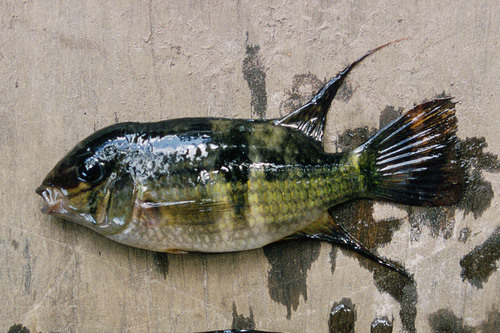
Aequidens potaroensis
Aequidens potaroensis
Aquarium hobby

Agassiz's dwarf cichlid
Apistogramma agassizii
Aquarium hobby

Altolamprologus calvus
Altolamprologus calvus
Aquarium hobby

Altum Angel
Pterophyllum altum
Aquarium hobby

Amatitlania myrnae
Amatitlania myrnae
Aquarium hobby
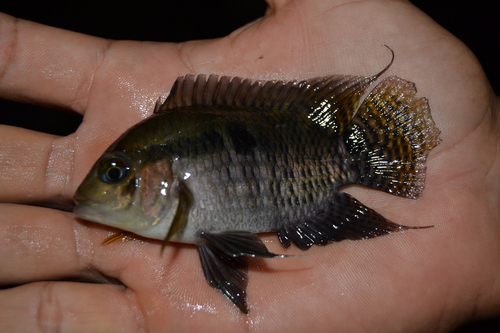
Amazon Cichlid
Cichlasoma amazonarum
Aquarium hobby