Home / Fishes / Killifish and livebearers / Rainbow goodeid
No federal permit to keepRainbow goodeid
Characodon lateralis
Fishes › Killifish and livebearers (Cyprinodontiformes) › Goodeidae (Goodeid livebearers and killifish)
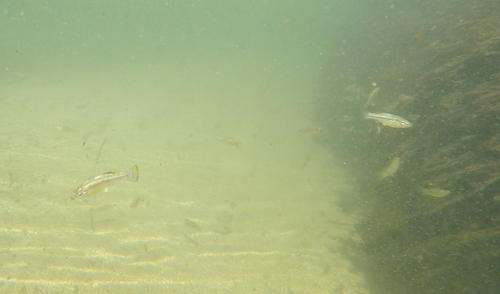
The rainbow goodeid (Characodon lateralis) is a species of critically endangered freshwater fish in the family Goodeidae, and are endemic to Mexico.

Care at a glance
Species-specific aquarium care
- Tank: At least 24 in long and 12 in front to back for one adult (adults commonly reach about 1.6 in / 4 cm).
- Water: Freshwater.
- Temperature: 64–81°F (range recorded for this species).
- pH: 6–8.
- Hardness: 9–19 dGH.
- Layout: Lives on or near the bottom: floor space and hiding places matter more than height.
- Diet: A grazer on plants and algae: base the diet on vegetable foods (algae wafers, blanched vegetables, spirulina). FishBase classes it as a herbivore.
Calculated from this species' own FishBase record: tank size from its typical adult length and swimming zone, water values from its recorded ranges. The group guide below fills in general care.
Care guide
Species care notes
- Tank: a base of at least 47 × 12 in (roughly 29 US gallons); space needed is rated “large tank”.
- Water: a fairly wide range, from slightly acidic to slightly alkaline, 64–75 °F, pH 6–8, 5–15 dGH.
- Behaviour: a shoaling fish best kept in a group of six or more; not a community fish.
- Difficulty: Moderate (Seriously Fish rating).
Short excerpts from the species profile:
- Setup: “It is essential to provide sufficient cover, ideally in the form of aquatic plants or filamentous algae, in order to restrict aggressive interactions between rival males and provide refuges for fry.”
- Diet: “Probably an omnivore feeding on small invertebrates, diatoms and algae in nature.”
- Tankmates: “Should ideally be maintained alone for breeding purposes, but can be kept alongside other species provided space is not limiting.”
- Breeding: “A matrotrophic livebearer that produces fully developed juveniles, which are supplied with nutrients through a placenta-like structure, the trophotaenia, prior to birth.”
From the Seriously Fish profile for this species, which has the full habitat, maintenance, diet, behaviour and breeding write-up 167
Goodeid livebearers and killifish
Applies to most species in this group. Habitat: Goodeids occupy freshwater springs and their outflows, including Mexican splitfin habitats and isolated Nevada poolfish springs. Individual species can differ, so compare with the species numbers above and the linked sources.
Housing & setup
- For Ameca splendens, provide at least 250 litres (66 US gallons); for Empetrichthys latos, at least 150 litres (40 US gallons), favouring broad tanks over height.
- Provide roots, rocks and dense vegetation patches that interrupt sightlines while leaving swimming space.
- Provide moderate to swift circulation; Ameca requires strongly oxygenated water, with the working group recommending at least 8 mg/L dissolved oxygen.
- The working group recommends weekly 60–80% water changes for these spring-associated species; match replacement chemistry and temperature carefully.
- Keep species and documented populations separately to preserve conservation stock identity.
Diet
- Algae and aufwuchs, especially for Ameca
- Vegetable supplements and plant-rich foods for Ameca
- Quality flakes, granules or tablets
- Artemia
- Daphnia or mysids, particularly for Empetrichthys
Social life
- Maintain breeding colonies with cover and room for subordinates; Ameca males can fight and nip other fishes. Fry are often tolerated when shelter and feeding are adequate.
Health watch
- Reduced disease resistance and accelerated ageing in Ameca kept persistently warm with inadequate water renewal
- Aggression-related fin damage
- General aquarium-fish water-quality disease and malnutrition; family-specific prevalence is not established
Understanding the animal
About this animal
About this animal
Specifically, they are found in shallow springs and ponds in the Durango and Coahuila area. They were first identified in 1866 by Albert Günther.
Quoted from the Wikipedia article “Rainbow goodeid” (CC BY-SA 4.0) 174
In the wild
In the wild
From this species’ own FishBase record (habitat, bottom type, water and breeding data), not its family. Good care copies these conditions.1
| Where it lives | Lives in freshwater, in rivers and streams. Stays near the bottom. Inhabits clear springs with plant growth. Feeds on algae. |
| Water it lives in | Freshwater, 64–81 °F (18–27 °C), pH 6–8, hardness 9–19 dH. |
| Climate | Subtropical climate. |
| Wild diet | Grazing on aquatic plants. |
| Behavior to plan for | Breeding: internal live bearers. |
What this means for care
- Keep water within its wild range, 64–81 °F.
Native climate (measured)
Native climate (measured)
| Warm-season highs | about 87°F (up to 88°F in the hottest sampled areas) |
| Cool-season lows | about 33°F (down to 29°F in the coldest sampled areas) |
| Average temperature | 54–64°F across sampled records |
| Relative humidity | 51–55% on average (driest month about 38%) |
| Rainfall | about 551 mm a year, with strong wet and dry seasons |
| Winters | Cool to cold winters (lows around 33°F) in much of its native range. Seasonal slowdown may be relevant, but species-specific biology determines whether brumation or hibernation occurs. |
Measured at 9 wild occurrence records sampled against WorldClim 2.1 climate data (1970–2000 averages). Air conditions in the range are ecological context, not enclosure settings: microhabitats such as burrows, leaf litter or basking rocks can be cooler, warmer or more humid.
From the sources
From the sources
Quoted from the matching sections of reputable sources for this exact species. Specialist databases are used first; Wikipedia (community-edited, CC BY-SA 4.0) only fills gaps. Other sources are short credited quotes.
| Overview | The rainbow goodeid (Characodon lateralis) is a species of critically endangered freshwater fish in the family Goodeidae, and are endemic to Mexico. Specifically, they are found in shallow springs and ponds in the Durango and Coahuila area. They were first identified in 1866 by Albert Günther. — Wikipedia (community-edited) |
| Where it lives | Home ranges Population dynamics Growth parameters Max. ages / sizes Length-weight rel. Length-frequencies Mass conversion Recruitment Abundance Life cycle Reproduction Maturity Maturity/Gills rel. — FishBase |
| Wild diet | These fish are herbivores, mostly feeding on algae. They prefer springs with heavy submerged vegetation. — Wikipedia (community-edited) |
| Reproduction | Gestation lasts for about 55 days. Female gives birth to 5-20 young. Reaches sexual maturity in about 5 months. — FishBase |
| Biology | Adults inhabit clear springs with plant growth. They feed on algae (Ref 26130). Migratory behaviour is undetermined. — FishBase |
| Conservation | The species was last assessed by the IUCN Red List of Threatened Species on April 18, 2018, and are critically endangered. In 1979, they were deemed threatened. The population is currently in decline. — Wikipedia (community-edited) |
Data and studies
The numbers
The numbers
Each bar is what one source reports. Where several sources weigh in, the dashed gold band marks their average.
Adult length
Maximum recorded length. Measured as total length. Fish in home aquariums often stay smaller than wild records.
Water temperature
Range the species tolerates in nature; aim for the middle.
Minimum tank footprint
Seriously Fish recommends a tank base of at least 47 × 12 in (about 29 US gallons).
Sources for this sheet
- FishBase (Froese & Pauly, eds.), version 24.07 Peer-reviewed researchThe global scientific database on fishes, maintained by a consortium of research institutions; every value is referenced.
- Seriously Fish species profiles Experienced keeper or breederLong-running aquarium reference written and peer-checked by experienced fishkeepers and ichthyologists; each profile covers habitat, tank size, water, diet, behaviour and breeding.
- Goodeid Working Group: Ameca splendens Experienced keeper or breederAdded in the 2026 source-checked care-guide review.
- Goodeid Working Group: Empetrichthys latos Experienced keeper or breederAdded in the 2026 source-checked care-guide review.
- Goodeid Working Group: Objectives Experienced keeper or breederAdded in the 2026 source-checked care-guide review.
- Merck Veterinary Manual: Disorders and Diseases of Fish Zoo, university or veterinaryAdded in the 2026 source-checked care-guide review.
- Wikipedia (species article) Community referenceFree encyclopedia; useful overviews with their own citations. Intro text is quoted under CC BY-SA 4.0.
More goodeid livebearers and killifish

Butterfly splitfin
Ameca splendens
Aquarium hobby
Goldbreast splitfin
Ilyodon furcidens
Aquarium hobby

Redtail splitfin
Xenotoca eiseni
Aquarium hobby

Tequila splitfin
Zoogoneticus tequila
Aquarium hobby