Home / Reptiles / Turtles and tortoises / Red-eared slider
Some federal rules apply In-depth sheetRed-eared slider
Trachemys scripta elegans
Reptiles › Turtles and tortoises (Testudines) › Emydidae (Pond turtles and box turtles)
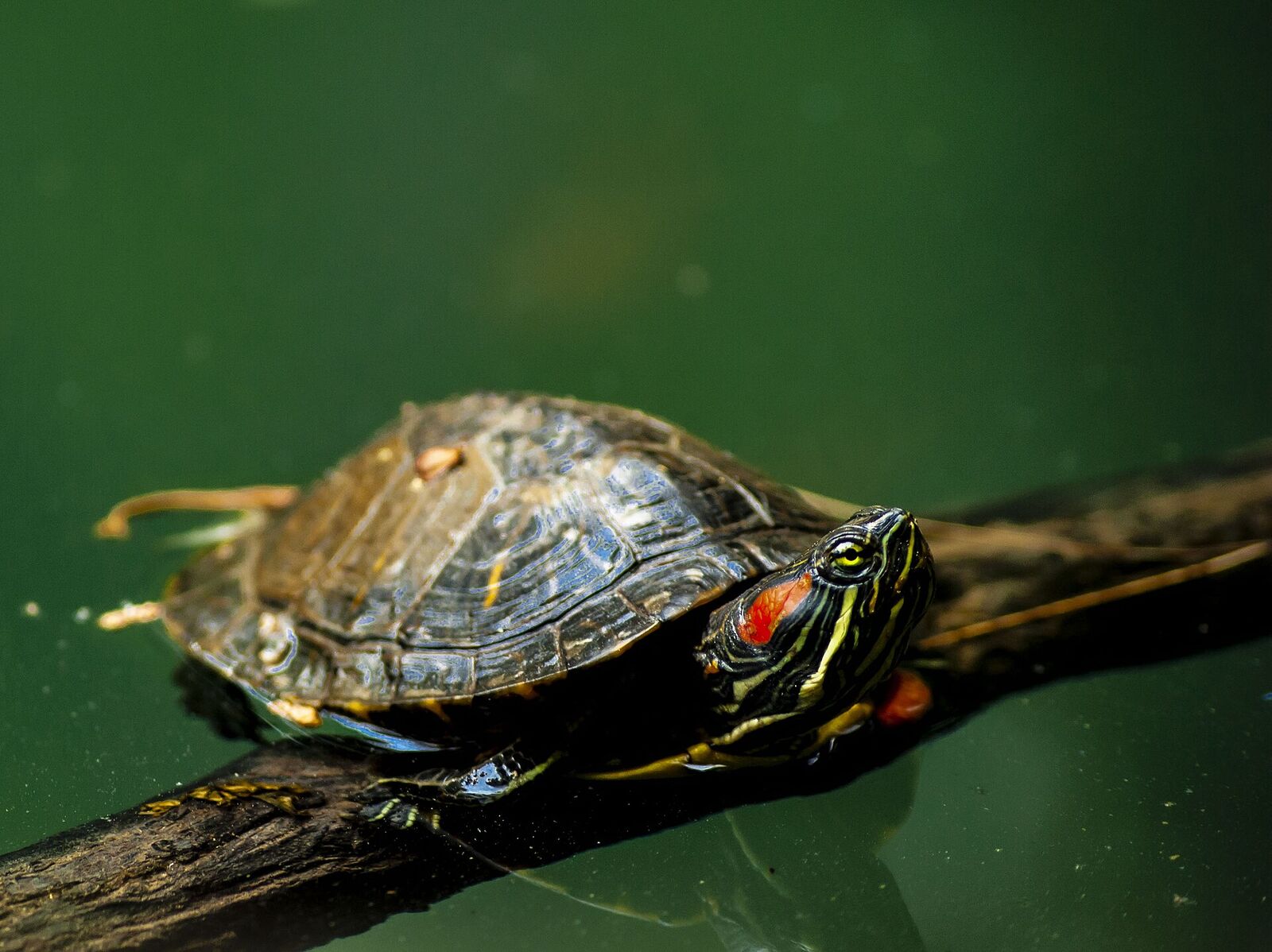
Red-eared sliders are hardy aquatic turtles that can live 30–40 years and need big, filtered tanks with a basking area.
Care at a glance
Species-specific values
Values researched for this exact species. Where they differ from the group guide below, follow these. Air, surface and water temperatures are listed separately, and each source is kept as published rather than averaged.
| Preferred air temperature zone | 72–81 °F (22–27 °C) Veterinary POTZ; not water or basking surface. | 218 |
| Basking surface temperature | 104 °F Slider basking platform; separate from air. | 229 |
| Basking air temperature | 85–90 °F | 229 |
| Water temperature | 78–82 °F Hatchlings under one year. | 229 |
| Water temperature | 74–76 °F Juveniles. | 229 |
| Water temperature | 70–88 °F Adults: source acceptable indoor limits, not a narrow optimum. Not brumation. | 229 |
Care guide
Diet
- Young sliders eat mostly animal matter (about 70–80%); adults shift toward plants, so offer more leafy greens and aquatic plants as they grow. Feed juveniles daily, adults every 2–3 days.
Sources 53
Note
- Juveniles are mostly carnivorous and shift toward plants with age. Never release one: they outcompete native turtles.
Sources 80
Show the group care guide for pond turtles, sliders and map turtles
Pond turtles, sliders and map turtles
Applies to most species in this group. Habitat: Ponds, rivers and marshes. Individual species can differ, so compare with the species numbers above and the linked sources.
Housing & setup
- Plan about 10 gallons of water per inch of shell as a common minimum, and filtration rated well above tank volume.
- A dry basking dock under UVB and a heat lamp; ponds are ideal in summer.
Climate & lighting
Starting point only: Slider life stages differ, and other pond-turtle genera cannot inherit one slider recipe. Check the species-specific values for this animal where shown.
| Basking spot | 90–95°F |
| Water | 72–80°F |
- UVB: Required.
Diet
- Turtle pellets plus aquatic plants and greens; adults eat more plants than juveniles.
Health watch
- Shell rot, ear abscesses (vitamin A deficiency) and respiratory infections.
- Never release pet turtles; red-eared sliders are invasive worldwide.
Understanding the animal
In the wild
In the wild
Researched for this exact species, not its family. Good care copies these conditions.1234567
| Where it lives | Native principally to the Mississippi Valley of the United States, from Illinois toward the Gulf of Mexico. It occupies vegetated ponds, oxbow lakes, sloughs and quiet river margins, using exposed logs and banks for basking. |
| Ground it lives on | Soft mud underwater for resting and overwintering; logs and banks for basking, and soil on land for nesting. |
| Water it lives in | Primarily freshwater, still or slow-flowing; muddy or turbid water is used naturally. Brackish water is tolerated but is not its principal habitat; no single species-specific pH, hardness or typical wild temperature range was established in the sources used. |
| Climate | Seasonal cooling varies geographically: northern native populations overwinter underwater, while southern populations can remain active year-round. A field-guide threshold for activity is water at approximately 50°F (10°C) or warmer; this is not a captive temperature target. A quantitative wild humidity range was not established. |
| Active | Diurnal, with early-morning and late-afternoon foraging and daytime basking; winter brumation in cooler parts of its range. |
| Social life | Individuals aggregate at shared basking sites, sometimes covering a log; this does not establish permanent social bonds. Aggression can include biting, shoving and ramming. |
| Wild diet | Aquatic vegetation and algae, including duckweed and waterweeds, plus insects and their larvae, snails, clams, crayfish, shrimp and frog eggs or tadpoles. Juveniles eat more animal prey; plant consumption increases with size. |
| Behavior to plan for | It quickly slides into water when disturbed and travels overland between water bodies. Females leave water to excavate soil nests. |
What this means for care
- Provide substantial swimming space, aquatic cover and an easily reached dry basking platform.
- Increase the plant component of feeding as the turtle matures rather than keeping adults on a juvenile prey-heavy diet.
- Secure both water and land boundaries against climbing and overland escape.
- Provide nesting soil for mature females; shared wild basking sites do not guarantee safe cohabitation.
- USGS Nonindigenous Aquatic Species: Red-eared Slider
- Missouri Department of Conservation: Red-Eared Slider field guide
- US Army Corps of Engineers: Riverine Turtle Habitats Potentially Impacted by Reservoir Operations, red-eared turtle profile
- Wikipedia: Red-eared slider
- The Reptile Database: Trachemys scripta elegans
- Red-Eared Slider Care Guide
- Red-Eared Slider Care Sheet
Native climate (measured)
Native climate (measured)
| Warm-season highs | about 93°F (up to 96°F in the hottest sampled areas) |
| Cool-season lows | about 42°F (down to 34°F in the coldest sampled areas) |
| Average temperature | 63–73°F across sampled records |
| Relative humidity | 61–71% on average (driest month about 61%) |
| Rainfall | about 835 mm a year |
Measured at 95 wild occurrence records sampled against WorldClim 2.1 climate data (1970–2000 averages). Air conditions in the range are ecological context, not enclosure settings: microhabitats such as burrows, leaf litter or basking rocks can be cooler, warmer or more humid.
Profile
Profile
Researched for this exact species. Sources are listed under In the wild above.
History
Red-eared sliders have a long history in the pet trade and were once commonly sold in dime stores, where many died because purchasers lacked appropriate husbandry knowledge. Millions have been traded internationally, and released pets have established invasive populations in many parts of the world.
Keeper tips
- Provide a large enclosure or pond appropriate for a turtle that can reach about 12 inches in adult length.
- Provide extensive freshwater swimming space.
- Include dry rocks, logs, or comparable surfaces above the water for basking.
- Plan for decades of care; individuals commonly live 20-30 years and may exceed 40 years.
- Treat them primarily as display animals even though captive individuals can become personable and may approach people for food.
Behaviors reported
- Basks frequently.
- May stack on other sliders while basking.
- Rapidly slides from exposed basking sites into water when startled.
- Captive individuals may swim toward people and beg for food.
Unique adaptations
- Webbed feet are adapted for swimming.
- Strong, sharp, beak-like jaws facilitate an omnivorous diet.
- Their ability to quickly retreat from exposed basking sites into water provides a rapid escape response.
- The species is described as exceptionally hardy and adaptable.
Remarkable facts
- The red-eared slider is a subspecies of the pond slider, Trachemys scripta.
- It is one of the most heavily traded turtles and is described as the most commonly traded chelonian in the world.
- It has become invasive in many regions after pet releases.
- Adults commonly reach about 12 inches, with females generally larger than males.
- Typical lifespan is about 20-30 years, with some individuals exceeding 40 years.
- The species has temperature-dependent sex determination.
Stories
- The common name refers both to the red marking behind each eye and to the turtle's habit of rapidly sliding from rocks or logs into the water when disturbed.
From the sources
From the sources
Quoted from the matching sections of reputable sources for this exact species. Specialist databases are used first; Wikipedia (community-edited, CC BY-SA 4.0) only fills gaps. Other sources are short credited quotes.
| Overview | The red-eared slider or red-eared terrapin (Trachemys scripta elegans) is a subspecies of the pond slider (Trachemys scripta), a terrapin belonging to the family Emydidae. Native to the southern United States and extreme northern Mexico, it is popular as a pet across the world, and is the most invasive chelonian. It is the most commonly traded chelonian in the world. — Wikipedia (community-edited) |
| Where it lives | The red-eared slider originated from the area around the Mississippi River and the Gulf of Mexico, in warm climates in the Southeastern United States. Their native areas range from the southeast of Colorado to Virginia and Florida. In nature, they inhabit areas with a source of still, warm water, such as ponds, lakes, swamps, creeks, streams, or slow-flowing rivers. — Wikipedia (community-edited) |
| Behavior | Red-eared sliders are almost entirely aquatic, but as they are cold-blooded, they leave the water to sunbathe to regulate their temperature. — Wikipedia (community-edited) |
| Reproduction | This species exhibits temperature-dependant sex determination (TSD) which seems to be determined by an epigenetic regulator, KDM6B (JMJD3, a histone demethylase) (Weber et al. 2020). — The Reptile Database |
| Appearance and size | The carapace of this species can reach more than 40 cm in length, but the typical length ranges from 15 to 20 cm. The females of the species are usually larger than the males. They typically live between 20–30 years, although some individuals can live for more than 40 years. — Wikipedia (community-edited) |
| History and naming | Named after Latin “scripta” means written; referring to the letter-like markings on the carapace. — The Reptile Database |
Data and studies
Researched care notes
Researched care notes
Findings checked against veterinary, zoo, welfare, keeper and peer-reviewed sources. Air, basking-surface and water temperatures are kept separate, and where sources disagree both are shown. “Study” notes report what a paper measured, not a universal rule.
Red-Eared Slider
- Provide substantial swimming water and an easily reached platform on which the entire turtle can become dry.1
- Water: VCA prints 75–82°F (correct conversion 23.9–27.8°C) alongside 24–29°C; the latter contains a conversion discrepancy, and neither interval is separated by age.1
- Surface: ReptiFiles recommends a basking-platform surface of 104°F (40°C), measured separately from the surrounding air.2
- Air: the same guide gives 85–90°F (29.4–32.2°C) in the basking area; do not heat all aquarium water to the surface target.2
- Water / age difference: ReptiFiles gives hatchlings 78–82°F (25.6–27.8°C) and juveniles 74–76°F (23.3–24.4°C), unlike VCA's single unaged range.2,1
- Diet shifts with age: juveniles consume proportionally more animal food, while older sliders need increasing emphasis on plant foods.3
- Use suitable aquatic-turtle pellets with varied leafy greens and other appropriate foods; grocery-store muscle meat alone has an unsuitable calcium-to-phosphorus balance.3
The numbers
The numbers
Each bar is what one source reports. Where several sources weigh in, the dashed gold band marks their average.
Water temperature
No lower than about 68°F overnight.
Basking
Lifespan
Maximum recorded lifespan
Longest recorded lifespan reported by each database; typical lifespans are usually shorter. The AnAge record comes from an animal in human care.
Typical adult weight
Average adult body mass in each database (FishBase gives the maximum recorded weight).
Clutch size
Average per litter or clutch.
Care articles for this species
Care articles for this species
- Red-Eared Slider Care Guide (ReptiFiles)
- Red-Eared Slider Care Sheet (Reptiles Magazine)
- Red-Eared Slider Care Tips And Information (Reptiles Magazine)
Veterinary & husbandry research
Veterinary & husbandry research
- Partial characterization of a new adenovirus lineage discovered in testudinoid turtles Doszpoly A et al., Infection, genetics and evolution: journal of molecular epidemiology and evolutionary genetics in infectious diseases 2013
- [Non-indigenous and non-specific parasitic nematodes--the background and the consequences] Okulewicz A et al., Wiadomosci parazytologiczne 2009
- A Mycoplasma species of Emydidae turtles in the northeastern USA Ossiboff RJ et al., Journal of wildlife diseases 2015
- Fasting and postprandial serum bile acid concentrations in 10 healthy female red-eared terrapins (Trachemys scripta elegans) Knotkova Z et al., The Veterinary record 2008
Peer-reviewed papers that mention this species alongside captivity, zoos, veterinary care or aquaculture. Some cover several species or mention it only in passing, so check the abstract. See all 37 on PubMed → 170
Sources for this sheet
- Royal Veterinary College Exotics Service: Red-eared terrapin (slider) care Zoo, university or veterinaryVet-school exotics hospital factsheet, reviewed 2021–2024.
- Animal Diversity Web (University of Michigan): Trachemys scripta Zoo, university or veterinaryUniversity-hosted species account, mostly wild biology.
- Clint's Reptiles (YouTube): Red-Eared Slider, The Best Pet Turtle? Expert educator & keeperClint Laidlaw, PhD in Biology Education and MS in Evolutionary Ecology; owner of Clint's Reptile Room and a longtime keeper. Rates each species on handleability, care, hardiness, availability and upfront cost.
- AnAge: The Animal Ageing and Longevity Database (Human Ageing Genomic Resources) Peer-reviewed researchCurated, referenced longevity and life-history records for thousands of species; maximum lifespans are often from zoo animals.
- Myhrvold et al. (2015). An amniote life-history database. Ecology 96: 3109 Peer-reviewed researchPeer-reviewed compilation of life-history data for over 21,000 birds, mammals and reptiles.
- ReptiFiles (care guides) Experienced keeper or breederWell-researched reptile care guides that cite herpetological literature and experienced keepers.
- Reptiles Magazine (care articles) Experienced keeper or breederEstablished reptile and amphibian hobby magazine; care articles are written by breeders, keepers and veterinarians.
- 21 CFR 1240.62: Turtles under 4 inches (FDA) Zoo, university or veterinaryFederal ban on selling small turtles.
- Merck Veterinary Manual: Management and husbandry of reptiles Zoo, university or veterinaryThe Merck Veterinary Manual: a standard veterinary reference written and reviewed by veterinary specialists.
- Merck Veterinary Manual: Nutritional, metabolic and endocrine diseases of reptiles Zoo, university or veterinaryThe Merck Veterinary Manual: a standard veterinary reference written and reviewed by veterinary specialists.
- ReptiFiles: Red-eared slider basking and water temperatures Zoo, university or veterinaryAdded in the 2026 source-checked care-guide review.
- Merck Veterinary Manual: Important Husbandry Requirements for Selected Reptiles Zoo, university or veterinaryAdded in the 2026 source-checked care-guide review.
- Clint's Reptiles (YouTube): Red-Eared Slider, The Best Pet Turtle? Expert educator & keeperClint Laidlaw, PhD in Biology Education and MS in Evolutionary Ecology; owner of Clint's Reptile Room and a longtime keeper. His "Best Pet?" series reviews each species' care in depth.
- The Reptile Database Peer-reviewed researchScientist-curated catalog of every reptile species, with taxonomy and literature.
- GBIF Backbone Taxonomy (Global Biodiversity Information Facility) Peer-reviewed researchInternational scientific taxonomy used here for classification.
- Species+ (UNEP-WCMC and the CITES Secretariat) Zoo, university or veterinaryThe official database of species listed under CITES.
- Wikipedia (species article) Community referenceFree encyclopedia; useful overviews with their own citations. Intro text is quoted under CC BY-SA 4.0.
- PubMed (U.S. National Library of Medicine) Peer-reviewed researchIndex of peer-reviewed veterinary, zoo and husbandry research.
- iNaturalist (captive observations) Community referenceCommunity observation platform run by the California Academy of Sciences and National Geographic; observations marked captive show animals living in homes, zoos and aquariums.