Home / Mammals / Monkeys, lemurs and apes / Ring-tailed lemur
Federal restrictions apply In-depth sheetRing-tailed lemur
Lemur catta
Mammals › Monkeys, lemurs and apes (Primates) › Lemuridae (Lemurs)
Ring-tailed lemurs live in female-dominated troops of 15–20 and can live about 30 years. They're endangered and need social groups and expert care.
Warnings
Care guide
Behavior
- Females dominate males; scent marking and "stink battles"; sunbathe in the morning.
Sources 75
Diet
- Omnivores: fruit, leaves, insects; tamarind is a key wild food.
Sources 75
Show the group care guide for lemurs
Lemurs
Applies to most species in this group. Habitat: Madagascar forests. Individual species can differ, so compare with the species numbers above and the linked sources.
Housing & setup
- Large, enriched indoor-outdoor enclosures with social groups.
Diet
- For herbivorous lemurs, use an appropriately formulated high-fibre plan with browse and vegetables; the veterinary manual discusses fruit-free diets because cultivated fruit can promote excessive sugar intake.
Health watch
- Diabetes and obesity on sugary fruit diets.
Understanding the animal
In the wild
In the wild
Researched for this exact species, not its family. Good care copies these conditions.1
| Where it lives | Southern and southwestern Madagascar, in riverine gallery forest, dry deciduous forest and thorn scrub. Uses canopy and ground while traveling and feeding. |
| Ground it lives on | forest-floor soil and leaf litter as well as trees and rocky scrub |
| Active | Diurnal, traveling and feeding from near dawn until dusk. |
| Social life | Multi-male, multi-female troops; females dominate males and troops defend resources. |
| Wild diet | Fruit and leaves, especially tamarind; also flowers, stems, plant exudates and occasional invertebrates and small vertebrates. |
| Behavior to plan for | Climbs and leaps but also travels extensively on the ground. Scent marking, grooming and tail displays organize social interactions. |
What this means for care
- Provide ground-level travel space and interconnected climbing routes.
- Manage compatible troops with multiple feeding sites and escape routes.
- Include leafy browse and foraging rather than relying on sweet fruit.
Profile
Profile
Researched for this exact species. Sources are listed under In the wild above.
History
The provided source describes the ring-tailed lemur as an island endemic restricted to southern and southwestern Madagascar and documents its use of several forest and scrub habitats.
Keeper tips
- Provide elevated climbing routes at multiple heights.
- Use branching or other structures that allow the feet to grasp securely.
- Include substantial vertical space rather than designing only around floor area.
Behaviors reported
- Climbs through the mid and upper canopy.
- Occupies several different forest types but is most commonly found in continuous-canopy forest.
Unique adaptations
- The first toe of the hind foot is opposable and is used during climbing.
- Thick, dense fur covers the body.
- The species tolerates a very broad reported temperature range.
Remarkable facts
- Ring-tailed lemurs are endemic to southern and southwestern Madagascar.
- They occur at elevations up to 2,600 m.
- Adults have a body length of about 39-46 cm and a tail about 56-63 cm long.
- Average body mass is reported as about 2.2 kg.
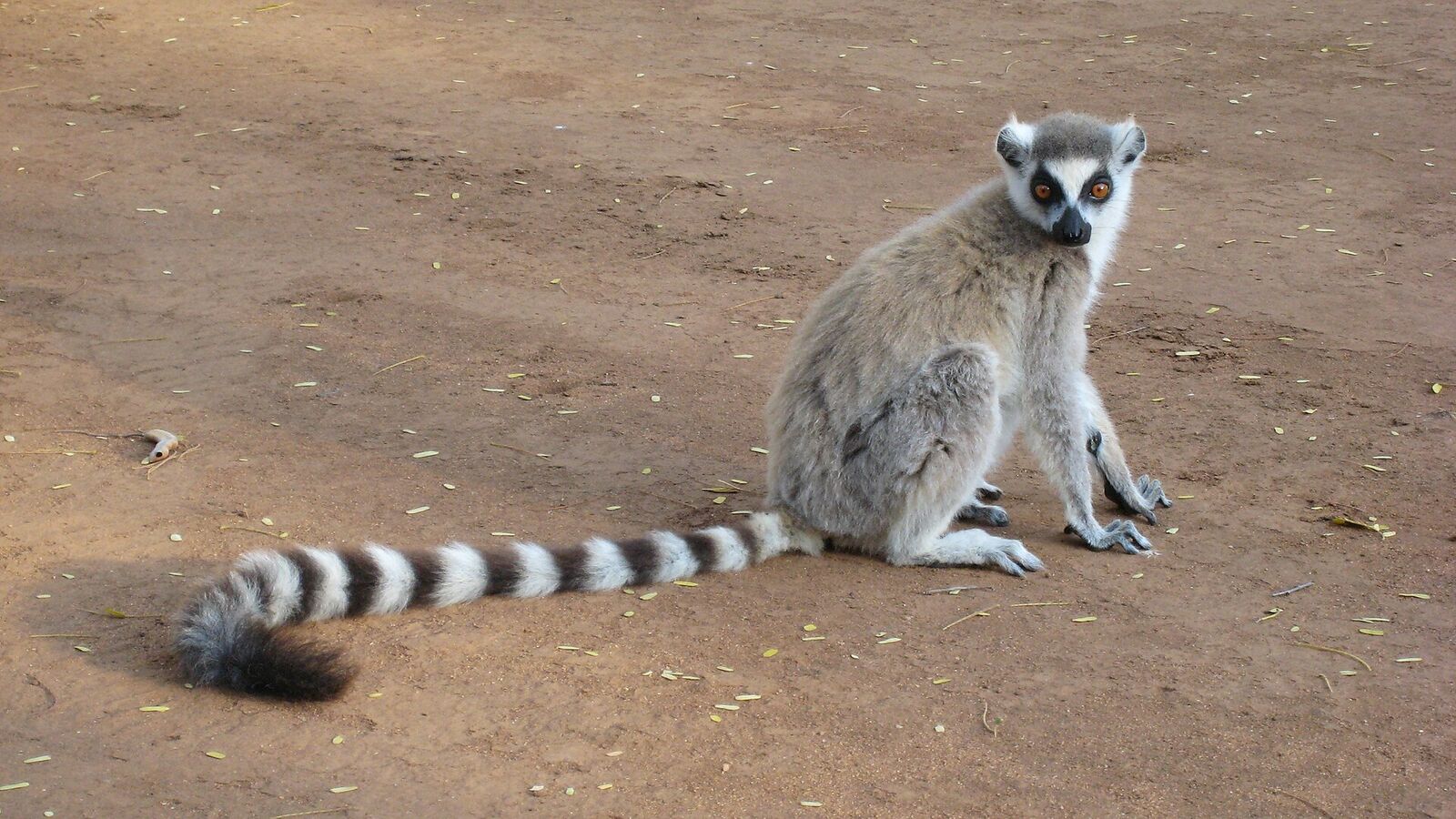
- The tail has strongly defined black-and-white rings.
- Continuous-canopy forests in their range include trees reaching about 20-25 m tall.
From the sources
From the sources
Quoted from the matching sections of reputable sources for this exact species. Specialist databases are used first; Wikipedia (community-edited, CC BY-SA 4.0) only fills gaps. Other sources are short credited quotes.
| Overview | The ring-tailed lemur (Lemur catta) is a medium- to larger-sized strepsirrhine (wet-nosed) primate and the most internationally recognized lemur species, owing to its long, black-and-white, ringed tail. It belongs to Lemuridae, one of five lemur families, and is the only member of the Lemur genus. Like all lemurs, it is endemic to the island of Madagascar, where it is endangered. Known locally in Malagasy as maky (, spelled maki in French) or hira, it ranges from gallery forests to spiny scrub in the southern regions of the island. — Wikipedia (community-edited) |
| Where it lives | Ring-tailed lemurs are found in three distinct habitats in south and southwestern Madagascar: continuous canopy forest, brush and scrub forests, and mixed forests. — Animal Diversity Web |
| Social life and communication | Ring-tailed lemur communication is complex. — Animal Diversity Web |
| Wild diet | Ring-tailed lemurs are opportunistic omnivores. — Animal Diversity Web |
| Behavior | Ring-tailed lemurs live in groups of 15 to 20 individuals called troops. — Animal Diversity Web |
| Reproduction | Ring-tailed lemurs begin mating in April, with a gestation period of 130 to 144 days, giving birth beginning in August and finishing in September. — Animal Diversity Web |
| Lifespan | Ring-tailed lemurs typically live to be 16 years old, with the oldest known ring-tailed lemur living to be 33 years old in captivity. — Animal Diversity Web |
| Appearance and size | Ring-tailed lemurs have a body length ranging from 39 to 46 cm in length with a tail ranging in length from 56 to 63cm and an average body weight of 2.2 kg. — Animal Diversity Web |
| History and naming | Although the term "lemur" was first intended for slender lorises, it was soon limited to the endemic Malagasy primates, which have been known as "lemurs" ever since. The name derives from the Latin term lemures, which refers to specters or ghosts that were exorcised during the Lemuria festival of ancient Rome. — Wikipedia (community-edited) |
Data and studies
Researched care notes
Researched care notes
Findings checked against veterinary, zoo, welfare, keeper and peer-reviewed sources. Air, basking-surface and water temperatures are kept separate, and where sources disagree both are shown. “Study” notes report what a paper measured, not a universal rule.
Ring-Tailed Lemur (species)
The numbers
The numbers
Each bar is what one source reports. Where several sources weigh in, the dashed gold band marks their average.
Lifespan in care (typical to oldest known)
Maximum recorded lifespan
Longest recorded lifespan reported by each database; typical lifespans are usually shorter. The AnAge record comes from an animal in human care.
Typical adult weight
Average adult body mass in each database (FishBase gives the maximum recorded weight).
Litter size
Average per litter or clutch.
Veterinary & husbandry research
Veterinary & husbandry research
- Toxoplasmosis in Captive Ring-Tailed Lemurs (Lemur catta) Rocchigiani G et al., Pathogens (Basel, Switzerland) 2022
- Species-specific transmission of novel picornaviruses in lemurs Lim ES et al., Journal of virology 2015
- Enriched sleep environments lengthen lemur sleep duration Vining AQ et al., PloS one 2021
- THORACIC RADIOGRAPHY AND TRANSTHORACIC ECHOCARDIOGRAPHY IN CLINICALLY HEALTHY RING-TAILED LEMURS (LEMUR CATTA) Houdellier B et al., Journal of zoo and wildlife medicine: official publication of the American Association of Zoo Veterinarians 2020
Peer-reviewed papers that mention this species alongside captivity, zoos, veterinary care or aquaculture. Some cover several species or mention it only in passing, so check the abstract. See all 127 on PubMed → 170
Sources for this sheet
- Animal Diversity Web (University of Michigan): Lemur catta Zoo, university or veterinaryUniversity-hosted species account, mostly wild biology.
- AnAge: The Animal Ageing and Longevity Database (Human Ageing Genomic Resources) Peer-reviewed researchCurated, referenced longevity and life-history records for thousands of species; maximum lifespans are often from zoo animals.
- Myhrvold et al. (2015). An amniote life-history database. Ecology 96: 3109 Peer-reviewed researchPeer-reviewed compilation of life-history data for over 21,000 birds, mammals and reptiles.
- 50 CFR 17.11: Endangered and threatened wildlife Zoo, university or veterinaryCurrent federal Endangered Species Act list.
- Species+ (UNEP-WCMC and the CITES Secretariat) Zoo, university or veterinaryThe official database of species listed under CITES.
- USFWS International Affairs: CITES Zoo, university or veterinaryFederal agency that issues CITES permits.
- CDC: Bringing an animal into the United States Zoo, university or veterinaryFederal rules on importing animals that can carry human disease.
- 9 CFR 2.1: Animal Welfare Act licensing (USDA) Zoo, university or veterinaryWho needs a USDA license to breed, sell or exhibit animals.
- Merck Veterinary Manual: Overview of nonhuman primates Zoo, university or veterinaryThe Merck Veterinary Manual: a standard veterinary reference written and reviewed by veterinary specialists.
- MSD Veterinary Manual — Nutrition in Primates Zoo, university or veterinaryAdded in the 2026 source-checked care-guide review.
- GBIF Backbone Taxonomy (Global Biodiversity Information Facility) Peer-reviewed researchInternational scientific taxonomy used here for classification.
- Wikipedia (species article) Community referenceFree encyclopedia; useful overviews with their own citations. Intro text is quoted under CC BY-SA 4.0.
- PubMed (U.S. National Library of Medicine) Peer-reviewed researchIndex of peer-reviewed veterinary, zoo and husbandry research.
- iNaturalist (captive observations) Community referenceCommunity observation platform run by the California Academy of Sciences and National Geographic; observations marked captive show animals living in homes, zoos and aquariums.