
Home / Fishes / Catfish / Loricariidae / Royal panaque
No federal permit to keepRoyal panaque
Panaque nigrolineatus
Fishes › Catfish (Siluriformes) › Loricariidae (Plecos)
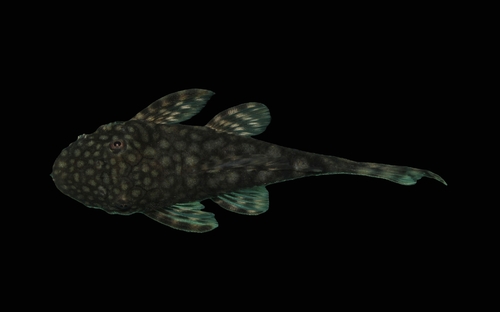
Panaque nigrolineatus, the royal panaque, royal plec, or royal pleco, is an herbivorous freshwater armored catfish native to Brazil, Colombia and Venezuela, where it occurs in the Orinoco and Amazon basins.

Care at a glance
Species-specific values
Values researched for this exact species. Air, surface and water temperatures are listed separately, and each source is kept as published rather than averaged.
| Diet | Feed sinking algae tablets, boiled peas, and zucchini; provide bogwood for roughage. Source: fishprofiles.com | |
| Feeding frequency | Administer food at night. Source: fishprofiles.com | |
| Social housing | Separate aggressively feeding tankmates during introduction until regular feeding begins; avoid timid tankmates. Source: fishprofiles.com | |
| Substrate | Provide large pieces of hollow driftwood as essential hiding places. Source: fishprofiles.com |
Species-specific aquarium care
- Tank: At least 84 in long and 33 in front to back for one adult (adults commonly reach about 16.9 in / 43 cm).
- Water: Freshwater.
- Temperature: 72–79°F (range recorded for this species).
- pH: 6.5–7.5.
- Hardness: 2–15 dGH.
- Layout: Uses both the bottom and open water: give open swimming space plus cover near the substrate.
Calculated from this species' own FishBase record: tank size from its typical adult length and swimming zone, water values from its recorded ranges. The group guide below fills in general care.
Understanding the animal
About this animal
About this animal
It is known for being one of the few xylophagous fish, and is able to survive for a long period of time on a wood-only diet. It is also a popular aquarium fish.
From Wikipedia: Panaque nigrolineatus, CC BY-SA 4.0 (excerpt)
In the wild
In the wild
From this species’ own FishBase record (habitat, bottom type, water and breeding data), not its family. Wild conditions are context, not enclosure settings.1
| Where it lives | Lives in freshwater. Uses both the bottom and open water. |
| Water it lives in | Freshwater, 72–79 °F (22–26 °C), pH 6.5–7.5, hardness 2–15 dH. |
| Climate | Tropical climate. |
Data and studies
The numbers
The numbers
Each bar is what one source reports. Where several sources weigh in, the dashed gold band marks their average.
Adult length
Maximum recorded length. Measured as standard length (snout to the base of the tail, not counting the tail fin). Fish in home aquariums often stay smaller than wild records.
Water temperature
Range the species tolerates in nature; aim for the middle.
pH
Water hardness
Veterinary & husbandry research
Veterinary & husbandry research
- Panaque nigrolineatus laurafabianae, a new, commercially exploited subspecies of ornamental wood-eating pleco (Loricariidae: Hypostominae) from the Guaviare River basin in Colombia Ortega-Lara A et al., Zootaxa 2020
- Phylogenetic analysis of microbial communities in different regions of the gastrointestinal tract in Panaque nigrolineatus, a wood-eating fish McDonald R et al., PloS one 2012
Peer-reviewed papers that mention this species alongside captivity, zoos, veterinary care or aquaculture. Some cover several species or mention it only in passing, so check the abstract. PubMed
Sources for this sheet
- FishBase (Froese & Pauly, eds.), version 24.07 (CC BY-NC 4.0) Peer-reviewed researchThe global scientific database on fishes, maintained by a consortium of research institutions; every value is referenced.
- Wikipedia (species article) (CC BY-SA 4.0) Community referenceFree encyclopedia; useful overviews with their own citations. Short excerpts are quoted under CC BY-SA 4.0, each credited with a link to its article.
- PubMed (U.S. National Library of Medicine) Peer-reviewed researchIndex of peer-reviewed veterinary, zoo and husbandry research.
- iNaturalist (captive observations) Community referenceCommunity observation platform run by the California Academy of Sciences and National Geographic; observations marked captive show animals living in homes, zoos and aquariums.
More plecos
Ancistrus claro
Ancistrus claro
Aquarium hobby

Ancistrus multispinis
Ancistrus multispinis
Aquarium hobby

Aphanotorulus unicolor
Aphanotorulus unicolor
Aquarium hobby

Armbruster's Pleco
Panaque armbrusteri
Aquarium hobby

Baryancistrus chrysolomus
Baryancistrus chrysolomus
Aquarium hobby

Baryancistrus demantoides
Baryancistrus demantoides
Aquarium hobby