
Home / Amphibians / Aquatic caecilians / Rubber eel (Cayenne caecilian)
No federal permit to keepRubber eel (Cayenne caecilian)
Typhlonectes natans
Amphibians › Aquatic caecilians (Gymnophiona) › Typhlonectidae (Aquatic caecilians)
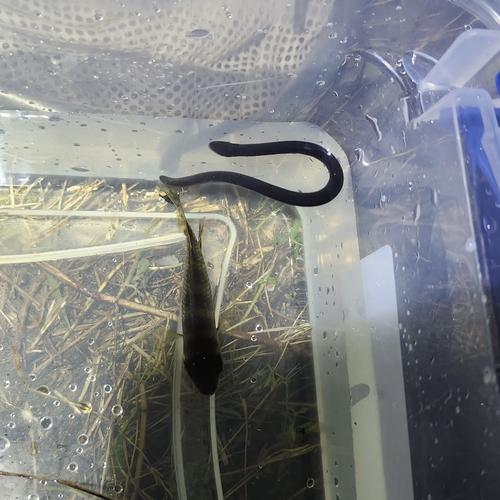
Typhlonectes natans, called the rubber eel or Rio Rauca caecilian, is a species of caecilian in the family Typhlonectidae found in Colombia, Venezuela, and possibly Trinidad and Tobago. Its natural habitats are dry savanna, subtropical or tropical…
From Wikipedia: Typhlonectes natans, CC BY-SA 4.0 (excerpt)
Care at a glance
Species-specific values
Values researched for this exact species. Air, surface and water temperatures are listed separately, and each source is kept as published rather than averaged.
| Water temperature | 75–86 °F (24–30 °C) Seasonal regime. | media.eaza.net |
| Tank volume recommendation | 250 L Trio with substantial external filtration; larger preferred. | media.eaza.net |
| Filter safety | Secure inlet guards; animals can enter filters and drown. Guard heaters and provide dark refuges. | media.eaza.net |
Understanding the animal
About this animal
About this animal
T. natans is commonly kept as an aquarium pet, and is sometimes sold as a "fish" in aquarium stores.
From Wikipedia: Typhlonectes natans, CC BY-SA 4.0 (excerpt)
In the wild
In the wild
| Overview | Typhlonectes natans, called the rubber eel or Rio Rauca caecilian, is a species of caecilian in the family Typhlonectidae found in Colombia, Venezuela, and possibly Trinidad and Tobago. Its natural habitats are dry savanna, subtropical or tropical dry shrubland, subtropical or tropical moist shrubland, subtropical or tropical seasonally wet or flooded lowland grassland, and rivers. T. natans is commonly kept as an aquarium pet, and is sometimes sold as a "fish" in aquarium stores. — From Wikipedia: Typhlonectes natans, CC BY-SA 4.0 (excerpt) |
Native climate (measured)
Native climate (measured)
| Warm-season highs | about 90°F (up to 90°F in the hottest sampled areas) |
| Cool-season lows | about 59°F (down to 59°F in the coldest sampled areas) |
| Average temperature | 76°F across sampled records |
| Relative humidity | 72–73% on average (driest month about 68%) |
| Rainfall | about 1490 mm a year |
Measured at 8 wild occurrence records sampled against WorldClim 2.1 climate data (1970–2000 averages). Air conditions in the range are ecological context, not enclosure settings: microhabitats such as burrows, leaf litter or basking rocks can be cooler, warmer or more humid.
Data and studies
Researched care notes
Researched care notes
Findings checked against veterinary, zoo, welfare, keeper and peer-reviewed sources. Air, basking-surface and water temperatures are kept separate, and where sources disagree both are shown. “Study” notes report what a paper measured, not a universal rule.
Aquatic Caecilians (group)
Researched for this whole family or group; check species differences before applying.
- The guideline gives 24–30°C water for Typhlonectes and 26–29°C for Potomotyphlus. Preserve the genus distinction.1
- Protect against heater contact and provide appropriate filtration and redundant temperature safeguards.1
- Use varied suitable prey; scrutinise a fish-only ration nutritionally.1
- Thiaminase affects thiamine, vitamin B1. The manual’s B12 wording is an error. Verified correction; this does not supply a supplement dose.1
- The guideline cautions against adding new males to breeding groups and against assuming compatibility with fish.1
Veterinary & husbandry research
Veterinary & husbandry research
- Batrachochytrium dendrobatidis in aquatic caecilians (Typhlonectes natans): a series of cases from two institutions Churgin SM et al., Journal of zoo and wildlife medicine: official publication of the American Association of Zoo Veterinarians 2013
- REVIEW OF HISTOLOGIC LESIONS AND MORTALITY IN RIO CAUCA CAECILIANS (TYPHLONECTES NATANS) OVER A 22-YEAR PERIOD Kane LP et al., Journal of zoo and wildlife medicine: official publication of the American Association of Zoo Veterinarians 2021
Peer-reviewed papers that mention this species alongside captivity, zoos, veterinary care or aquaculture. Some cover several species or mention it only in passing, so check the abstract. See all 3 on PubMed → PubMed
Sources for this sheet
- AnAge: The Animal Ageing and Longevity Database (Human Ageing Genomic Resources) (CC BY 3.0) Peer-reviewed researchCurated, referenced longevity and life-history records for thousands of species; maximum lifespans are often from zoo animals.
- AmphibiaWeb (University of California, Berkeley) (CC BY-NC) Peer-reviewed researchUniversity-hosted database of amphibian biology and conservation.
- GBIF Backbone Taxonomy (Global Biodiversity Information Facility) (CC BY 4.0) Peer-reviewed researchInternational scientific taxonomy used here for classification. GBIF Secretariat (2023). GBIF Backbone Taxonomy. Checklist dataset https://doi.org/10.15468/39omei, accessed via GBIF.org.
- Wikipedia (species article) (CC BY-SA 4.0) Community referenceFree encyclopedia; useful overviews with their own citations. Short excerpts are quoted under CC BY-SA 4.0, each credited with a link to its article.
- PubMed (U.S. National Library of Medicine) Peer-reviewed researchIndex of peer-reviewed veterinary, zoo and husbandry research.
- iNaturalist (captive observations) Community referenceCommunity observation platform run by the California Academy of Sciences and National Geographic; observations marked captive show animals living in homes, zoos and aquariums.
