
Home / Fishes / Seahorses and pipefish / Short-tailed pipefish
No federal permit to keepShort-tailed pipefish
Microphis brachyurus
Fishes › Seahorses and pipefish (Syngnathiformes) › Syngnathidae (Seahorses and pipefish)
The short-tailed pipefish (Microphis brachyurus) is a species of fish in the family Syngnathidae.

Care at a glance
Species-specific values
Values researched for this exact species. Air, surface and water temperatures are listed separately, and each source is kept as published rather than averaged.
| Minimum enclosure | Minimum tank volume is at least 120 L. Source: atlarium.bio | |
| Water temperature | 72–82 °F (22–28 °C) Source: atlarium.bio | |
| Diet | Feed live copepods, daphnia, brine shrimp nauplii, bloodworms, and glass worms; dry foods are ignored. Source: atlarium.bio | |
| Feeding frequency | Feed multiple times daily in targeted portions. Source: atlarium.bio | |
| Social housing | Keep as a species-only tank; compatible tankmates should be small, very peaceful, and slow-moving. Source: atlarium.bio | |
| Substrate | Use dense planting with salt-tolerant plants and thin roots or branches for cover and hitching posts. Source: atlarium.bio |
Species-specific aquarium care
- Tank: At least 36 in long and 18 in front to back for one adult (adults commonly reach about 8.7 in / 22 cm).
- Water: Freshwater (tolerates brackish).
- Layout: Lives on or near the bottom: floor space and hiding places matter more than height.
- Diet: FishBase classes it as a carnivore.
Calculated from this species' own FishBase record: tank size from its typical adult length and swimming zone, water values from its recorded ranges. The group guide below fills in general care.
Understanding the animal
About this animal
About this animal
It is found in fresh and brackish waters from Sri Lanka and India east to southern Japan and the Society Islands. It inhabits places with little or no current in rivers, streams and estuaries.
From Wikipedia: Short-tailed pipefish, CC BY-SA 4.0 (excerpt)
In the wild
In the wild
From this species’ own FishBase record (habitat, bottom type, water and breeding data), not its family. Wild conditions are context, not enclosure settings.1
| Where it lives | Lives in freshwater and brackish water and the sea, in rivers and streams, estuaries. Stays near the bottom. |
| Climate | Subtropical climate. |
| Behavior to plan for | Breeding: external brooders, paternal parental care. |
Data and studies
The numbers
The numbers
Each bar is what one source reports. Where several sources weigh in, the dashed gold band marks their average.
Adult length
Maximum recorded length. Measured as standard length (snout to the base of the tail, not counting the tail fin). Fish in home aquariums often stay smaller than wild records.
Sources for this sheet
- FishBase (Froese & Pauly, eds.), version 24.07 (CC BY-NC 4.0) Peer-reviewed researchThe global scientific database on fishes, maintained by a consortium of research institutions; every value is referenced.
- Wikipedia (species article) (CC BY-SA 4.0) Community referenceFree encyclopedia; useful overviews with their own citations. Short excerpts are quoted under CC BY-SA 4.0, each credited with a link to its article.
- iNaturalist (captive observations) Community referenceCommunity observation platform run by the California Academy of Sciences and National Geographic; observations marked captive show animals living in homes, zoos and aquariums.
More seahorses and pipefish
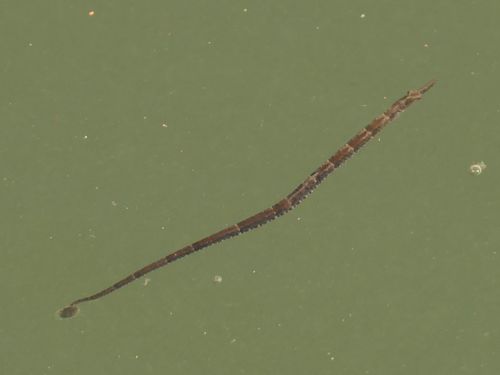
Bellybarred pipefish
Hippichthys spicifer
Aquarium hobby

Bluestripe pipefish
Doryrhamphus excisus
Aquarium hobby

Chain pipefish
Syngnathus louisianae
Aquarium hobby

Dwarf seahorse
Hippocampus zosterae
Aquarium hobby
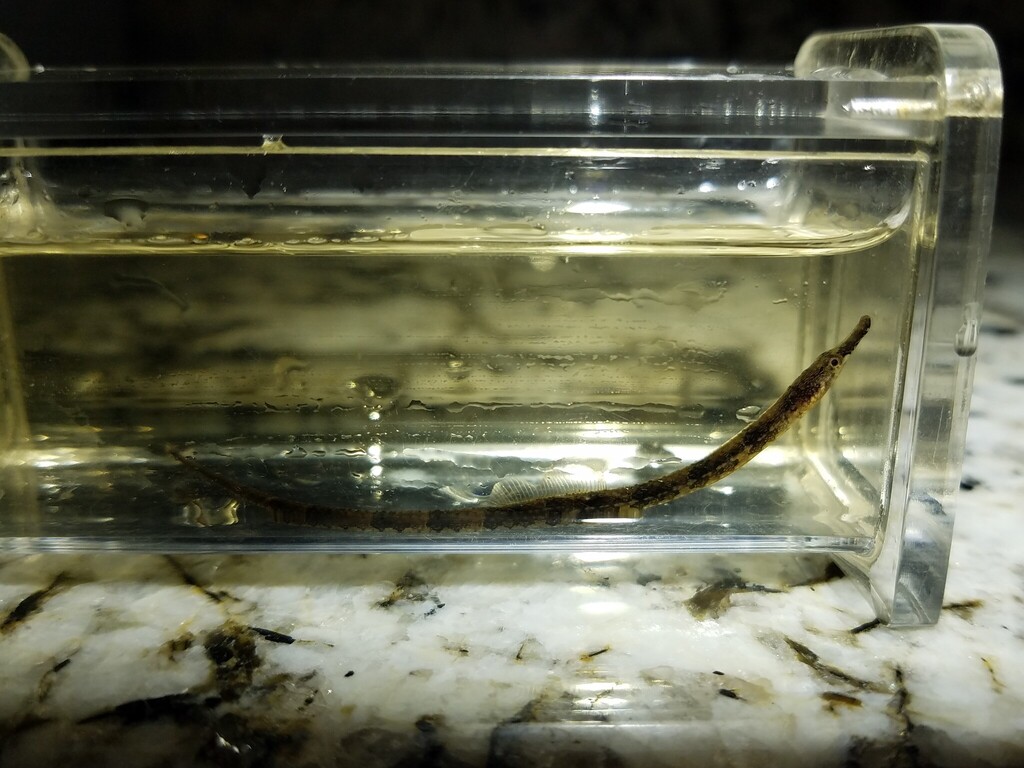
Gulf pipefish
Syngnathus scovelli
Aquarium hobby

Honshu pipefish
Doryrhamphus japonicus
Aquarium hobby