Home / Mammals / Cats, dogs and other carnivores / Striped skunk
No federal permit to keep In-depth sheetStriped skunk
Mephitis mephitis
Mammals › Cats, dogs and other carnivores (Carnivora) › Mephitidae (Skunks)
Striped skunks are nocturnal omnivores that eat mostly animal foods in the wild. Their musk spray reaches about 20 feet.
Care guide
Diet
- In the wild, 80–90% animal foods (insects, larvae, small animals, eggs) plus fruit and seeds.
Sources 69
Health
- A rabies vector species; can carry fleas, ticks and parasites.
Sources 69
Show the group care guide for skunks
Skunks
Applies to most species in this group. Habitat: Woodland and suburbs. Individual species can differ, so compare with the species numbers above and the linked sources.
Housing & setup
- Indoor living with escape-proofing, or secure enclosures with dens; descenting is a veterinary procedure regulated by some states.
Sources 69
Diet
- Balanced omnivore diet with vegetables and lean protein; avoid obesity.
Sources 69
Health watch
- Obesity and metabolic bone disease; rabies vector species.
Sources 69
Understanding the animal
In the wild
In the wild
Researched for this exact species, not its family. Good care copies these conditions.1
| Where it lives | Woodlands, grassy plains, ravines, farms and suburban areas across southern Canada, the United States and northern Mexico. Uses underground dens, hollow logs and brush or rock piles. |
| Ground it lives on | Soil, grass and leaf litter; digs or occupies existing burrows. |
| Climate | Temperate climates with cold winters in northern populations; underground winter dens buffer exposure. Measured temperature and relative-humidity ranges were not found. |
| Active | Primarily nocturnal or crepuscular; prolonged winter inactivity in cold regions, without true hibernation. |
| Social life | Usually solitary; females, sometimes with one male, may share winter dens. |
| Wild diet | Grasshoppers, crickets, beetles and larvae, bees, worms, crayfish, small vertebrates, eggs and seasonally available plant foods. |
| Behavior to plan for | Digs for prey and shelter. Tail raising and foot stamping warn of defensive musk spraying, which can irritate eyes. |
What this means for care
- Provide diggable ground and a secluded den.
- Allow undisturbed daytime sleep and evening foraging.
- Respect warning displays and avoid startling or cornering animals.
Native climate (measured)
Native climate (measured)
| Warm-season highs | about 86°F (up to 95°F in the hottest sampled areas) |
| Cool-season lows | about 34°F (down to 14°F in the coldest sampled areas) |
| Average temperature | 47–66°F across sampled records |
| Relative humidity | 60–71% on average (driest month about 59%) |
| Rainfall | about 836 mm a year, spread fairly evenly |
| Winters | Cool to cold winters (lows around 34°F) in much of its native range. Seasonal slowdown may be relevant, but species-specific biology determines whether brumation or hibernation occurs. |
Measured at 110 wild occurrence records sampled against WorldClim 2.1 climate data (1970–2000 averages). Air conditions in the range are ecological context, not enclosure settings: microhabitats such as burrows, leaf litter or basking rocks can be cooler, warmer or more humid.
Profile
Profile
Researched for this exact species. Sources are listed under In the wild above.
History
striped skunks is native Nearctic mammals that now occur not only in natural habitats but also prominently in cultivated, suburban, and urban landscapes.
Keeper tips
- Provide opportunities and substrate suitable for digging.
- Include terrestrial environmental complexity rather than treating the species as specialized for a single narrow habitat type.
- Account for their stout, plantigrade build and five-toed feet when designing ground surfaces.
Behaviors reported
- Digging with long foreclaws.
Unique adaptations
- Long foreclaws suited for digging.
- Stout legs with five-toed plantigrade feet.
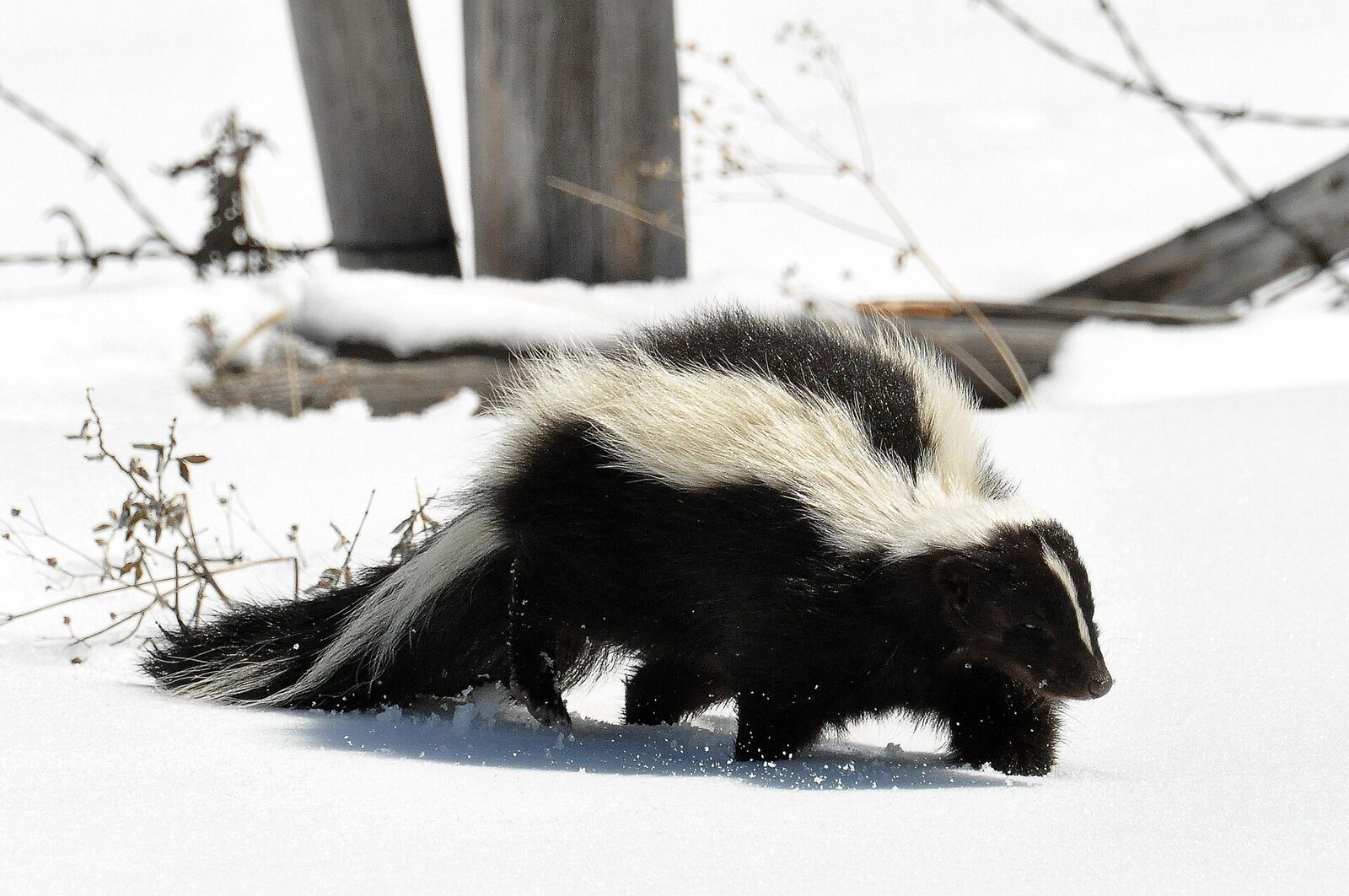
- Conspicuous black-and-white coloration with a variable dorsal stripe pattern.
Remarkable facts
- Striped skunks range from the Atlantic to the Pacific across most of the continental United States, southern Canada, and part of northern Mexico.
- They have become prominent in highly cultivated areas and suburban neighborhoods.
- They have been documented as high as 4,200 m elevation.
- Their feet are plantigrade and have five toes.
- Males are slightly larger than females.
From the sources
From the sources
Quoted from the matching sections of reputable sources for this exact species. Specialist databases are used first; Wikipedia (community-edited, CC BY-SA 4.0) only fills gaps. Other sources are short credited quotes.
| Overview | The striped skunk (Mephitis mephitis) is a skunk of the genus Mephitis that occurs across much of North America, including southern Canada, the United States, and northern Mexico. It is currently listed as least concern by the IUCN on account of its wide range and ability to adapt to human-modified environments. Striped skunks are polygamous omnivores with few natural predators, save for birds of prey. Striped skunks are mostly nocturnal. — Wikipedia (community-edited) |
| Where it lives | Mephitis mephitis is commonly found in a variety of habitats including woodlands, forests, wooded ravines and grassy plains. — Animal Diversity Web |
| Wild diet | While primarily an insectivore, the striped skunk is adaptable enough to incorporate other animals and even vegetable matter into its diet. The most frequently consumed insects include grasshoppers, beetles, crickets, caterpillars, other insect larvae and bees. Other invertebrates may include worms, crayfish and other non-insect arthropods. — Wikipedia (community-edited) |
| Behavior | Mephitis mephitis is a docile creature and often ignores other animals, except during the breeding season. — Animal Diversity Web |
| Reproduction | Under normal circumstances, female striped skunks only reproduce once a year, although males will reproduce with multiple females. — Animal Diversity Web |
| Lifespan | Mephitis mephitis has a high mortality rate and usually does not survive its first year due to severe weather conditions and infectious disease. — Animal Diversity Web |
| Appearance and size | Striped skunks are easily distinguishable by their coloration pattern. — Animal Diversity Web |
| History and naming | The striped skunk was first formally named by Johann Christian Daniel von Schreber as Viverra mephitis. The type locality is in eastern Canada. — Wikipedia (community-edited) |
Data and studies
The numbers
The numbers
Each bar is what one source reports. Where several sources weigh in, the dashed gold band marks their average.
Lifespan in care
Maximum recorded lifespan
Longest recorded lifespan reported by each database; typical lifespans are usually shorter. The AnAge record comes from an animal in human care.
Typical adult weight
Average adult body mass in each database (FishBase gives the maximum recorded weight).
Veterinary & husbandry research
Veterinary & husbandry research
- Trypanosoma cruzi Transmission Among Captive Nonhuman Primates, Wildlife, and Vectors Hodo CL et al., EcoHealth 2018
- Challenges to controlling rabies in skunk populations using oral rabies vaccination: A review Wohlers A et al., Zoonoses and public health 2018
- Survey of cardiac pathologies in captive striped skunks (Mephitis mephitis) Benato L et al., Journal of zoo and wildlife medicine: official publication of the American Association of Zoo Veterinarians 2014
- Physiological adaptations to prolonged fasting in the overwintering striped skunk (Mephitis mephitis) Mustonen AM et al., Comparative biochemistry and physiology. Part A, Molecular & integrative physiology 2013
Peer-reviewed papers that mention this species alongside captivity, zoos, veterinary care or aquaculture. Some cover several species or mention it only in passing, so check the abstract. See all 39 on PubMed → 170
Sources for this sheet
- Animal Diversity Web (University of Michigan): Mephitis mephitis Zoo, university or veterinaryUniversity-hosted species account, mostly wild biology.
- AnAge: The Animal Ageing and Longevity Database (Human Ageing Genomic Resources) Peer-reviewed researchCurated, referenced longevity and life-history records for thousands of species; maximum lifespans are often from zoo animals.
- Myhrvold et al. (2015). An amniote life-history database. Ecology 96: 3109 Peer-reviewed researchPeer-reviewed compilation of life-history data for over 21,000 birds, mammals and reptiles.
- 9 CFR 2.1: Animal Welfare Act licensing (USDA) Zoo, university or veterinaryWho needs a USDA license to breed, sell or exhibit animals.
- GBIF Backbone Taxonomy (Global Biodiversity Information Facility) Peer-reviewed researchInternational scientific taxonomy used here for classification.
- Wikipedia (species article) Community referenceFree encyclopedia; useful overviews with their own citations. Intro text is quoted under CC BY-SA 4.0.
- PubMed (U.S. National Library of Medicine) Peer-reviewed researchIndex of peer-reviewed veterinary, zoo and husbandry research.
- iNaturalist (captive observations) Community referenceCommunity observation platform run by the California Academy of Sciences and National Geographic; observations marked captive show animals living in homes, zoos and aquariums.