
Home / Mammals / Cats, dogs and other carnivores / Striped skunk
No federal permit to keepStriped skunk
Mephitis mephitis
Mammals › Cats, dogs and other carnivores (Carnivora) › Mephitidae (Skunks)
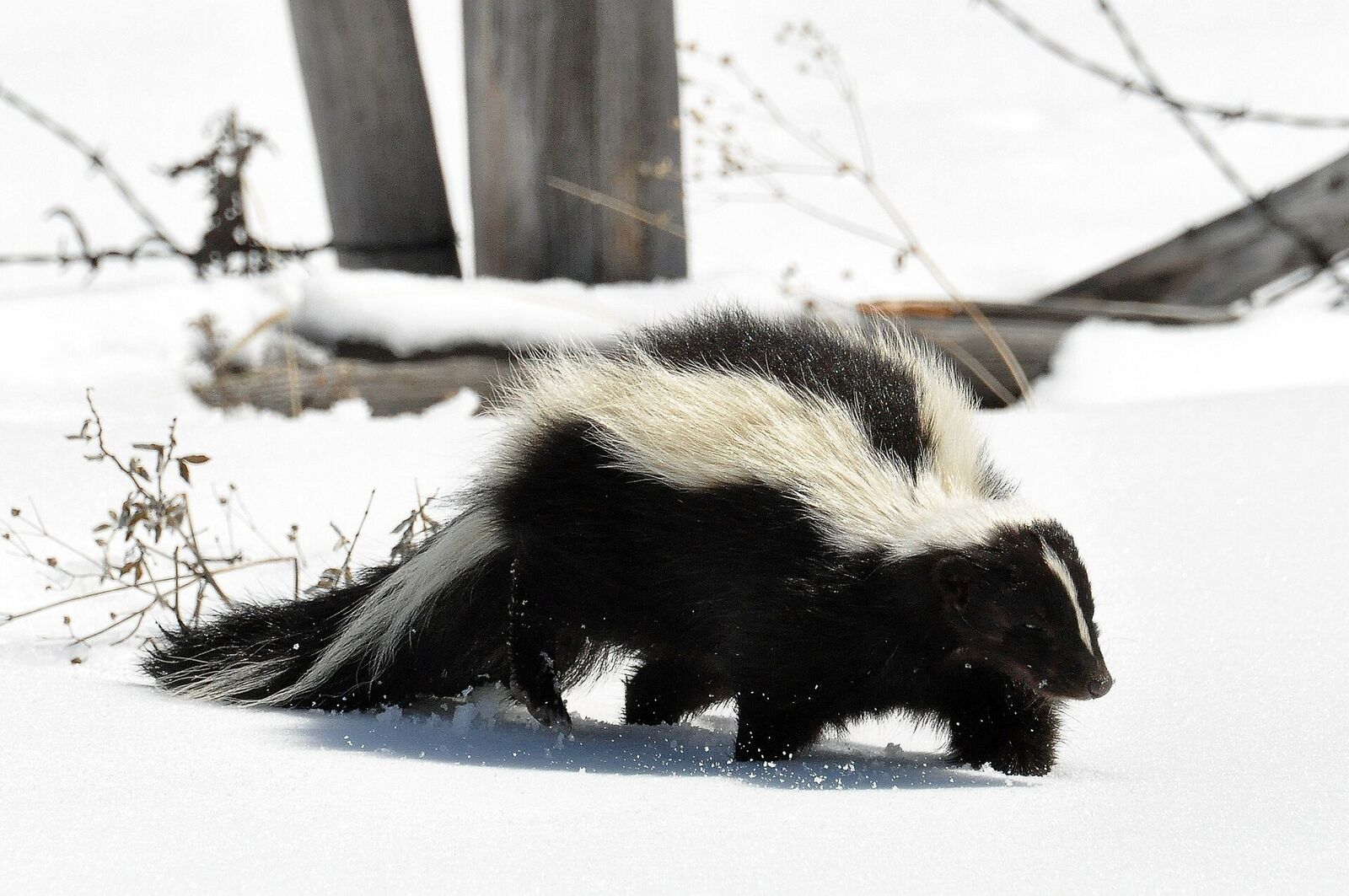
Striped skunks are nocturnal omnivores that eat mostly animal foods in the wild. Their musk spray reaches about 20 feet.
Care guide
Diet
- In the wild, 80–90% animal foods (insects, larvae, small animals, eggs) plus fruit and seeds.
Sources animaldiversity.org
Health
- A rabies vector species; can carry fleas, ticks and parasites.
Sources animaldiversity.org
Understanding the animal
In the wild
In the wild
Researched for this exact species, not its family. Wild conditions are context, not enclosure settings.1
| Where it lives | Woodlands, grassy plains, ravines, farms and suburban areas across southern Canada, the United States and northern Mexico. Uses underground dens, hollow logs and brush or rock piles. |
| Ground it lives on | Soil, grass and leaf litter; digs or occupies existing burrows. |
| Climate | Temperate climates with cold winters in northern populations; underground winter dens buffer exposure. Measured temperature and relative-humidity ranges were not found. |
| Active | Primarily nocturnal or crepuscular; prolonged winter inactivity in cold regions, without true hibernation. |
| Social life | Usually solitary; females, sometimes with one male, may share winter dens. |
| Wild diet | Grasshoppers, crickets, beetles and larvae, bees, worms, crayfish, small vertebrates, eggs and seasonally available plant foods. |
| Behavior to plan for | Digs for prey and shelter. Tail raising and foot stamping warn of defensive musk spraying, which can irritate eyes. |
Native climate (measured)
Native climate (measured)
| Warm-season highs | about 86°F (up to 95°F in the hottest sampled areas) |
| Cool-season lows | about 34°F (down to 14°F in the coldest sampled areas) |
| Average temperature | 47–66°F across sampled records |
| Relative humidity | 60–71% on average (driest month about 59%) |
| Rainfall | about 836 mm a year, spread fairly evenly |
| Winters | Cool to cold winters (lows around 34°F) in much of its native range. Seasonal slowdown may be relevant, but species-specific biology determines whether brumation or hibernation occurs. |
Measured at 110 wild occurrence records sampled against WorldClim 2.1 climate data (1970–2000 averages). Air conditions in the range are ecological context, not enclosure settings: microhabitats such as burrows, leaf litter or basking rocks can be cooler, warmer or more humid.
Profile
Profile
Researched for this exact species. Sources are listed under In the wild above.
History
striped skunks is native Nearctic mammals that now occur not only in natural habitats but also prominently in cultivated, suburban, and urban landscapes.
Data and studies
The numbers
The numbers
Each bar is what one source reports. Where several sources weigh in, the dashed gold band marks their average.
Lifespan in care
Maximum recorded lifespan
Longest recorded lifespan reported by each database; typical lifespans are usually shorter. The AnAge record comes from an animal in human care.
Typical adult weight
Average adult body mass in each database (FishBase gives the maximum recorded weight).
Litter size
Average per litter or clutch.
Gestation
Female maturity
Veterinary & husbandry research
Veterinary & husbandry research
- Survey of cardiac pathologies in captive striped skunks (Mephitis mephitis) Benato L et al., Journal of zoo and wildlife medicine: official publication of the American Association of Zoo Veterinarians 2014
- Physiological adaptations to prolonged fasting in the overwintering striped skunk (Mephitis mephitis) Mustonen AM et al., Comparative biochemistry and physiology. Part A, Molecular & integrative physiology 2013
Peer-reviewed papers that mention this species alongside captivity, zoos, veterinary care or aquaculture. Some cover several species or mention it only in passing, so check the abstract. See all 39 on PubMed → PubMed
Sources for this sheet
- Animal Diversity Web (University of Michigan): Mephitis mephitis (CC BY-NC-SA 3.0) Zoo, university or veterinaryUniversity-hosted species account, mostly wild biology.
- AnAge: The Animal Ageing and Longevity Database (Human Ageing Genomic Resources) (CC BY 3.0) Peer-reviewed researchCurated, referenced longevity and life-history records for thousands of species; maximum lifespans are often from zoo animals.
- Myhrvold et al. (2015). An amniote life-history database. Ecology 96: 3109 Peer-reviewed researchPeer-reviewed compilation of life-history data for over 21,000 birds, mammals and reptiles.
- 9 CFR 2.1: Animal Welfare Act licensing (USDA) Zoo, university or veterinaryWho needs a USDA license to breed, sell or exhibit animals.
- GBIF Backbone Taxonomy (Global Biodiversity Information Facility) (CC BY 4.0) Peer-reviewed researchInternational scientific taxonomy used here for classification. GBIF Secretariat (2023). GBIF Backbone Taxonomy. Checklist dataset https://doi.org/10.15468/39omei, accessed via GBIF.org.
- Wikipedia (species article) (CC BY-SA 4.0) Community referenceFree encyclopedia; useful overviews with their own citations. Short excerpts are quoted under CC BY-SA 4.0, each credited with a link to its article.
- PubMed (U.S. National Library of Medicine) Peer-reviewed researchIndex of peer-reviewed veterinary, zoo and husbandry research.
- iNaturalist (captive observations) Community referenceCommunity observation platform run by the California Academy of Sciences and National Geographic; observations marked captive show animals living in homes, zoos and aquariums.