
Home / Fishes / Perches, groupers, scorpionfish / Small red scorpionfish
No federal permit to keepSmall red scorpionfish
Scorpaena notata
Fishes › Perches, groupers, scorpionfish (Perciformes) › Scorpaenidae (Scorpionfish and lionfish)
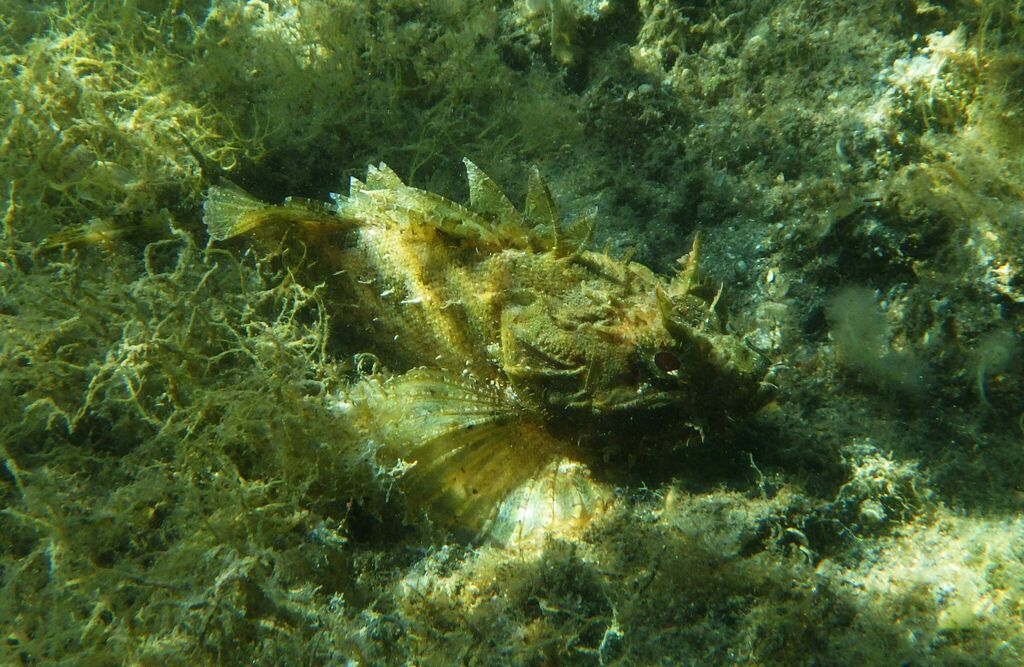
Small red scorpionfish (Scorpaena notata) is a venomous scorpionfish, common in marine subtropical waters.

Care at a glance
Species-specific values
Values researched for this exact species. Air, surface and water temperatures are listed separately, and each source is kept as published rather than averaged.
| Diet | Mostly marine fish and crustacean flesh, clams, and other marine meaty foods; small freshwater live fish only as an occasional treat. Source: saltcorner.com | |
| Feeding frequency | Three or four feedings per week should suffice. Source: saltcorner.com | |
| Social housing | Best kept alone, one per aquarium. Source: saltcorner.com | |
| Water temperature | 59–79 °F Source: saltcorner.com |
Species-specific aquarium care
- Tank: At least 24 in long and 12 in front to back for one adult (adults commonly reach about 4.7 in / 12 cm; the largest recorded was 10.2 in).
- Water: Marine.
- Temperature: 59–79°F (range recorded for this species).
- Layout: Lives on or near the bottom: floor space and hiding places matter more than height.
- Diet: A predator: feed meaty foods sized to its mouth (frozen fish, shrimp, worms); it will eat tankmates that fit in its mouth. FishBase classes it as a carnivore.
- Safety: Venomous spines or sting: handle with care and keep a first-aid plan; never handle with bare hands.
Calculated from this species' own FishBase record: tank size from its typical adult length and swimming zone, water values from its recorded ranges. The group guide below fills in general care.
Understanding the animal
About this animal
About this animal
It is widespread in the Eastern Atlantic from the Bay of Biscay to Senegal, Madeira, Azores and the Canary Islands, including the Mediterranean (rare in northern Adriatic) and the Black Sea.
From Wikipedia: Small red scorpionfish, CC BY-SA 4.0 (excerpt)
In the wild
In the wild
From this species’ own FishBase record (habitat, bottom type, water and breeding data), not its family. Wild conditions are context, not enclosure settings.1
| Where it lives | Lives in the sea, in open ocean. Stays near the bottom. |
| Ground it lives on | Over aquatic plants. |
| Climate | Subtropical climate. |
| Wild diet | Hunting macrofauna (predator). |
Data and studies
The numbers
The numbers
Each bar is what one source reports. Where several sources weigh in, the dashed gold band marks their average.
Maximum recorded lifespan
Longest recorded lifespan reported by each database; typical lifespans are usually shorter.
Adult length
Common length to maximum recorded length. Measured as total length. Fish in home aquariums often stay smaller than wild records.
Sources for this sheet
- FishBase (Froese & Pauly, eds.), version 24.07 (CC BY-NC 4.0) Peer-reviewed researchThe global scientific database on fishes, maintained by a consortium of research institutions; every value is referenced.
- Wikipedia (species article) (CC BY-SA 4.0) Community referenceFree encyclopedia; useful overviews with their own citations. Short excerpts are quoted under CC BY-SA 4.0, each credited with a link to its article.
- iNaturalist (captive observations) Community referenceCommunity observation platform run by the California Academy of Sciences and National Geographic; observations marked captive show animals living in homes, zoos and aquariums.
More scorpionfish and lionfish
Black scorpionfish
Scorpaena porcus
Aquarium hobby

Blackfoot firefish
Parapterois heterura
Aquarium hobby

False stonefish
Scorpaenopsis diabolus
Aquarium hobby

Hawaiian turkeyfish
Pterois sphex
Aquarium hobby

Neochirus barberi
Dendrochirus barberi
Aquarium hobby

Neochirus brachypterus
Dendrochirus brachypterus
Aquarium hobby