
Home / Invertebrates / Apple and mystery snails / Spike-topped apple snail (mystery snail)
No federal permit to keepSpike-topped apple snail (mystery snail)
Pomacea diffusa
Invertebrates › Apple and mystery snails (Architaenioglossa) › Ampullariidae (Apple and mystery snails)
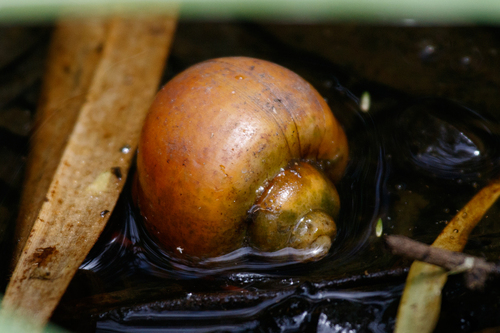
Pomacea diffusa, common name the spike-topped apple snail or Mystery Snail, is a species of freshwater snail, an aquatic gastropod mollusk in the family Ampullariidae, the apple snails.
From Wikipedia: Pomacea diffusa, CC BY-SA 4.0 (excerpt)
Care at a glance
Species-specific values
Values researched for this exact species. Air, surface and water temperatures are listed separately, and each source is kept as published rather than averaged.
| Water temperature | 70–78 degF Current keeper recommendation for mystery snails. | aquariumcoop.com |
| Water pH minimum | 7.2 pH Keeper lower bound; mineral content matters separately. | aquariumcoop.com |
| Water gh minimum | 150 ppm as CaCO3; above this value Source also rounds to 8 dGH; exact conversion is approximately 8.4 dGH. | aquariumcoop.com |
| Adult shell diameter | 5 cm approximately Shell diameter, not extended animal length. | aquariumcoop.com |
| Lifespan | 1–2 years Keeper average range dependent on temperature, not maximum longevity. | aquariumcoop.com |
Understanding the animal
In the wild
In the wild
| Overview | Pomacea diffusa, common name the spike-topped apple snail or Mystery Snail, is a species of freshwater snail, an aquatic gastropod mollusk in the family Ampullariidae, the apple snails. — From Wikipedia: Pomacea diffusa, CC BY-SA 4.0 (excerpt) |
| Where it lives | The type locality of Pomacea diffusa is in the city of Santa Cruz de la Sierra, Bolivia, although the species is widespread throughout the Amazon Basin. Non-indigenous distribution of Pomacea diffusa include: * Thompson recorded this species (as Pomacea bridgesii) in Florida in Monroe, Miami-Dade, Broward, Palm Beach, and Pinellas Counties. — From Wikipedia: Pomacea diffusa, CC BY-SA 4.0 (excerpt) |
| Appearance and size | Pomacea diffusa is known as the spike-topped apple snail, because of its relatively raised spire. It lacks a channeled suture, and overlaps in size with the Pomacea paludosa. The egg masses have an irregular honeycombed appearance, like those of Pomacea haustrum, but are smaller and have a tan to salmon color, although they are white when freshly laid. — From Wikipedia: Pomacea diffusa, CC BY-SA 4.0 (excerpt) |
| History and naming | Pomacea diffusa was originally described as a subspecies of Pomacea bridgesii. Pain (1960) argued that Pomacea bridgesii was a larger form with a restricted range, with the smaller Pomacea bridgesii diffusa being the common form throughout the Amazon Basin (Brazil, Peru, Bolivia). — From Wikipedia: Pomacea diffusa, CC BY-SA 4.0 (excerpt) |
Profile
Profile
Researched for this exact species. Sources are listed under In the wild above.
History
Pomacea diffusa was originally described as a subspecies of Pomacea bridgesii. Pain (1960) argued that Pomacea bridgesii was a larger form with a restricted range, with the smaller Pomacea bridgesii diffusa being the common form throughout the Amazon Basin (Brazil, Peru, Bolivia).
From Wikipedia: Pomacea diffusa, CC BY-SA 4.0 (excerpt)
Sources for this sheet
- GBIF Backbone Taxonomy (Global Biodiversity Information Facility) (CC BY 4.0) Peer-reviewed researchInternational scientific taxonomy used here for classification. GBIF Secretariat (2023). GBIF Backbone Taxonomy. Checklist dataset https://doi.org/10.15468/39omei, accessed via GBIF.org.
- Wikipedia (species article) (CC BY-SA 4.0) Community referenceFree encyclopedia; useful overviews with their own citations. Short excerpts are quoted under CC BY-SA 4.0, each credited with a link to its article.
- iNaturalist (captive observations) Community referenceCommunity observation platform run by the California Academy of Sciences and National Geographic; observations marked captive show animals living in homes, zoos and aquariums.
