
Home / Fishes / Gouramis, bettas, snakeheads / Spiketail gourami
No federal permit to keepSpiketail gourami
Parosphromenus filamentosus
Fishes › Gouramis, bettas, snakeheads (Anabantiformes) › Osphronemidae (Gouramis and bettas)
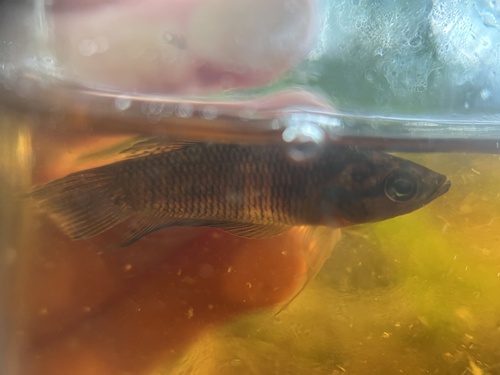
Parosphromenus filamentosus, also known as the spiketail gourami or the filament licorice gourami, is a species of gourami.
Care at a glance
Species-specific values
Values researched for this exact species. Air, surface and water temperatures are listed separately, and each source is kept as published rather than averaged.
| Minimum enclosure | At least 5 gallons (20 L). Source: tankbud.com | |
| Water temperature | 72–81 °F (22–27 °C) Source: tankbud.com | |
| Diet | Offer small live and frozen foods such as baby brine shrimp, microworm, and daphnia; it often ignores dry food. Source: tankbud.com | |
| Social housing | Maintain either one pair, multiple pairs in a big tank each with its own cave, or a species‑only tank. Source: tankbud.com | |
| Substrate | Employ dark substrate, thick leaf litter, botanical décor, and gentle peat‑based filtration. Source: tankbud.com |
Species-specific aquarium care
- Tank: At least 24 in long and 12 in front to back for one adult (adults commonly reach about 1.6 in / 4 cm).
- Water: Freshwater.
- Temperature: 70–82°F (range recorded for this species).
- pH: 6.5–7.2.
- Hardness: 0–15 dGH.
- Layout: Uses both the bottom and open water: give open swimming space plus cover near the substrate.
Calculated from this species' own FishBase record: tank size from its typical adult length and swimming zone, water values from its recorded ranges. The group guide below fills in general care.
Understanding the animal
About this animal
About this animal
It is native to Asia, where it is known only from freshwater habitats in southeastern Borneo. The species reaches 4.0 cm (1.6 in) in standard length and is known to be a facultative air-breather.
From Wikipedia: Parosphromenus filamentosus, CC BY-SA 4.0 (excerpt)
In the wild
In the wild
From this species’ own FishBase record (habitat, bottom type, water and breeding data), not its family. Wild conditions are context, not enclosure settings.1
| Where it lives | Lives in freshwater. Uses both the bottom and open water. |
| Climate | Tropical climate. |
| Behavior to plan for | Breeding: nesters. |
Data and studies
Researched care notes
Researched care notes
Findings checked against veterinary, zoo, welfare, keeper and peer-reviewed sources. Air, basking-surface and water temperatures are kept separate, and where sources disagree both are shown. “Study” notes report what a paper measured, not a universal rule.
Liquorice Gouramis (group)
Researched for this genus; applies to its species unless a species note says otherwise.
- The guideline describes soft, low-conductivity acidic water; pH preferences differ among species.1
- An unusual successful institutional water protocol is an exception, not evidence that all populations have broad tolerance. Confidence: LOW.1
- Suitable live microfoods are important; many species accept non-live foods unreliably.1
- Small pair breeding tanks and larger community displays are different contexts; food competition affects stocking.1
The numbers
The numbers
Each bar is what one source reports. Where several sources weigh in, the dashed gold band marks their average.
Adult length
Maximum recorded length. Measured as total length. Fish in home aquariums often stay smaller than wild records.
Sources for this sheet
- FishBase (Froese & Pauly, eds.), version 24.07 (CC BY-NC 4.0) Peer-reviewed researchThe global scientific database on fishes, maintained by a consortium of research institutions; every value is referenced.
- Wikipedia (species article) (CC BY-SA 4.0) Community referenceFree encyclopedia; useful overviews with their own citations. Short excerpts are quoted under CC BY-SA 4.0, each credited with a link to its article.
More gouramis and bettas

Alfred's Licorice Gourami
Parosphromenus alfredi
Aquarium hobby

Banded gourami
Trichogaster fasciata
Aquarium hobby

Barito Betta
Betta pallifina
Aquarium hobby
Betta hipposideros
Betta hipposideros
Aquarium hobby

Betta stigmosa
Betta stigmosa
Aquarium hobby

Black Dwarf Betta
Betta persephone
Aquarium hobby