Home / Fishes / Silversides and rainbowfish / Spotted blue-eye
No federal permit to keepSpotted blue-eye
Pseudomugil gertrudae
Fishes › Silversides and rainbowfish (Atheriniformes) › Pseudomugilidae (Blue-eye rainbowfish)
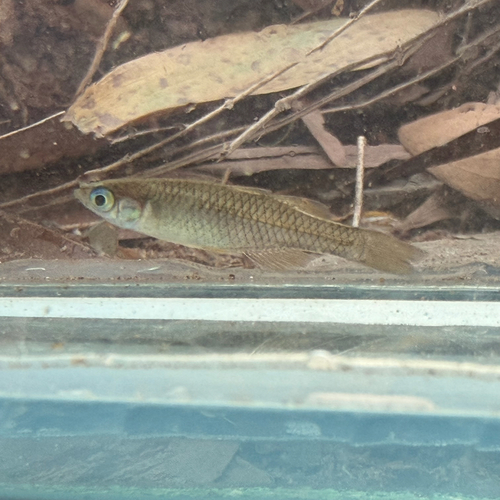
The spotted blue-eye (Pseudomugil gertrudae), also known as the delicate blue-eye, Gertrude's blue-eye, or northern blue-eye, is a species of freshwater ray-finned fish in the family Pseudomugilidae.

Care at a glance
Species-specific aquarium care
- Tank: At least 24 in long and 12 in front to back for one adult (adults commonly reach about 1.5 in / 3.8 cm).
- Water: Freshwater (tolerates brackish).
- Temperature: 77–86°F (range recorded for this species).
- pH: 6–6.
- Hardness: 5–12 dGH.
- Layout: Lives on or near the bottom: floor space and hiding places matter more than height.
Calculated from this species' own FishBase record: tank size from its typical adult length and swimming zone, water values from its recorded ranges. The group guide below fills in general care.
Care guide
Species care notes
- Tank: a base of at least 18 × 12 in (roughly 11 US gallons); space needed is rated “modest tank”.
- Water: a fairly wide range, from slightly acidic to slightly alkaline, 70–82 °F, pH 4.5–7.5, 5–12 dGH.
- Behaviour: temperament peaceful; a shoaling fish best kept in a group of six or more; suited to a community tank.
- Difficulty: Moderate (Seriously Fish rating).
Short excerpts from the species profile:
- Setup: “Best kept in a densely-planted tank and an excellent choice for the carefully-aquascaped set-up.”
- Diet: “Feeds chiefly on floating or suspended zooplankton, phytoplankton, and invertebrates in nature, and in the aquarium must be offered items of a suitable size.”
- Tankmates: “Peaceful but unsuitable for the general community aquarium since it's easily outcompeted and quite timid.”
- Breeding: “This species is an egg-scatterer exhibiting no parental care and will consume its own eggs and fry given the opportunity.”
From the Seriously Fish profile for this species, which has the full habitat, maintenance, diet, behaviour and breeding write-up 167
Blue-eye rainbowfish
Applies to most species in this group. Habitat: Blue-eyes occupy Australasian streams and vegetated freshwater margins, with some Pacific blue-eye populations also using brackish mangrove creeks. Individual species can differ, so compare with the species numbers above and the linked sources.
Housing & setup
- Spotted blue-eyes: tank base at least 18 × 12 inches; forktail blue-eyes: at least 24 × 12 inches.
- Plant densely, including floating vegetation and roots that shade the upper water.
- Provide a biologically mature aquarium with well-oxygenated water and some flow.
- For breeding provide fine aquatic moss or spawning mops; adults can eat eggs and fry.
Climate & lighting
| Water | 75.2–82.4°F |
Diet
- Live Daphnia or Moina sized to the fish
- Artemia nauplii
- Microworms
- Small or crushed floating dried foods
Social life
- Keep spotted blue-eyes in shoals of at least 8–10 with similarly small, peaceful companions; avoid competitors that monopolize food.
Health watch
- Ammonia toxicity in immature systems
- Hypoxia
- Inbred forktail stocks can produce deformed fry and reduced fertility
Understanding the animal
About this animal
About this animal
It is native to Indonesia, Papua New Guinea and northern Australia. It adapts readily to captivity and can be kept in a small freshwater aquarium.
Quoted from the Wikipedia article “Spotted blue-eye” (CC BY-SA 4.0) 174
In the wild
In the wild
From this species’ own FishBase record (habitat, bottom type, water and breeding data), not its family. Good care copies these conditions.1
| Where it lives | Lives in freshwater and brackish water. Stays near the bottom. Inhabits small creeks, swampy marshes, heavily shaded rainforest streams, lily lagoons and backwaters adjacent to major water courses. Usually found in Pandanus-lined creeks with muddy bottoms. Aggregations are encountered in areas with abundant vegetation and submerged log debris. |
| Water it lives in | Freshwater / brackish water, 77–86 °F (25–30 °C), pH 6–6, hardness 5–12 dH. |
| Climate | Tropical climate. |
| Behavior to plan for | Breeding: open water/substratum egg scatterers. |
What this means for care
- Keep water within its wild range, 77–86 °F.
- It tolerates or needs brackish water; check salinity needs before setup.
Native climate (measured)
Native climate (measured)
| Warm-season highs | about 92°F (up to 96°F in the hottest sampled areas) |
| Cool-season lows | about 65°F (down to 59°F in the coldest sampled areas) |
| Average temperature | 75–81°F across sampled records |
| Relative humidity | 70–77% on average (driest month about 67%) |
| Rainfall | about 1622 mm a year, with strong wet and dry seasons |
Measured at 58 wild occurrence records sampled against WorldClim 2.1 climate data (1970–2000 averages). Air conditions in the range are ecological context, not enclosure settings: microhabitats such as burrows, leaf litter or basking rocks can be cooler, warmer or more humid.
From the sources
From the sources
Quoted from the matching sections of reputable sources for this exact species. Specialist databases are used first; Wikipedia (community-edited, CC BY-SA 4.0) only fills gaps. Other sources are short credited quotes.
| Overview | The spotted blue-eye (Pseudomugil gertrudae), also known as the delicate blue-eye, Gertrude's blue-eye, or northern blue-eye, is a species of freshwater ray-finned fish in the family Pseudomugilidae. It is native to Indonesia, Papua New Guinea and northern Australia. It adapts readily to captivity and can be kept in a small freshwater aquarium. — Wikipedia (community-edited) |
| Where it lives | Home ranges Population dynamics Growth parameters Max. ages / sizes Length-weight rel. Length-frequencies Mass conversion Recruitment Abundance Life cycle Reproduction Maturity Maturity/Gills rel. — FishBase |
| Wild diet | Its diet has been little-studied, but algae and small invertebrates are believed to make up a large part of it. — Wikipedia (community-edited) |
| Reproduction | Little is known of the reproductive behavior of the spotted blue-eye in the wild, but it is believed to have a complex courtship behavior. In captivity, this species breeds readily. — Wikipedia (community-edited) |
| Appearance and size | The spotted blue-eye has an elongated body generally up to 2.5 cm in length; rarely, it may grow to 3 cm. The overall color is transparent to pale silver-white, sometimes with tints of tan or yellow. The rear half of the body is marked by three horizontal black lines (which break up into spots anteriorly), and the fins are yellow with black markings. — Wikipedia (community-edited) |
| Biology | Inhabits small creeks, swampy marshes, heavily shaded rainforest streams, lily lagoons and backwaters adjacent to major water courses. Usually found in Pandanus-lined creeks with muddy bottoms. Aggregations are encountered in areas with abundant vegetation and submerged log debris. — FishBase |
| History and naming | Max Carl Wilhelm Weber described Pseudomugil gertrudae in 1911 from specimens collected from Trangan Island, the Aru Islands (in Indonesia). He named it in honor of Gertrude Merton, the wife of the German zoologist Hugo Merton. The couple visited the Aru Islands in 1907–08, and the type of this species was collected then. — Wikipedia (community-edited) |
Data and studies
The numbers
The numbers
Each bar is what one source reports. Where several sources weigh in, the dashed gold band marks their average.
Adult length
Maximum recorded length. Measured as standard length (snout to the base of the tail, not counting the tail fin). Fish in home aquariums often stay smaller than wild records.
Water temperature
Range the species tolerates in nature; aim for the middle.
Minimum tank footprint
Seriously Fish recommends a tank base of at least 18 × 12 in (about 11 US gallons).
Sources for this sheet
- FishBase (Froese & Pauly, eds.), version 24.07 Peer-reviewed researchThe global scientific database on fishes, maintained by a consortium of research institutions; every value is referenced.
- Seriously Fish species profiles Experienced keeper or breederLong-running aquarium reference written and peer-checked by experienced fishkeepers and ichthyologists; each profile covers habitat, tank size, water, diet, behaviour and breeding.
- Seriously Fish: Pseudomugil gertrudae Experienced keeper or breederAdded in the 2026 source-checked care-guide review.
- Seriously Fish: Pseudomugil furcatus Experienced keeper or breederAdded in the 2026 source-checked care-guide review.
- FishBase: Pseudomugil signifer Peer-reviewed researchAdded in the 2026 source-checked care-guide review.
- Merck Veterinary Manual: Common Environmental Hazards for Fish Zoo, university or veterinaryAdded in the 2026 source-checked care-guide review.
- Wikipedia (species article) Community referenceFree encyclopedia; useful overviews with their own citations. Intro text is quoted under CC BY-SA 4.0.
- iNaturalist (captive observations) Community referenceCommunity observation platform run by the California Academy of Sciences and National Geographic; observations marked captive show animals living in homes, zoos and aquariums.