
Home / Fishes / Killifish and livebearers / Spotted lampeye
No federal permit to keepSpotted lampeye
Lacustricola maculatus
Fishes › Killifish and livebearers (Cyprinodontiformes) › Procatopodidae (Lampeyes)
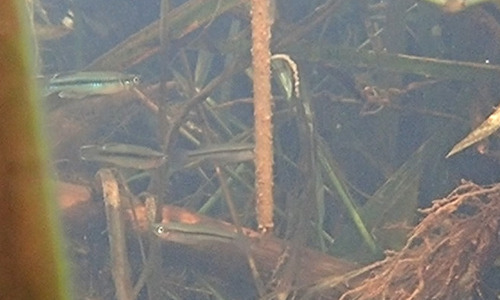
The spotted lampeye (Lacustricola maculatus) is a species of poeciliid fish.
Care at a glance
Species-specific values
Values researched for this exact species. Air, surface and water temperatures are listed separately, and each source is kept as published rather than averaged.
| Minimum enclosure | A well-filtered, planted tank in the 10–15 US gal range is appropriate for a small group. Source: aquaristatlas.com | |
| Diet | Accepts fine dried foods; live and frozen small invertebrates are offered regularly. Source: aquaristatlas.com | |
| Social housing | Peaceful schoolers do best with their own kind or similarly sized, non-aggressive companions. Source: aquaristatlas.com |
Species-specific aquarium care
- Tank: At least 24 in long and 12 in front to back for one adult (adults commonly reach about 1.2 in / 3 cm; the largest recorded was 1.4 in).
- Water: Freshwater.
- Temperature: 72–79°F (range recorded for this species).
- pH: 6.5–7.2.
- Layout: Uses both the bottom and open water: give open swimming space plus cover near the substrate.
Calculated from this species' own FishBase record: tank size from its typical adult length and swimming zone, water values from its recorded ranges. The group guide below fills in general care.
Understanding the animal
About this animal
About this animal
It is native to the drainages of the Ruvu, Rufiji, Mbezi, and Wami Rivers in Kenya and Tanzania. This species grows to a length of 3.5 centimetres (1.4 in) TL. Its natural habitats are small rivers, brooks and swamps.
From Wikipedia: Spotted lampeye, CC BY-SA 4.0 (excerpt)
In the wild
In the wild
From this species’ own FishBase record (habitat, bottom type, water and breeding data), not its family. Wild conditions are context, not enclosure settings.1
| Where it lives | Lives in freshwater. Uses both the bottom and open water. |
| Water it lives in | Freshwater, 72–79 °F (22–26 °C), pH 6.5–7.2. |
| Climate | Tropical climate. |
Data and studies
The numbers
The numbers
Each bar is what one source reports. Where several sources weigh in, the dashed gold band marks their average.
Adult length
Common length to maximum recorded length. Measured as total length. Fish in home aquariums often stay smaller than wild records.
Water temperature
Range the species tolerates in nature; aim for the middle.
pH
Sources for this sheet
- FishBase (Froese & Pauly, eds.), version 24.07 (CC BY-NC 4.0) Peer-reviewed researchThe global scientific database on fishes, maintained by a consortium of research institutions; every value is referenced.
- Wikipedia (species article) (CC BY-SA 4.0) Community referenceFree encyclopedia; useful overviews with their own citations. Short excerpts are quoted under CC BY-SA 4.0, each credited with a link to its article.
More lampeyes

Nile killifish
Micropanchax loati
Aquarium hobby

Norman's lampeye
Poropanchax normani
Aquarium hobby
Tanganyika lampeye
Lacustricola pumilus
Aquarium hobby
Bluegreen lampeye
Procatopus aberrans
Aquarium hobby
Bukoba lampeye
Lacustricola bukobanus
Aquarium hobby
Cameroon lampeye
Micropanchax camerunensis
Aquarium hobby