
Home / Fishes / Catfish / Bagridae / Striped dwarf catfish
No federal permit to keepStriped dwarf catfish
Mystus vittatus
Fishes › Catfish (Siluriformes) › Bagridae (Asian whiskered catfish)
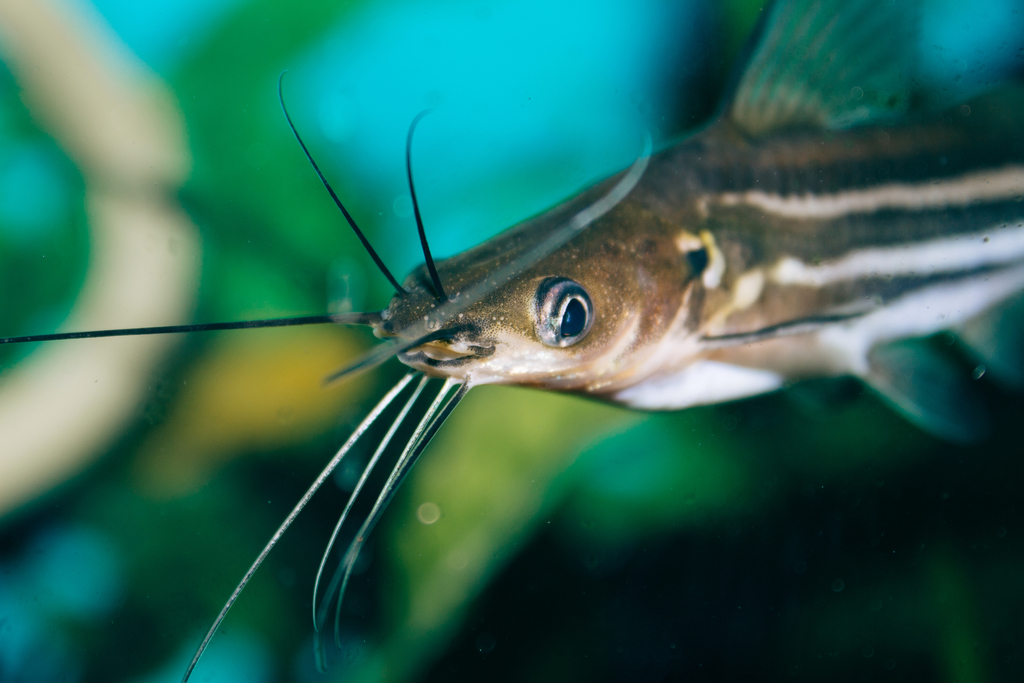
Mystus vittatus also known as the Striped dwarf catfish is a species of catfish of the family Bagridae.
Care at a glance
Species-specific values
Values researched for this exact species. Air, surface and water temperatures are listed separately, and each source is kept as published rather than averaged.
| Minimum enclosure | Requires a spacious aquarium. Source: fishkeeper.co.uk | |
| Social housing | Best housed in groups of 5 or more. Source: fishkeeper.co.uk | |
| Substrate | Use a soft sand substrate. Source: fishkeeper.co.uk | |
| Diet | Offer sinking catfish pellets or granules, frozen foods, and some vegetable matter. Source: fishkeeper.co.uk |
Species-specific aquarium care
- Tank: At least 36 in long and 18 in front to back for one adult (adults commonly reach about 8.3 in / 21 cm).
- Water: Freshwater (tolerates brackish).
- Temperature: 72–82°F (range recorded for this species).
- pH: 6–7.5.
- Hardness: 4–25 dGH.
- Layout: Lives on or near the bottom: floor space and hiding places matter more than height.
- Diet: Eats a varied diet: mix quality prepared foods with frozen and live foods. FishBase classes it as a carnivore.
Calculated from this species' own FishBase record: tank size from its typical adult length and swimming zone, water values from its recorded ranges. The group guide below fills in general care.
Understanding the animal
About this animal
About this animal
It is found in brackish water systems with marginal vegetation in lakes and swamps with a mud substrate of Asian countries Pakistan, India, Sri Lanka, Nepal, Bangladesh and probably Myanmar. Populations of Southeast Asian countries is in debate, due to close morphological similarities among Mystus species in that region.
From Wikipedia: Mystus vittatus, CC BY-SA 4.0 (excerpt)
In the wild
In the wild
From this species’ own FishBase record (habitat, bottom type, water and breeding data), not its family. Wild conditions are context, not enclosure settings.1
| Where it lives | Lives in freshwater and brackish water, in rivers and streams, estuaries. Stays near the bottom. |
| Water it lives in | Freshwater / brackish water, 72–82 °F (22–28 °C), pH 6–7.5, hardness 4–25 dH. |
| Climate | Tropical climate. |
| Behavior to plan for | Breeding: open water/substratum egg scatterers. |
Data and studies
The numbers
The numbers
Each bar is what one source reports. Where several sources weigh in, the dashed gold band marks their average.
Adult length
Maximum recorded length. Measured as standard length (snout to the base of the tail, not counting the tail fin). Fish in home aquariums often stay smaller than wild records.
Water temperature
Range the species tolerates in nature; aim for the middle.
pH
Water hardness
Veterinary & husbandry research
Veterinary & husbandry research
- Prevalence and spatial distribution of the ectoparasites on the gills of Mystus vittatus from River Penna flowing through YSR District, Andhra Pradesh, India Modi AK et al., Journal of parasitic diseases: official organ of the Indian Society for Parasitology 2021
Peer-reviewed papers that mention this species alongside captivity, zoos, veterinary care or aquaculture. Some cover several species or mention it only in passing, so check the abstract. See all 2 on PubMed → PubMed
Sources for this sheet
- FishBase (Froese & Pauly, eds.), version 24.07 (CC BY-NC 4.0) Peer-reviewed researchThe global scientific database on fishes, maintained by a consortium of research institutions; every value is referenced.
- Wikipedia (species article) (CC BY-SA 4.0) Community referenceFree encyclopedia; useful overviews with their own citations. Short excerpts are quoted under CC BY-SA 4.0, each credited with a link to its article.
- PubMed (U.S. National Library of Medicine) Peer-reviewed researchIndex of peer-reviewed veterinary, zoo and husbandry research.