Home / Mammals / Kangaroos, wallabies, possums / Sugar glider
No federal permit to keep In-depth sheetSugar glider
Petaurus breviceps
Mammals › Kangaroos, wallabies, possums (Diprotodontia) › Petauridae (Sugar gliders and possums)
Sugar gliders are social, nocturnal marsupials that can glide up to 50 m. They need tall aviary-style cages, company and daily interaction.
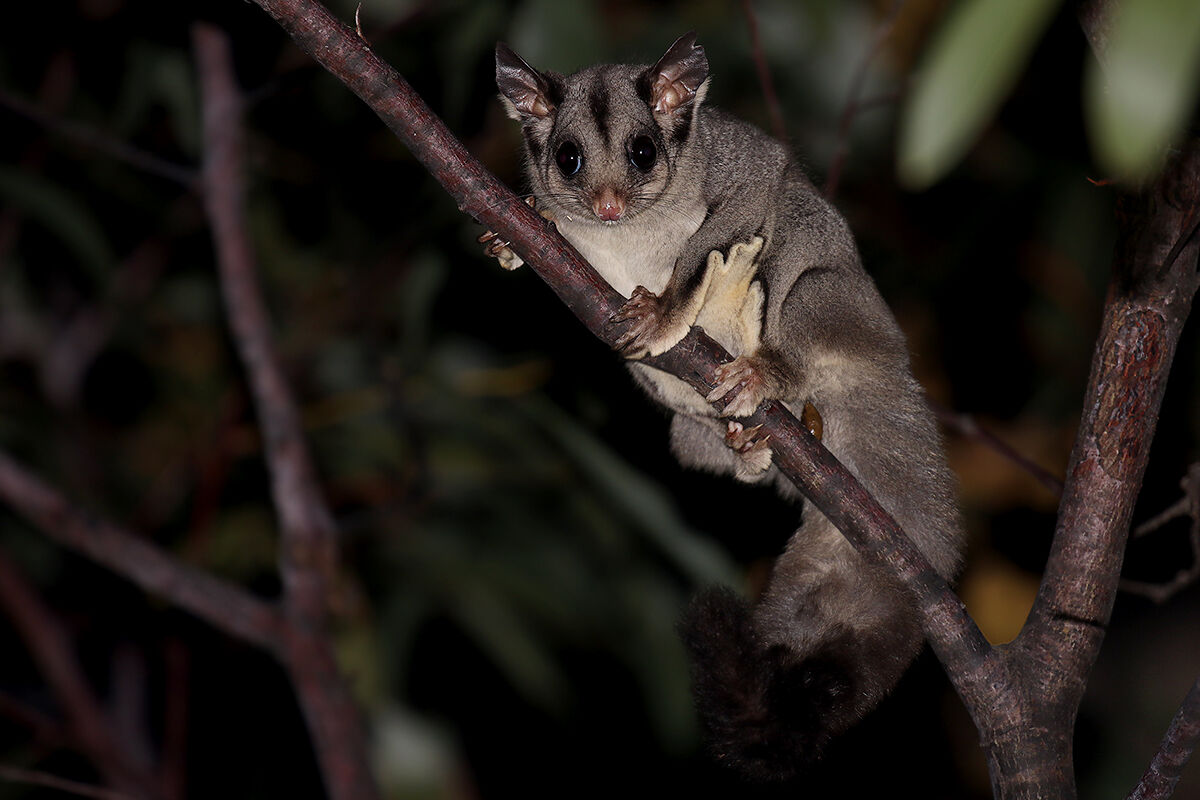
Care at a glance
Species-specific values
Values researched for this exact species. Where they differ from the group guide below, follow these. Air, surface and water temperatures are listed separately, and each source is kept as published rather than averaged.
| Enclosure minimum | length: 36 in; width: 24 in; height: 36 in Scale above minimum for group size | 134 |
| Bar spacing maximum | 0.5 in | 134 |
| Lifespan captive reported | 4–15 years | 134 |
| Air temperature | 80–88 °F Preferred room recommendation; retain tolerance separately | 295 |
| Air temperature tolerance | 60–90 °F Tolerance is not a target range | 295 |
| Social | Compatible pairs or groups; avoid unintended breeding. | 295 |
Care guide
Housing
- Tall wire aviary-type cage with small mesh, kept indoors. Go as big as you can: a large walk-in flight (around 2×2×2 m) is ideal, well beyond the common 36×24×36 in minimum.
Sources 56
Diet
- About 50–60% insects or an insectivore diet and 40–50% mixed vegetables, with only small amounts of fruit.
Sources 56
Social needs
- At least 2 hours a day of interactive contact is recommended.
Sources 56
Show the group care guide for sugar gliders
Sugar gliders
Applies to most species in this group. Habitat: Australian and New Guinean forests. Individual species can differ, so compare with the species numbers above and the linked sources.
Housing & setup
- For pet sugar gliders, MSD recommends at least 36×24×36 inches, narrow bar spacing, climbing branches and high sleeping refuges.
Diet
- Carefully balanced diets of nectar or gum sources, protein (insects, egg) and produce, with calcium.
Social life
- Must be kept in pairs or groups.
Health watch
- Metabolic bone disease and stress-related self-mutilation when kept alone.
Understanding the animal
In the wild
In the wild
Researched for this exact species, not its family. Good care copies these conditions.1234
| Where it lives | Forests and woodlands east of Australia’s Great Dividing Range under the current species definition, which excludes savanna and Krefft’s gliders. Sleeps in leaf-lined tree hollows. |
| Ground it lives on | arboreal; trunks, branches and tree hollows |
| Climate | The supplied sources state that sugar gliders occur as far south as southern Australia and are able to cope with cold conditions, but they provide no specific temperatures in F, humidity values or seasonal climate ranges. |
| Active | Nocturnal. |
| Social life | Nest-sharing clans of up to seven adults plus young; territorial toward outsiders. |
| Wild diet | Coastal woodland field observations document banksia and eucalypt nectar and pollen, and sap obtained by incising Eucalyptus gummifera. |
| Behavior to plan for | Glides between trees and uses its tail to steer. Nest mates share shelter, but unfamiliar gliders may provoke vigorous defense. |
What this means for care
- Provide tall climbing routes and enclosed sleeping nests.
- Maintain compatible companions with careful introductions.
- Use a balanced glider diet accounting for flower and exudate feeding; fruit alone does not represent the documented diet.
Native climate (measured)
Native climate (measured)
| Warm-season highs | about 80°F (up to 84°F in the hottest sampled areas) |
| Cool-season lows | about 43°F (down to 37°F in the coldest sampled areas) |
| Average temperature | 58–65°F across sampled records |
| Relative humidity | 69–72% on average (driest month about 65%) |
| Rainfall | about 1143 mm a year, spread fairly evenly |
Measured at 130 wild occurrence records sampled against WorldClim 2.1 climate data (1970–2000 averages). Air conditions in the range are ecological context, not enclosure settings: microhabitats such as burrows, leaf litter or basking rocks can be cooler, warmer or more humid.
Profile
Profile
Researched for this exact species. Sources are listed under In the wild above.
History
The genus Petaurus is believed to have originated in New Guinea roughly 18 to 24 million years ago, with ancestors dispersing into Australia millions of years later. The taxonomy of Petaurus breviceps remains complex and incompletely resolved, and populations once grouped under this name have been reassessed.
Keeper tips
- Provide substantial elevated structure because sugar gliders are arboreal.
- Allow room for movement that accommodates the gliding membrane extending between the forelimbs and hindlimbs.
- Provide elevated nesting opportunities consistent with their natural use of tree branches.
- Expect most natural activity during the night.
- Do not infer a complete captive diet from the mention of sap and nectar; the source also identifies the species as omnivorous.
Behaviors reported
- Glides through the air using patagia extending from the forelegs to the hindlegs.
- Uses gliding to reach food and evade predators.
- Builds nests in eucalyptus trees.
- Is nocturnal.
Unique adaptations
- Paired gliding membranes, or patagia, allow controlled movement through the canopy.
- Its pale grey to light brown fur is countershaded, with a lighter underside.
- Its gliding lifestyle closely resembles that of flying squirrels despite the groups not being closely related, an example of convergent evolution.
- Females possess a well-developed marsupial pouch.
Remarkable facts
- The scientific name Petaurus breviceps has been translated as 'short-headed rope-dancer,' referring to its canopy acrobatics.
- Average mass is given as about 110 g.
- Captive sugar gliders have been reported to live up to 14 years.
- Females reach sexual maturity late in their first year, while males mature early in their second year.
- Gestation is reported to last about 16 days, with typical litters of one or two young.
From the sources
From the sources
Quoted from the matching sections of reputable sources for this exact species. Specialist databases are used first; Wikipedia (community-edited, CC BY-SA 4.0) only fills gaps. Other sources are short credited quotes.
| Overview | The sugar glider (Petaurus breviceps) is a small, omnivorous, arboreal, and nocturnal gliding possum. The common name refers to its predilection for sugary foods such as sap and nectar and its ability to glide through the air, much like a flying squirrel. They have very similar habits and appearance to the flying squirrel, despite not being closely related—an example of convergent evolution. The scientific name, Petaurus breviceps, translates from Latin as "short-headed rope-dancer", a reference to their canopy acrobatics. — Wikipedia (community-edited) |
| Where it lives | Sugar gliders can live in forests of all types, given that there is an adequate food supply. — Animal Diversity Web |
| Wild diet | Sugar gliders are omnivorous. — Animal Diversity Web |
| Behavior | Sugar gliders are extremely active animals that can glide up to 45 meters. — Animal Diversity Web |
| Reproduction | Sugar gliders held in captivity have been found to live up to 14 years. — Animal Diversity Web |
| Appearance and size | The sugar glider is a relatively small marsupial; its head and body are approximately 120-320mm long and the tail has a length of 150-480mm. — Animal Diversity Web |
| History and naming | The genus Petaurus is believed to have originated in New Guinea during the mid Miocene epoch, approximately 18 to 24 million years ago. The modern Australian Petaurus, along with New Guinean members of what were formerly considered P. breviceps, diverged from their closest living New Guinean relatives ~9-12 mya. — Wikipedia (community-edited) |
Data and studies
Researched care notes
Researched care notes
Findings checked against veterinary, zoo, welfare, keeper and peer-reviewed sources. Air, basking-surface and water temperatures are kept separate, and where sources disagree both are shown. “Study” notes report what a paper measured, not a universal rule.
Sugar Glider (species)
- Sugar gliders are social; the reference supports compatible group housing rather than routine isolation.1
- Provide vertical climbing space, nest accommodation, and safe enclosure materials.1
- Feeding recommendations rest on limited comparative commercial-diet research. This dossier does not endorse a homemade branded recipe as a validated complete ration. Evidence gap; confidence LOW.1
Sugar Glider
- Merck recommends cage-bar gaps no greater than 1.25 cm to reduce head and foot entrapment.1
- Use exercise wheels with smooth interiors to reduce toe entrapment.1
- Inspect sleeping pouches for fraying and loose threads; replace damaged fabric before it causes injury or is ingested.1
- Provide several food and water locations throughout shared housing rather than one easily monopolized station.1
The numbers
The numbers
Each bar is what one source reports. Where several sources weigh in, the dashed gold band marks their average.
Room temperature
Maximum recorded lifespan
Longest recorded lifespan reported by each database; typical lifespans are usually shorter. The AnAge record comes from an animal in human care.
Typical adult weight
Average adult body mass in each database (FishBase gives the maximum recorded weight).
Veterinary & husbandry research
Veterinary & husbandry research
- Physiological and behavioral responses of an arboreal mammal to smoke and charcoal-ash substrate Nowack J et al., Physiology & behavior 2018
- Pulmonary hyalinosis in captive sugar gliders ( Petaurus breviceps) Sokol SA et al., Journal of veterinary diagnostic investigation: official publication of the American Association of Veterinary Laboratory Diagnosticians, Inc 2017
- Forelimb preferences in quadrupedal marsupials and their implications for laterality evolution in mammals Giljov A et al., BMC evolutionary biology 2013
- Feeding behavior and nutrition of the sugar glider (Petaurus breviceps) Dierenfeld ES et al., The veterinary clinics of North America. Exotic animal practice 2009
Peer-reviewed papers that mention this species alongside captivity, zoos, veterinary care or aquaculture. Some cover several species or mention it only in passing, so check the abstract. See all 16 on PubMed → 170
Sources for this sheet
- Royal Veterinary College Exotics Service: Sugar glider care Zoo, university or veterinaryVet-school exotics hospital factsheet, reviewed 2021–2024.
- AnAge: The Animal Ageing and Longevity Database (Human Ageing Genomic Resources) Peer-reviewed researchCurated, referenced longevity and life-history records for thousands of species; maximum lifespans are often from zoo animals.
- Myhrvold et al. (2015). An amniote life-history database. Ecology 96: 3109 Peer-reviewed researchPeer-reviewed compilation of life-history data for over 21,000 birds, mammals and reptiles.
- 9 CFR 2.1: Animal Welfare Act licensing (USDA) Zoo, university or veterinaryWho needs a USDA license to breed, sell or exhibit animals.
- Merck Veterinary Manual: Overview of sugar gliders Zoo, university or veterinaryThe Merck Veterinary Manual: a standard veterinary reference written and reviewed by veterinary specialists.
- Clint's Reptiles (YouTube): Sugar Glider, The Best Pet Mammal? Expert educator & keeperClint Laidlaw, PhD in Biology Education and MS in Evolutionary Ecology; owner of Clint's Reptile Room and a longtime keeper. His "Best Pet?" series reviews each species' care in depth.
- GBIF Backbone Taxonomy (Global Biodiversity Information Facility) Peer-reviewed researchInternational scientific taxonomy used here for classification.
- Wikipedia (species article) Community referenceFree encyclopedia; useful overviews with their own citations. Intro text is quoted under CC BY-SA 4.0.
- PubMed (U.S. National Library of Medicine) Peer-reviewed researchIndex of peer-reviewed veterinary, zoo and husbandry research.
- iNaturalist (captive observations) Community referenceCommunity observation platform run by the California Academy of Sciences and National Geographic; observations marked captive show animals living in homes, zoos and aquariums.