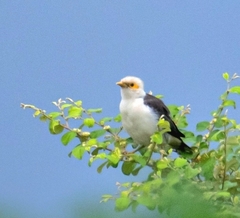
Home / Birds / Songbirds and perching birds / Superb starling
No federal permit to keepSuperb starling
Lamprotornis superbus
Birds › Songbirds and perching birds (Passeriformes) › Sturnidae (Starlings and mynas)
The superb starling (Lamprotornis superbus) is a member of the starling family of birds.
From Wikipedia: Superb starling, CC BY-SA 4.0 (excerpt)

Care at a glance
Species-specific values
Values researched for this exact species. Air, surface and water temperatures are listed separately, and each source is kept as published rather than averaged.
| Minimum enclosure | Initially housed the 18 cm birds in a temporary flight cage measuring 4 feet tall, 2 ½ feet deep, and 3 ½ feet wide. Source: nfss.org | |
| Diet | Diet included diced mango and papaya, mealworms, soaked monkey pellets, Bevo, and cockatiel fruit blend. Source: nfss.org | |
| Diet | For chick rearing, offered mashed hard-boiled egg mixed with soaked monkey pellets, with occasional Bevo Insectivorous mix and daily mealworms. Source: nfss.org | |
| Feeding frequency | For the second brood, offered 12–15 mealworms per day. Source: nfss.org | |
| Substrate | Fresh Ficus leaves were placed on the cage floor. Source: nfss.org | |
| Social housing | The author reports keeping two unrelated adult breeding pairs together with six juveniles. Source: nfss.org |
Understanding the animal
In the wild
In the wild
Researched for this exact species, not its family. Wild conditions are context, not enclosure settings.123
| Where it lives | Inhabits East African savannas, open woodland, scrub and farmland. Studied Kenyan groups occupy mosaics of trees, grass and bare soil. |
| Ground it lives on | Grass-covered and bare soil used for probing; trees for nesting and roosting. |
| Climate | At Mpala, Kenya, rainfall varies greatly, with March–May and October–November rainy seasons separated by dry periods; wild temperature and humidity ranges were not reported. |
| Active | Diurnal. |
| Social life | Large cooperative groups containing multiple breeding pairs and helpers; groups occupy territories. |
| Wild diet | Invertebrates, seeds and berries. |
| Behavior to plan for | Probes soil and opens its bill to expose prey. Nonbreeding helpers contribute to raising young within complex social groups. |
Native climate (measured)
Native climate (measured)
| Warm-season highs | about 82°F (up to 89°F in the hottest sampled areas) |
| Cool-season lows | about 53°F (down to 47°F in the coldest sampled areas) |
| Average temperature | 62–74°F across sampled records |
| Relative humidity | 68–72% on average (driest month about 62%) |
| Rainfall | about 752 mm a year |
Measured at 108 wild occurrence records sampled against WorldClim 2.1 climate data (1970–2000 averages). Air conditions in the range are ecological context, not enclosure settings: microhabitats such as burrows, leaf litter or basking rocks can be cooler, warmer or more humid.
Data and studies
The numbers
The numbers
Each bar is what one source reports. Where several sources weigh in, the dashed gold band marks their average.
Maximum recorded lifespan
Longest recorded lifespan reported by each database; typical lifespans are usually shorter. The AnAge record comes from an animal in human care.
Typical adult weight
Average adult body mass in each database (FishBase gives the maximum recorded weight).
Veterinary & husbandry research
Veterinary & husbandry research
- Description of two new Isospora species causing visceral coccidiosis in captive superb glossy starlings, Lamprotornis superbus (Aves: Sturnidae) Hafeez MA et al., Parasitology research 2014
Peer-reviewed papers that mention this species alongside captivity, zoos, veterinary care or aquaculture. Some cover several species or mention it only in passing, so check the abstract. See all 4 on PubMed → PubMed
Sources for this sheet
- AnAge: The Animal Ageing and Longevity Database (Human Ageing Genomic Resources) (CC BY 3.0) Peer-reviewed researchCurated, referenced longevity and life-history records for thousands of species; maximum lifespans are often from zoo animals.
- Myhrvold et al. (2015). An amniote life-history database. Ecology 96: 3109 Peer-reviewed researchPeer-reviewed compilation of life-history data for over 21,000 birds, mammals and reptiles.
- 9 CFR 2.1: Animal Welfare Act licensing (USDA) Zoo, university or veterinaryWho needs a USDA license to breed, sell or exhibit animals.
- GBIF Backbone Taxonomy (Global Biodiversity Information Facility) (CC BY 4.0) Peer-reviewed researchInternational scientific taxonomy used here for classification. GBIF Secretariat (2023). GBIF Backbone Taxonomy. Checklist dataset https://doi.org/10.15468/39omei, accessed via GBIF.org.
- Wikipedia (species article) (CC BY-SA 4.0) Community referenceFree encyclopedia; useful overviews with their own citations. Short excerpts are quoted under CC BY-SA 4.0, each credited with a link to its article.
- PubMed (U.S. National Library of Medicine) Peer-reviewed researchIndex of peer-reviewed veterinary, zoo and husbandry research.
- iNaturalist (captive observations) Community referenceCommunity observation platform run by the California Academy of Sciences and National Geographic; observations marked captive show animals living in homes, zoos and aquariums.