Home / Fishes / Perches, groupers, scorpionfish / Three-spined stickleback
Some federal rules applyThree-spined stickleback
Gasterosteus aculeatus
+ 22 more names
Doctor, Jacksharp, New York stickleback, Pinfish, Prickley, Prickly, Santa Ana stickleback, Saw-finned stickleback, Spanicle, Spannistickle, Spanny, Spannytickle, Spantickle, Sparnicle, Sparny, Sparnytickle, Spawn, Spawnykettle, Spawnytickle, Stickleback, Thornback, TiddlerFishes › Perches, groupers, scorpionfish (Perciformes) › Gasterosteidae (Sticklebacks)
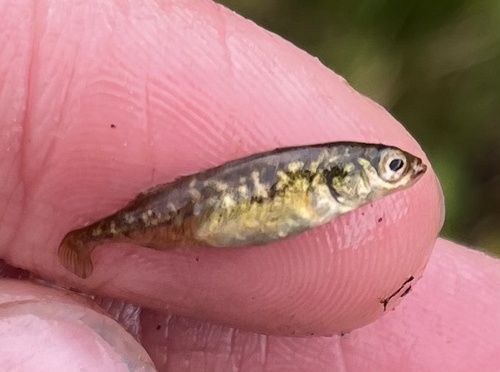
The three-spined stickleback (Gasterosteus aculeatus) is a fish native to most inland and coastal waters north of 30°N.

Care at a glance
Species-specific values
Values researched for this exact species. Air, surface and water temperatures are listed separately, and each source is kept as published rather than averaged.
| Minimum enclosure | 20 gallon (75 L)+ Source: fishyfriends.ca | |
| Water temperature | 50–68 °F Source: fishyfriends.ca | |
| Diet | As a micropredator, provide live/frozen items plus micro pellets or quality flakes. Source: fishyfriends.ca | |
| Feeding frequency | Feed frozen or live foods several times weekly. Source: fishyfriends.ca | |
| Social housing | Keep in groups; species tank preferred when schooling applies. Source: fishyfriends.ca |
Species-specific aquarium care
- Tank: At least 24 in long and 12 in front to back for one adult (adults commonly reach about 2.0 in / 5.1 cm; the largest recorded was 4.3 in).
- Water: Freshwater (tolerates brackish).
- Temperature: 39–68°F (range recorded for this species).
- Layout: Uses both the bottom and open water: give open swimming space plus cover near the substrate.
- Diet: A predator: feed meaty foods sized to its mouth (frozen fish, shrimp, worms); it will eat tankmates that fit in its mouth. FishBase classes it as a carnivore.
- Availability: Mostly kept by public aquariums; private keeping is uncommon.
Calculated from this species' own FishBase record: tank size from its typical adult length and swimming zone, water values from its recorded ranges. The group guide below fills in general care.
Understanding the animal
About this animal
About this animal
It has long been a subject of scientific study for many reasons. It shows great morphological variation throughout its range, ideal for questions about evolution and population genetics. Many populations are anadromous (they live in seawater but breed in fresh or brackish water) and very tolerant of changes in salinity, a subject of interest to physiologists.
From Wikipedia: Three-spined stickleback, CC BY-SA 4.0 (excerpt)
In the wild
In the wild
From this species’ own FishBase record (habitat, bottom type, water and breeding data), not its family. Wild conditions are context, not enclosure settings.1
| Where it lives | Lives in freshwater and brackish water and the sea, in rivers and streams, lakes, estuaries, open ocean. Uses both the bottom and open water. |
| Ground it lives on | Over sand, mud, vegetation. |
| Climate | Subtropical climate. |
| Wild diet | Hunting macrofauna (predator). |
| Behavior to plan for | Breeding: nesters, paternal parental care. |
Data and studies
The numbers
The numbers
Each bar is what one source reports. Where several sources weigh in, the dashed gold band marks their average.
Maximum recorded lifespan
Longest recorded lifespan reported by each database; typical lifespans are usually shorter.
Adult length
Common length to maximum recorded length. Measured as total length. Fish in home aquariums often stay smaller than wild records.
Veterinary & husbandry research
Veterinary & husbandry research
- Routine handling methods affect behaviour of three-spined sticklebacks in a novel test of anxiety Thompson RR et al., Behavioural brain research 2016
- Sex-differences and temporal consistency in stickleback fish boldness King AJ et al., PloS one 2013
- Butyl benzyl phthalate affects shoaling behavior and bottom-dwelling behavior in threespine stickleback Wibe AE et al., Environmental research 2002
Peer-reviewed papers that mention this species alongside captivity, zoos, veterinary care or aquaculture. Some cover several species or mention it only in passing, so check the abstract. See all 34 on PubMed → PubMed
Sources for this sheet
- AnAge: The Animal Ageing and Longevity Database (Human Ageing Genomic Resources) (CC BY 3.0) Peer-reviewed researchCurated, referenced longevity and life-history records for thousands of species; maximum lifespans are often from zoo animals.
- FishBase (Froese & Pauly, eds.), version 24.07 (CC BY-NC 4.0) Peer-reviewed researchThe global scientific database on fishes, maintained by a consortium of research institutions; every value is referenced.
- 50 CFR 17.11: Endangered and threatened wildlife Zoo, university or veterinaryCurrent federal Endangered Species Act list.
- Wikipedia (species article) (CC BY-SA 4.0) Community referenceFree encyclopedia; useful overviews with their own citations. Short excerpts are quoted under CC BY-SA 4.0, each credited with a link to its article.
- PubMed (U.S. National Library of Medicine) Peer-reviewed researchIndex of peer-reviewed veterinary, zoo and husbandry research.
- iNaturalist (captive observations) Community referenceCommunity observation platform run by the California Academy of Sciences and National Geographic; observations marked captive show animals living in homes, zoos and aquariums.