
Home / Fishes / Catfish / Tigerstriped catfish
No federal permit to keepTigerstriped catfish
Brachyplatystoma tigrinum
Fishes › Catfish (Siluriformes) › Pimelodidae (Long-whiskered catfish)
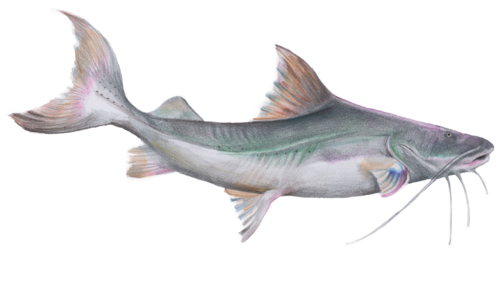
Brachyplatystoma tigrinum, the zebra shovelnose, or tigerstriped catfish, is a large species of catfish of the family Pimelodidae that is native to the Amazon basin in Brazil, Colombia, and Peru.

Care at a glance
Species care notes
- Tank: a base of at least 394 × 157 in (roughly 42272 US gallons); space needed is rated “very large tank”.
- Water: a fairly wide range, from slightly acidic to slightly alkaline, 72–90 °F, pH 6–7.6, 1–12 dGH.
- Behaviour: kept alone; not a community fish.
- Difficulty: Moderate (Seriously Fish rating).
Short excerpts from the species profile:
- Setup: “The choice of décor is as much down to personal preference as anything else though a carefully-aquascaped, planted set-up is obviously out of the question.”
- Diet: “Almost entirely piscivorous preying on smaller fishes captured in the water column in nature, though most specimens readily adapt to dead alternatives such as prawn/shrimp, mussel, squid, whitebait, strips of larger white fish, etc., in aquaria.”
- Tankmates: “Only keep with species large enough to avoid predation and that require similar environmental conditions.”
From the Seriously Fish profile for this species, which has the full habitat, maintenance, diet, behaviour and breeding write-up 167
Understanding the animal
About this animal
About this animal
It is entirely piscivorous.
Quoted from the Wikipedia article “Brachyplatystoma tigrinum” (CC BY-SA 4.0) 175
In the wild
In the wild
From this species’ own FishBase record (habitat, bottom type, water and breeding data), not its family. Wild conditions are context, not enclosure settings.1
| Where it lives | Lives in freshwater. Stays near the bottom. |
| Climate | Tropical climate. |
Native climate (measured)
Native climate (measured)
| Warm-season highs | about 89°F (up to 92°F in the hottest sampled areas) |
| Cool-season lows | about 66°F (down to 63°F in the coldest sampled areas) |
| Average temperature | 76–80°F across sampled records |
| Relative humidity | 81–85% on average (driest month about 78%) |
| Rainfall | about 2228 mm a year |
Measured at 25 wild occurrence records sampled against WorldClim 2.1 climate data (1970–2000 averages). Air conditions in the range are ecological context, not enclosure settings: microhabitats such as burrows, leaf litter or basking rocks can be cooler, warmer or more humid.
Data and studies
The numbers
The numbers
Each bar is what one source reports. Where several sources weigh in, the dashed gold band marks their average.
Sources for this sheet
- FishBase (Froese & Pauly, eds.), version 24.07 Peer-reviewed researchThe global scientific database on fishes, maintained by a consortium of research institutions; every value is referenced.
- Seriously Fish species profiles Experienced keeper or breederLong-running aquarium reference written and peer-checked by experienced fishkeepers and ichthyologists; each profile covers habitat, tank size, water, diet, behaviour and breeding.
- Wikipedia (species article) Community referenceFree encyclopedia; useful overviews with their own citations. Intro text is quoted under CC BY-SA 4.0.
- iNaturalist (captive observations) Community referenceCommunity observation platform run by the California Academy of Sciences and National Geographic; observations marked captive show animals living in homes, zoos and aquariums.
More long-whiskered catfish

Barred sorubim
Pseudoplatystoma fasciatum
Aquarium hobby

Bolt Catfish
Aguarunichthys torosus
Aquarium hobby

Duckbill catfish
Sorubim lima
Aquarium hobby

Kumakuma
Brachyplatystoma filamentosum
Aquarium hobby
Laulao catfish
Brachyplatystoma vaillantii
Aquarium hobby

Leiarius longibarbis
Leiarius longibarbis
Aquarium hobby