
Home / Reptiles / Lizards / Agamidae / Long-tailed Earless Dragon
Some federal rules applyLong-tailed Earless Dragon
Tympanocryptis tetraporophora
Reptiles › Lizards (Lacertilia) › Agamidae (Agamas and dragons)
Tympanocryptis tetraporophora, also known as Eyrean earless dragon or long-tailed earless dragon, is one of a documented species of a relatively small dragon belonging to the genus Tympanocryptis.
From Wikipedia: Tympanocryptis tetraporophora, CC BY-SA 4.0 (excerpt)

Care at a glance
Species-specific values
Values researched for this exact species. Air, surface and water temperatures are listed separately, and each source is kept as published rather than averaged.
| Minimum enclosure | At least 80 x 60 cm floor area for a pair. Source: terrariengemeinschaft.de | |
| Basking surface temperature | 113–122 °F (45–50 °C) Source: terrariengemeinschaft.de | |
| Warm side air temperature | 77–86 °F (25–30 °C) Source: terrariengemeinschaft.de | |
| Humidity | 30–40 % Source: terrariengemeinschaft.de | |
| Uvb lighting | Provide ultraviolet light irradiation. Source: terrariengemeinschaft.de | |
| Diet | Diet consists mainly of small invertebrates; plants are eaten occasionally. Source: terrariengemeinschaft.de | |
| Social housing | May be kept in groups, but only one male should be housed, even in larger enclosures. Source: terrariengemeinschaft.de | |
| Substrate | Use a diggable sand-clay mixture. Source: terrariengemeinschaft.de | |
| Seasonal cooling | For breeding, provide a 6–8 week winter rest, shortening lighting duration and lowering temperatures by about 5°C. Source: terrariengemeinschaft.de |
Understanding the animal
About this animal
About this animal
Tympanocryptis is differentiated from other genera within the family Agamidae by a tympanum covered with scales and a missing phalange in the fifth toe of the rear foot. T. tetraporophora is a ground dwelling dragon inhabiting semi arid regions of central New South Wales, arid regions of South Australia, Northern Territory, Queensland and tropical grasslands of Northern Queensland.
From Wikipedia: Tympanocryptis tetraporophora, CC BY-SA 4.0 (excerpt)
In the wild
In the wild
| Overview | Tympanocryptis tetraporophora, also known as Eyrean earless dragon or long-tailed earless dragon, is one of a documented species of a relatively small dragon belonging to the genus Tympanocryptis. Tympanocryptis is differentiated from other genera within the family Agamidae by a tympanum covered with scales and a missing phalange in the fifth toe of the rear foot. T. tetraporophora is a ground dwelling dragon inhabiting semi arid regions of central New South Wales, arid regions of South Australia, Northern Territory, Queensland and tropical grasslands of Northern Queensland. — From Wikipedia: Tympanocryptis tetraporophora, CC BY-SA 4.0 (excerpt) |
| Where it lives | T tetraporopho distribution covers a large area, some of which is disjunct and or continuous which includes four states South Australia, the Northern Territory, New South Wales and Queensland. T tetraporophora distribution overlaps with other Tympanocryptis including T cephalus, T lineata, T intima and T pentalineata. — From Wikipedia: Tympanocryptis tetraporophora, CC BY-SA 4.0 (excerpt) |
| Reproduction | T tetraporophora are oviparous meaning they lay eggs. Breeding occurs between early spring and mid autumn. Females become sexually mature at a Mean Snout Vent Length(SVL) around 46mm and males are sexually active at about 42mm SVL. — From Wikipedia: Tympanocryptis tetraporophora, CC BY-SA 4.0 (excerpt) |
Read about this species in the wild at The Reptile Database.
Native climate (measured)
Native climate (measured)
| Warm-season highs | about 98°F (up to 101°F in the hottest sampled areas) |
| Cool-season lows | about 43°F (down to 39°F in the coldest sampled areas) |
| Average temperature | 64–78°F across sampled records |
| Relative humidity | 36–43% on average (driest month about 27%) |
| Rainfall | about 250 mm a year, spread fairly evenly |
Measured at 445 wild occurrence records sampled against WorldClim 2.1 climate data (1970–2000 averages). Air conditions in the range are ecological context, not enclosure settings: microhabitats such as burrows, leaf litter or basking rocks can be cooler, warmer or more humid.
Profile
Profile
Researched for this exact species. Sources are listed under In the wild above.
Data and studies
The numbers
The numbers
Each bar is what one source reports. Where several sources weigh in, the dashed gold band marks their average.
Typical adult weight
Average adult body mass in each database (FishBase gives the maximum recorded weight).
Adult snout-to-vent length
Body length without the tail.
Incubation
Sources for this sheet
- Myhrvold et al. (2015). An amniote life-history database. Ecology 96: 3109 Peer-reviewed researchPeer-reviewed compilation of life-history data for over 21,000 birds, mammals and reptiles.
- Species+ (UNEP-WCMC and the CITES Secretariat) Zoo, university or veterinaryThe official database of species listed under CITES. UNEP (2026). The Species+ Website. Nairobi, Kenya. Compiled by UNEP-WCMC, Cambridge, UK. Available at: www.speciesplus.net. [Accessed 04/10/2026].
- USFWS International Affairs: CITES Zoo, university or veterinaryFederal agency that issues CITES permits.
- The Reptile Database Peer-reviewed researchScientist-curated catalog of every reptile species, with taxonomy and literature.
- GBIF Backbone Taxonomy (Global Biodiversity Information Facility) (CC BY 4.0) Peer-reviewed researchInternational scientific taxonomy used here for classification. GBIF Secretariat (2023). GBIF Backbone Taxonomy. Checklist dataset https://doi.org/10.15468/39omei, accessed via GBIF.org.
- Wikipedia (species article) (CC BY-SA 4.0) Community referenceFree encyclopedia; useful overviews with their own citations. Short excerpts are quoted under CC BY-SA 4.0, each credited with a link to its article.
More agamas and dragons
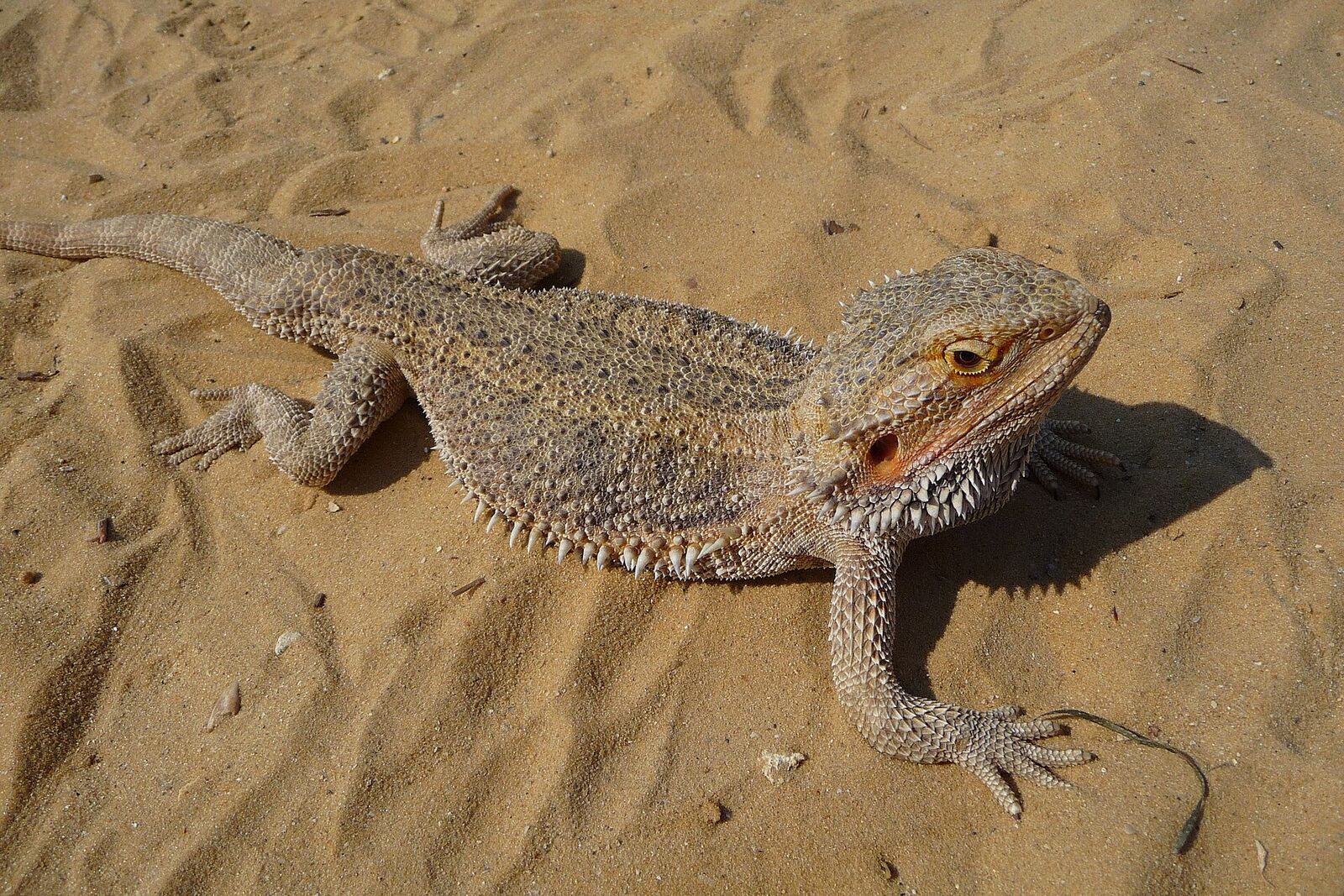
Bearded dragon
Pogona vitticeps
Sun-loving, friendly and endlessly popular.
Pet trade

(Sulawesi) Sailfin Lizard
Hydrosaurus celebensis
Pet trade

(Sulawesi) Sailfin Lizard (Hydrosaurus microlophus)
Hydrosaurus microlophus
Pet trade

Australian water dragon
Intellagama lesueurii
Pet trade

Bent's Mastigure
Uromastyx benti
Pet trade

Black-necked agama
Acanthocercus atricollis
Zoos & aquariums