
Home / Amphibians / Frogs and toads / Variable poison frog
Some federal rules applyVariable poison frog
Ranitomeya variabilis
Amphibians › Frogs and toads (Anura) › Dendrobatidae (Poison dart frogs)
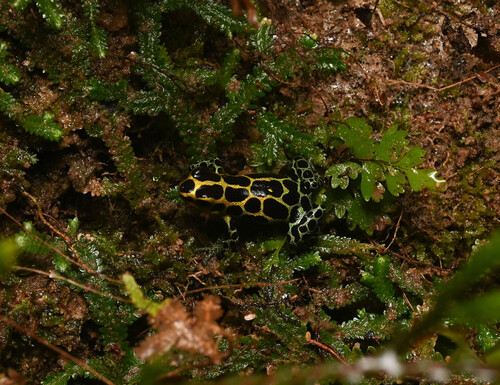
Ranitomeya variabilis, formerly known as Dendrodates variabilis, is a species of small poison dart frog distributed in northern Peru, along the eastern slope of Andes in the upper Rio Huallaga drainage basin.
From Wikipedia: Zimmerman's poison frog, CC BY-SA 4.0 (excerpt)
Care at a glance
Species-specific values
Values researched for this exact species. Air, surface and water temperatures are listed separately, and each source is kept as published rather than averaged.
| Minimum enclosure | Start with a compatible pair in a densely planted enclosure measuring 45 × 45 × 60 cm. Source: academy.herpeton.net | |
| Night temperature | 66–72 °F (19–22 °C) Source: academy.herpeton.net | |
| Humidity | 75–100 % Source: academy.herpeton.net | |
| Uvb lighting | Optional low-level UVB should be measured, paired with a supplementation plan, and frogs must be able to leave it completely. Source: academy.herpeton.net | |
| Diet | Offer small flightless Drosophila melanogaster as the main cultured prey, with springtails and suitable tiny aphids for variety. Source: academy.herpeton.net | |
| Feeding frequency | Feed small portions daily and confirm each frog eats. Source: academy.herpeton.net | |
| Social housing | Start with a compatible pair; provide more room for any larger group. Source: academy.herpeton.net | |
| Substrate | Use about 5–8 cm of drained soil with leaf litter. Source: academy.herpeton.net |
Understanding the animal
About this animal
About this animal
Its common name, Zimmerman's poison frog, is named after Elke Zimmermann, a German zoologist who described the morph of this species and differentiated it from D. ventrimaculatus. The species was formerly considered to be synonymous with Ranitomeya ventrimaculata.
From Wikipedia: Zimmerman's poison frog, CC BY-SA 4.0 (excerpt)
In the wild
In the wild
| Overview | Ranitomeya variabilis, formerly known as Dendrodates variabilis, is a species of small poison dart frog distributed in northern Peru, along the eastern slope of Andes in the upper Rio Huallaga drainage basin. Its common name, Zimmerman's poison frog, is named after Elke Zimmermann, a German zoologist who described the morph of this species and differentiated it from D. ventrimaculatus. The species was formerly considered to be synonymous with Ranitomeya ventrimaculata. — From Wikipedia: Zimmerman's poison frog, CC BY-SA 4.0 (excerpt) |
| Where it lives | R. variabilis is native to South America. It is mainly distributed in the western region of the Amazonian-Orinocan Lowlands, which is around northern Peru, Ecuador, western Brazil, and the southern Colombia region. R. variabilis can be found as far as 195 kilometers southeast of Brazil. — From Wikipedia: Zimmerman's poison frog, CC BY-SA 4.0 (excerpt) |
| Wild diet | R. variabilis tadpoles are known to be omnivorous and cannibalistic. In addition to eggs and conspecific tadpoles in the same phytotelma, R. variabilis tadpoles are also able to feed on organic detritus, small insect larvae, and other anuran eggs. Adult R. variabilis generally prey on ants, fruit flies, termites, and small beetles. — From Wikipedia: Zimmerman's poison frog, CC BY-SA 4.0 (excerpt) |
| Reproduction | Reproduction occurs during the day and peaks after rain. Males initiate advertisement calls when they see a female and approach the female with increasing calling frequency. Males usually call around suitable phytotelma, and once the female lay the eggs, the male fertilize them. — From Wikipedia: Zimmerman's poison frog, CC BY-SA 4.0 (excerpt) |
| History and naming | R. variabilis belongs to the genus Ranitomeya, a monophyletic evolutionary group. It is most closely related to the species R. amazonica. The genus Ranitomeya is divided into four separate species groups, and R. variabilis along with R. amazonica belong to the variabilis group. — From Wikipedia: Zimmerman's poison frog, CC BY-SA 4.0 (excerpt) |
| Conservation | R. variabilis populations are threatened by habitat loss and fragmentation due to agricultural development and logging. R. variabilis is involved in illegal pet trafficking for poison dart frogs. — From Wikipedia: Zimmerman's poison frog, CC BY-SA 4.0 (excerpt) |
Native climate (measured)
Native climate (measured)
| Warm-season highs | about 89°F (up to 90°F in the hottest sampled areas) |
| Cool-season lows | about 69°F (down to 64°F in the coldest sampled areas) |
| Average temperature | 76–80°F across sampled records |
| Relative humidity | 83–85% on average (driest month about 80%) |
| Rainfall | about 3170 mm a year, spread fairly evenly |
Measured at 84 wild occurrence records sampled against WorldClim 2.1 climate data (1970–2000 averages). Air conditions in the range are ecological context, not enclosure settings: microhabitats such as burrows, leaf litter or basking rocks can be cooler, warmer or more humid.
Profile
Profile
Researched for this exact species. Sources are listed under In the wild above.
History
R. variabilis belongs to the genus Ranitomeya, a monophyletic evolutionary group. It is most closely related to the species R. amazonica. The genus Ranitomeya is divided into four separate species groups, and R. variabilis along with R. amazonica belong to the variabilis group.
From Wikipedia: Zimmerman's poison frog, CC BY-SA 4.0 (excerpt)
Sources for this sheet
- Species+ (UNEP-WCMC and the CITES Secretariat) Zoo, university or veterinaryThe official database of species listed under CITES. UNEP (2026). The Species+ Website. Nairobi, Kenya. Compiled by UNEP-WCMC, Cambridge, UK. Available at: www.speciesplus.net. [Accessed 04/10/2026].
- USFWS International Affairs: CITES Zoo, university or veterinaryFederal agency that issues CITES permits.
- AmphibiaWeb (University of California, Berkeley) (CC BY-NC) Peer-reviewed researchUniversity-hosted database of amphibian biology and conservation.
- GBIF Backbone Taxonomy (Global Biodiversity Information Facility) (CC BY 4.0) Peer-reviewed researchInternational scientific taxonomy used here for classification. GBIF Secretariat (2023). GBIF Backbone Taxonomy. Checklist dataset https://doi.org/10.15468/39omei, accessed via GBIF.org.
- Wikipedia (species article) (CC BY-SA 4.0) Community referenceFree encyclopedia; useful overviews with their own citations. Short excerpts are quoted under CC BY-SA 4.0, each credited with a link to its article.
- iNaturalist (captive observations) Community referenceCommunity observation platform run by the California Academy of Sciences and National Geographic; observations marked captive show animals living in homes, zoos and aquariums.
More poison dart frogs

Amazonian Poison Frog
Ranitomeya amazonica
Pet trade

Anthony's poison arrow frog
Epipedobates anthonyi
Pet trade

Black-legged poison frog
Phyllobates bicolor
Pet trade

Blue-bellied poison frog
Andinobates minutus
Pet trade

Brazil-nut poison frog
Adelphobates castaneoticus
Pet trade

Dyeing poison frog
Dendrobates tinctorius
Pet trade