Home / Mammals / Kangaroos, wallabies, possums / Red-necked (Bennett's) wallaby
No federal permit to keep In-depth sheetRed-necked (Bennett's) wallaby
Notamacropus rufogriseus
Mammals › Kangaroos, wallabies, possums (Diprotodontia) › Macropodidae (Kangaroos and wallabies)
Bennett's (red-necked) wallabies are grazing marsupials from Tasmania and southeastern Australia, among the more cold-tolerant macropods.
Care guide
Diet
- Grasses and herbs; they cool themselves by licking their forearms.
Sources 73
Behavior
- Mostly solitary but may forage in groups; give space to hop and shelter to rest by day.
Sources 73
Show the group care guide for kangaroos, wallabies and rat-kangaroos
Kangaroos, wallabies and rat-kangaroos
Applies to most species in this group. Habitat: Australian grassland and forest. Individual species can differ, so compare with the species numbers above and the linked sources.
Housing & setup
- Large grassy paddocks with 6–8 ft fencing, shelter from heat and cold, and soft ground.
- Tree-kangaroos need tall, enriched, climbing habitats.
Diet
- Grass hay, browse and macropod pellets.
Social life
- Groups.
Health watch
- Lumpy jaw (bacterial jaw infection), toxoplasmosis and capture stress.
Understanding the animal
In the wild
In the wild
Researched for this exact species, not its family. Good care copies these conditions.123
| Where it lives | Eastern and southeastern Australia, including Tasmania and Bass Strait islands; favors forest and scrub beside grassy openings. Shelters in bush by day and feeds in open areas after dusk. |
| Ground it lives on | grassy soil at woodland edges; leaf litter under dense cover |
| Climate | Described as occurring mainly in the more temperate parts of eastern Australia. The provided source gives no specific temperature, humidity, or seasonal climate values. |
| Active | Crepuscular and nocturnal feeding, with some afternoon activity. |
| Social life | Mostly solitary; loose mobs share feeding areas. |
| Wild diet | Predominantly grasses and herbs; may browse shrubs and seedlings. |
| Behavior to plan for | Moves between covered resting sites and open pasture at night. Tasmania’s Bennett’s form has seasonal breeding unlike many mainland populations. |
What this means for care
- Provide grassy exercise space and dense-cover-like retreats.
- Allow individuals to feed and rest apart within compatible groups.
- Plan breeding management around the actual subspecies and seasonal pattern.
Native climate (measured)
Native climate (measured)
| Warm-season highs | about 75°F (up to 85°F in the hottest sampled areas) |
| Cool-season lows | about 39°F (down to 32°F in the coldest sampled areas) |
| Average temperature | 49–67°F across sampled records |
| Relative humidity | 69–74% on average (driest month about 67%) |
| Rainfall | about 879 mm a year, spread fairly evenly |
| Winters | Cool to cold winters (lows around 39°F) in much of its native range. Seasonal slowdown may be relevant, but species-specific biology determines whether brumation or hibernation occurs. |
Measured at 126 wild occurrence records sampled against WorldClim 2.1 climate data (1970–2000 averages). Air conditions in the range are ecological context, not enclosure settings: microhabitats such as burrows, leaf litter or basking rocks can be cooler, warmer or more humid.
Profile
Profile
Researched for this exact species. Sources are listed under In the wild above.
History
The species is native to eastern Australia and Tasmania but has been introduced to several other countries. In Tasmania and coastal Queensland, numbers reportedly increased over the previous 30 years as hunting pressure declined and forest clearing created pasture-and-bushland mosaics favorable for feeding and shelter.
Behaviors reported
- Usually lives solitarily.
- Aggregates when food, water, or shelter is abundant.
- Forms a social hierarchy when gathered in groups.
- Former opponents may reunite after fights in a form of post-conflict reconciliation.
- Feeds in more open pasture at night while using bushland for daytime shelter.
Remarkable facts
- Adults weigh roughly 13.8-18.6 kg, or about 30-41 lb.
- Head-body length can reach about 90 cm, or 35 inches.
- Males are generally larger than females.
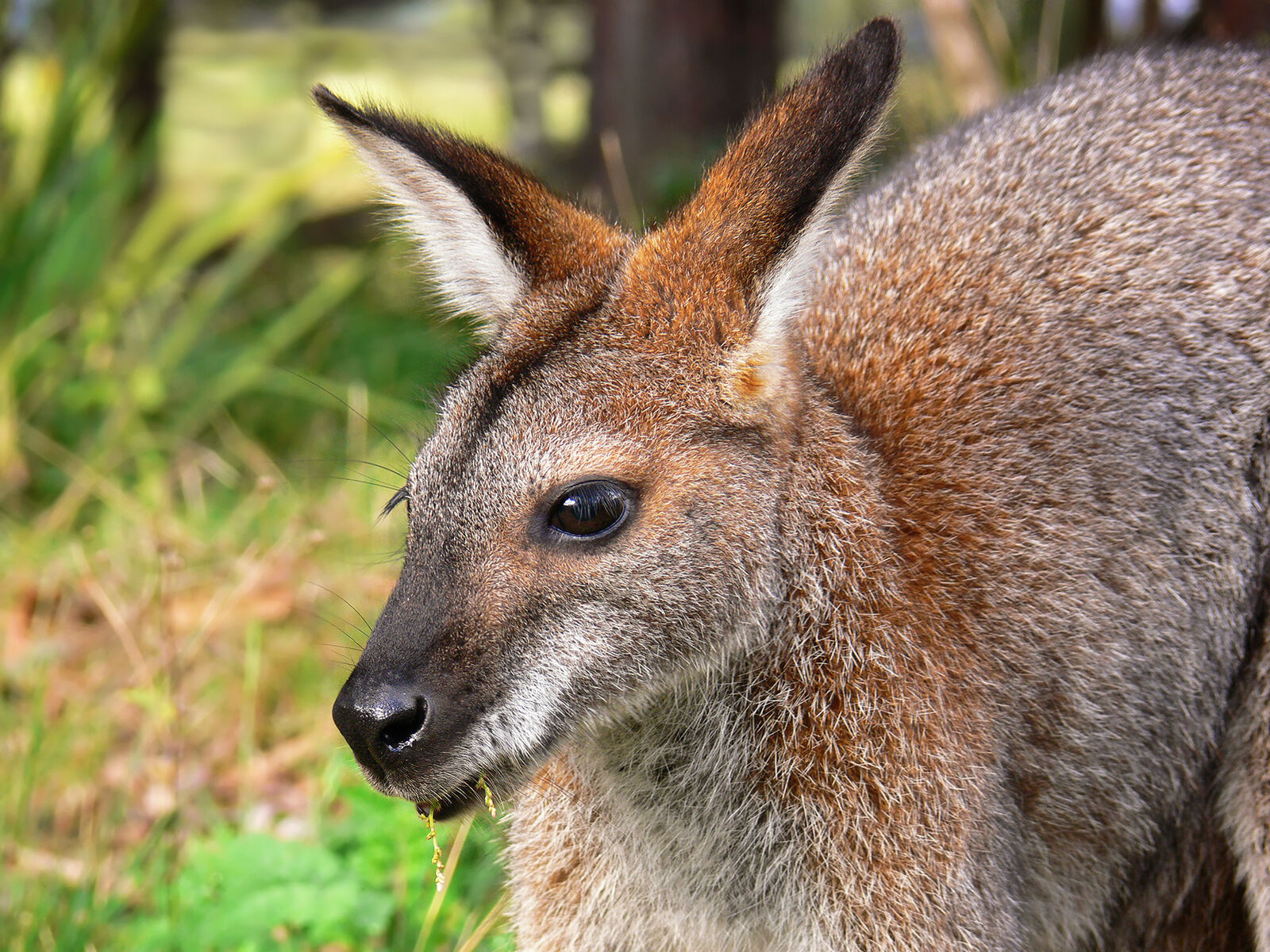
- The coat is grizzled medium gray with a reddish wash across the shoulders, along with a black nose and paws and a white stripe on the upper lip.
- Introduced populations occur outside Australia, including New Zealand, the United Kingdom, Ireland, the Isle of Man, France, and Germany.
Stories
- A study cited in the source documented post-conflict reconciliation, in which former opponents reunited after a fight.
From the sources
From the sources
Quoted from the matching sections of reputable sources for this exact species. Specialist databases are used first; Wikipedia (community-edited, CC BY-SA 4.0) only fills gaps. Other sources are short credited quotes.
| Overview | The red-necked wallaby or Bennett's wallaby (Notamacropus rufogriseus) is a medium-sized macropod marsupial (wallaby), common in the more temperate and fertile parts of eastern Australia, including Tasmania. Red-necked wallabies have been introduced to several other countries, including New Zealand, the United Kingdom (in England and Scotland), Ireland, the Isle of Man, France and Germany. — Wikipedia (community-edited) |
| Where it lives | Red-necked wallabies are found in coastal scrub and sclerophyll forest throughout coastal and highland eastern Australia, from Bundaberg, Queensland, to the South Australian border; in Tasmania and on many of the Bass Strait islands. It is unclear which of the Tasmanian islands have native populations as opposed to introduced ones. — Wikipedia (community-edited) |
| Wild diet | Red-necked wallabies’ diets consists of grasses, roots, tree leaves, and weeds. — Wikipedia (community-edited) |
| Behavior | Red-necked wallabies are mainly solitary but will gather together when there is an abundance of resources, such as food, water or shelter. When they do gather in groups, they have a social hierarchy similar to other wallaby species. — Wikipedia (community-edited) |
| Appearance and size | Red-necked wallabies are distinguished by their black nose and paws, white stripe on the upper lip, and grizzled medium grey coat with a reddish wash across the shoulders. They can weigh 13.8 to 18.6 kg and attain a head-body length of 90 cm, although males are generally bigger than females. — Wikipedia (community-edited) |
Data and studies
Researched care notes
Researched care notes
Findings checked against veterinary, zoo, welfare, keeper and peer-reviewed sources. Air, basking-surface and water temperatures are kept separate, and where sources disagree both are shown. “Study” notes report what a paper measured, not a universal rule.
Wallabies (Bennett's wallaby)
- Provide substantial outdoor exercise space rather than treating an adult wallaby as an indoor cage pet; the ranch's observations concern Bennett's wallabies and cannot define all macropods.1
- Provide accessible shelter with dry bedding, food and water areas, and protection from temperature extremes.1
- Keep climbable furnishings away from enclosure fences, where they could become escape steps or help predators enter.1
- Prevent dogs chasing or harassing wallabies through a fence; the ranch identifies this as a risk for trauma and severe stress.1
Grazing Kangaroos And Wallabies (feeding group)
Researched for this genus; applies to its species unless a species note says otherwise.
The numbers
The numbers
Each bar is what one source reports. Where several sources weigh in, the dashed gold band marks their average.
Lifespan in care
Sources for this sheet
- Animal Diversity Web (University of Michigan): Macropus rufogriseus Zoo, university or veterinaryUniversity-hosted species account, mostly wild biology.
- 9 CFR 2.1: Animal Welfare Act licensing (USDA) Zoo, university or veterinaryWho needs a USDA license to breed, sell or exhibit animals.
- Merck Veterinary Manual: Management of zoo animals Zoo, university or veterinaryThe Merck Veterinary Manual: a standard veterinary reference written and reviewed by veterinary specialists.
- Merck Veterinary Manual: Nutrition: exotic and zoo animals Zoo, university or veterinaryThe Merck Veterinary Manual: a standard veterinary reference written and reviewed by veterinary specialists.
- GBIF Backbone Taxonomy (Global Biodiversity Information Facility) Peer-reviewed researchInternational scientific taxonomy used here for classification.
- Wikipedia (species article) Community referenceFree encyclopedia; useful overviews with their own citations. Intro text is quoted under CC BY-SA 4.0.
- iNaturalist (captive observations) Community referenceCommunity observation platform run by the California Academy of Sciences and National Geographic; observations marked captive show animals living in homes, zoos and aquariums.
