Home / Amphibians / Frogs and toads / White's tree frog
No federal permit to keep In-depth sheetWhite's tree frog
Litoria caerulea
Amphibians › Frogs and toads (Anura) › Pelodryadidae (Australian tree frogs)
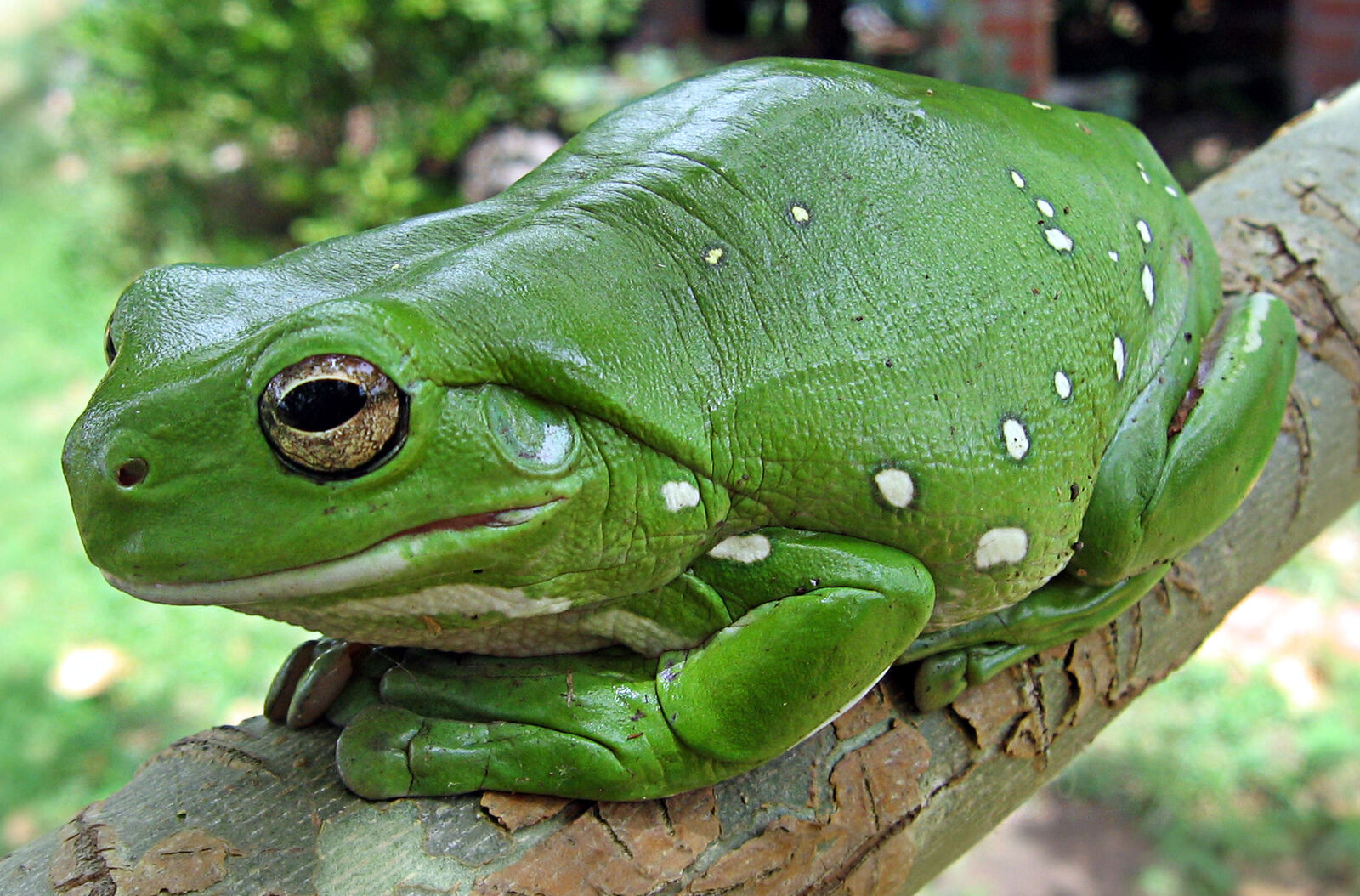
White's tree frogs are calm, long-lived insect-eaters with huge toe pads. Clint's Reptiles scores them 3.8/5.
Care at a glance
Species-specific values
Values researched for this exact species. Where they differ from the group guide below, follow these. Air, surface and water temperatures are listed separately, and each source is kept as published rather than averaged.
| Air temperature day | approximate: 80 °F | 213 |
| Lifespan typical captive | 7–10 years Historical keeper estimate; records exceed 20 years | 213 |
| Adult snout vent length female | 4–4.5 in Typical large females; occasional animals reach 5 inches | 213 |
| Social | Compatible similar-sized frogs may share; separate markedly different sizes. | 213 |
| Diet | Gut-loaded crickets and earthworms; adults generally fed two or three times weekly. | 213 |
Care guide
Care
- Tall, humid terrarium with climbing branches; they adapt to seasonal dry periods.
Show the group care guide for australian tree frogs (white's and relatives)
Australian tree frogs (White's and relatives)
Applies to most species in this group. Habitat: Australian and New Guinean forests. Individual species can differ, so compare with the species numbers above and the linked sources.
Housing & setup
- Tall enclosures with sturdy branches; White's tree frogs are hardy and tolerate a range of humidity.
- A large, shallow water bowl.
Climate & lighting
| Warm side / daytime | 78–85°F |
| Cool side | 70–75°F |
| Humidity | 50–70% |
- UVB: Low-level UVB recommended.
Diet
- Insects; adults eat large prey items, and obesity is common.
Social life
- White’s treefrogs may be kept with similarly sized conspecifics; avoid mixing large adults with small frogs.
Health watch
- Obesity and chytrid.
Understanding the animal
In the wild
In the wild
Researched for this exact species, not its family. Good care copies these conditions.123
| Where it lives | Northern and eastern Australia and southern New Guinea, in seasonally wet and dry wooded habitats. Shelters in tree hollows, rock crevices and buildings. |
| Ground it lives on | mainly arboreal; branches, tree hollows and rock crevices |
| Climate | Experiences wet and dry seasons; numerical wild temperature and relative-humidity ranges were not established. |
| Active | Cathemeral activity is reported, including daytime calling after rain; dry-season dormancy/aestivation is reported. |
| Social life | Males call at breeding sites; stable wild social-group structure is not established. |
| Wild diet | Moths, locusts, cockroaches and other insects. |
| Behavior to plan for | Climbs using large adhesive toe pads and spreads moisture-conserving secretion over its skin. Retreats into protected shelters during dry conditions. |
What this means for care
- Provide sturdy elevated perches and hollow-like retreats.
- Allow ventilation and surface drying while retaining access to moisture.
- Dry-season adaptations do not justify withholding water.
Native climate (measured)
Native climate (measured)
| Warm-season highs | about 87°F (up to 99°F in the hottest sampled areas) |
| Cool-season lows | about 46°F (down to 39°F in the coldest sampled areas) |
| Average temperature | 63–79°F across sampled records |
| Relative humidity | 54–73% on average (driest month about 62%) |
| Rainfall | about 944 mm a year |
Measured at 353 wild occurrence records sampled against WorldClim 2.1 climate data (1970–2000 averages). Air conditions in the range are ecological context, not enclosure settings: microhabitats such as burrows, leaf litter or basking rocks can be cooler, warmer or more humid.
Profile
Profile
Researched for this exact species. Sources are listed under In the wild above.
History
John White first described the species in 1790, and the common name White's tree frog honors him. The species was originally called Rana caerulea, or the blue frog, because preserved specimens sent to England appeared blue. The original specimen eventually entered Sir Joseph Banks's collection but was destroyed when London's Hunterian Museum was bombed during World War II.
Keeper tips
- Expect an adult length of roughly 3 to 4.5 inches, with females generally larger than males.
- Provide reliable access to moisture because wild frogs actively seek moist places during hot summer conditions.
- Account for the species' enormous toe pads and tree-frog morphology when furnishing its space.
- Be aware that the frog may squeak when touched and scream when it feels threatened.
- Its reported average captive lifespan is about 16 years.
Behaviors reported
- Screams when threatened, apparently to scare an attacker.
- Squeaks when touched.
- Frequently lives close to people and may enter buildings.
- Seeks out moisture during hot summer months.
- Has been reported leaping onto people's laps from lavatories.
Unique adaptations
- Skin can adjust to drier situations.
- Some scientists believe it can regulate how much water evaporates through its skin.
- Enormous toe pads aid its tree-frog lifestyle.
- Fingers are partially webbed and toes are almost completely webbed.
- The skin produces secretions with antibacterial and antiviral properties.
Remarkable facts
- Adults reach about 3 to 4.5 inches in length, with females usually larger than males.
- Its average reported lifespan in captivity is about 16 years.
- It is native to Australia and southern New Guinea.
- Introduced populations have occurred in the United States and New Zealand, although the New Zealand population is believed to have died out.
- The species is assessed as least concern by the IUCN.
- It was the first Australian frog to be scientifically described.
Stories
- Animal Diversity Web reports that White's tree frogs have been found in lavatories, where they have sometimes leapt onto people's laps.
- The original scientifically described specimen was destroyed when the Hunterian Museum in London was bombed during World War II.
From the sources
From the sources
Quoted from the matching sections of reputable sources for this exact species. Specialist databases are used first; Wikipedia (community-edited, CC BY-SA 4.0) only fills gaps. Other sources are short credited quotes.
| Overview | The Australian green tree frog (Pelodryas caerulea), also known as simply green tree frog in Australia, White's tree frog, or dumpy tree frog, is a species of tree frog native to Australia and New Guinea, with introduced populations in the United States and New Zealand, though the latter is believed to have died out. It is morphologically similar to some other members of its family, particularly the magnificent tree frog (P. splendida) and the white-lipped tree frog (Sandyrana infrafrenata). — Wikipedia (community-edited) |
| Where it lives | These treefrogs have adapted to seasonally dry or wet habitats. — Animal Diversity Web |
| Wild diet | Reports on the food habits of this species in the wild are rare, but they are largely insectivorous, and eat moths, locusts, roaches and other insects. — Animal Diversity Web |
| Behavior | These frogs are very tame in nature and are have little fear of humans. — Animal Diversity Web |
| Reproduction | Breeding takes place in the summer rainy season. — Animal Diversity Web |
| Appearance and size | This treefrog has many unique factors that set it apart from other hylids. — Animal Diversity Web |
| History and naming | The Australian green tree frog is a member of the family Pelodryadidae, which is endemic to Australia and New Guinea. The common name of the species, "White's tree frog", is in honour of John White's first description in 1790. — Wikipedia (community-edited) |
| Conservation | Reportedly this species is still common in parts of its natural range. — Animal Diversity Web |
Data and studies
Researched care notes
Researched care notes
Findings checked against veterinary, zoo, welfare, keeper and peer-reviewed sources. Air, basking-surface and water temperatures are kept separate, and where sources disagree both are shown. “Study” notes report what a paper measured, not a universal rule.
White's Tree Frog
- Provide robust climbing branches and perches at several heights in a secure vertical enclosure.1
- Tree of Life specifies daytime ambient air of 75–80°F and nighttime 70–72°F, separate from its basking-spot recommendation.1
- Tree of Life gives 50–70% enclosure relative humidity with drying periods between mistings and good ventilation, rather than continuously stagnant wet conditions.1
- Provide a shallow soaking dish that is easy to access, and replace its water daily.1
- LafeberVet recommends varied appropriately sized invertebrates, feeding juveniles daily and adults two or three times weekly; adjust quantity to body condition.2
The numbers
The numbers
Each bar is what one source reports. Where several sources weigh in, the dashed gold band marks their average.
Lifespan in care
Maximum recorded lifespan
Longest recorded lifespan reported by each database; typical lifespans are usually shorter. The AnAge record comes from an animal in human care.
Veterinary & husbandry research
Veterinary & husbandry research
- Treatment of chytridiomycosis with reduced-dose itraconazole Jones ME et al., Diseases of aquatic organisms 2012
- Gastrointestinal entamoebiasis in captive anurans in North America Weisbrod TC et al., Diseases of aquatic organisms 2021
- Novel chytrid pathogen variants and the global amphibian pet trade Fu M et al., Conservation biology: the journal of the Society for Conservation Biology 2022
- Analgesic Efficacy of Tramadol and Morphine in White's Tree Frogs (Litoria caerulea) Hausmann JC et al., Journal of the American Association for Laboratory Animal Science: JAALAS 2021
Peer-reviewed papers that mention this species alongside captivity, zoos, veterinary care or aquaculture. Some cover several species or mention it only in passing, so check the abstract. See all 15 on PubMed → 170
Sources for this sheet
- Animal Diversity Web (University of Michigan): Litoria caerulea Zoo, university or veterinaryUniversity-hosted species account, mostly wild biology.
- Clint's Reptiles (YouTube): White's Tree Frog, The Best Pet Amphibian? Expert educator & keeperClint Laidlaw, PhD in Biology Education and MS in Evolutionary Ecology; owner of Clint's Reptile Room and a longtime keeper. Rates each species on handleability, care, hardiness, availability and upfront cost.
- AnAge: The Animal Ageing and Longevity Database (Human Ageing Genomic Resources) Peer-reviewed researchCurated, referenced longevity and life-history records for thousands of species; maximum lifespans are often from zoo animals.
- Merck Veterinary Manual: Environment and husbandry for amphibians Zoo, university or veterinaryThe Merck Veterinary Manual: a standard veterinary reference written and reviewed by veterinary specialists.
- Merck Veterinary Manual: Overview of amphibians Zoo, university or veterinaryThe Merck Veterinary Manual: a standard veterinary reference written and reviewed by veterinary specialists.
- Reptiles Magazine: White’s Treefrog Care Sheet — John Clare Experienced keeper or breederAdded in the 2026 source-checked care-guide review.
- Clint's Reptiles (YouTube): White's Tree Frog, The Best Pet Amphibian? Expert educator & keeperClint Laidlaw, PhD in Biology Education and MS in Evolutionary Ecology; owner of Clint's Reptile Room and a longtime keeper. His "Best Pet?" series reviews each species' care in depth.
- AmphibiaWeb (University of California, Berkeley) Peer-reviewed researchUniversity-hosted database of amphibian biology and conservation.
- GBIF Backbone Taxonomy (Global Biodiversity Information Facility) Peer-reviewed researchInternational scientific taxonomy used here for classification.
- Wikipedia (species article) Community referenceFree encyclopedia; useful overviews with their own citations. Intro text is quoted under CC BY-SA 4.0.
- PubMed (U.S. National Library of Medicine) Peer-reviewed researchIndex of peer-reviewed veterinary, zoo and husbandry research.