
Home / Invertebrates / Nerite snails / Zebra nerite snail
No federal permit to keepZebra nerite snail
Vittina natalensis
Invertebrates › Nerite snails (Cycloneritida) › Neritidae (Nerite snails)
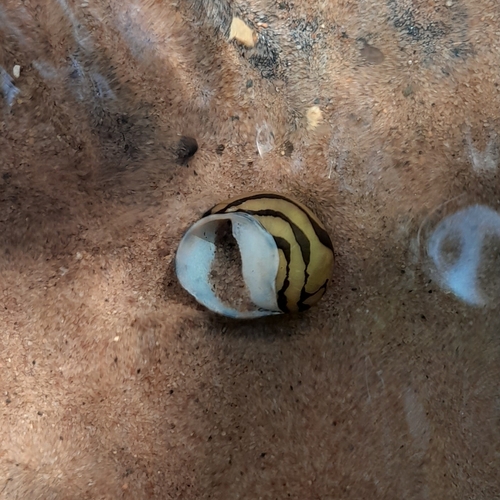
Vittina natalensis, commonly known as spotted nerite, red spotted snail or zebra nerite, is a species of small freshwater snail with an operculum, an aquatic gastropod mollusk in the family Neritidae, the nerites.
From Wikipedia: Vittina natalensis, CC BY-SA 4.0 (excerpt)
Care at a glance
Species-specific values
Values researched for this exact species. Air, surface and water temperatures are listed separately, and each source is kept as published rather than averaged.
| Water temperature | 65–85 °F Source: aquaticarts.com | |
| Water temperature | 79–80 °F Source: aquaticarts.com | |
| Diet | They graze on algae; supplement with algae wafers or blanched kale, zucchini, or carrots if algae is scarce. Source: aquaticarts.com | |
| Social housing | They are peaceful and compatible with fish, shrimp, plants, and other snails; avoid aggressive fish such as cichlids or loaches. Source: aquaticarts.com | |
| Substrate | For breeding, use crushed coral or a similar calcium-rich substrate to support juvenile shell formation. Source: aquaticarts.com |
Understanding the animal
About this animal
About this animal
It returns to brackish waters to reproduce. This is a popular aquarium snail, sold because it looks attractive and eats algae in freshwater tanks, but can only reproduce in saltwater or brackish water conditions.
From Wikipedia: Vittina natalensis, CC BY-SA 4.0 (excerpt)
In the wild
In the wild
| Overview | Vittina natalensis, commonly known as spotted nerite, red spotted snail or zebra nerite, is a species of small freshwater snail with an operculum, an aquatic gastropod mollusk in the family Neritidae, the nerites. It returns to brackish waters to reproduce. This is a popular aquarium snail, sold because it looks attractive and eats algae in freshwater tanks, but can only reproduce in saltwater or brackish water conditions. — From Wikipedia: Vittina natalensis, CC BY-SA 4.0 (excerpt) |
| Where it lives | This species is endemic to the coastal plain of East Africa -- Kenya, Mozambique, Somalia, South Africa, and Tanzania. Its specific name natalensis refers to the region of Natal, South Africa. — From Wikipedia: Vittina natalensis, CC BY-SA 4.0 (excerpt) |
Sources for this sheet
- GBIF Backbone Taxonomy (Global Biodiversity Information Facility) (CC BY 4.0) Peer-reviewed researchInternational scientific taxonomy used here for classification. GBIF Secretariat (2023). GBIF Backbone Taxonomy. Checklist dataset https://doi.org/10.15468/39omei, accessed via GBIF.org.
- Wikipedia (species article) (CC BY-SA 4.0) Community referenceFree encyclopedia; useful overviews with their own citations. Short excerpts are quoted under CC BY-SA 4.0, each credited with a link to its article.
- iNaturalist (captive observations) Community referenceCommunity observation platform run by the California Academy of Sciences and National Geographic; observations marked captive show animals living in homes, zoos and aquariums.
