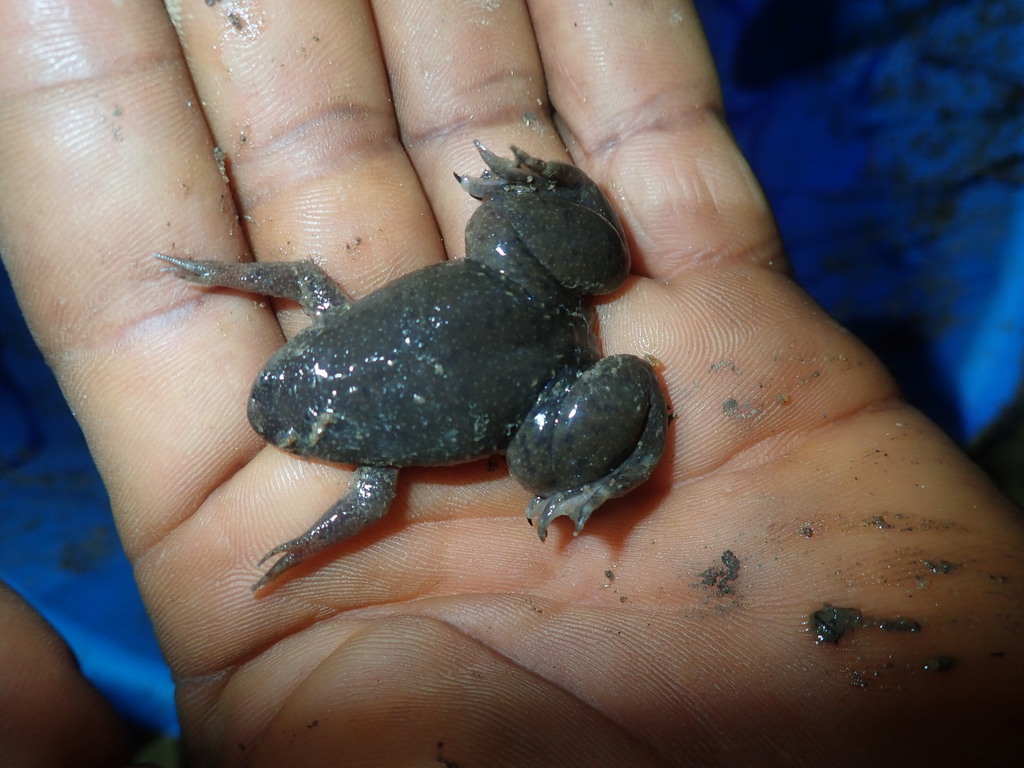
Home / Amphibians / Frogs and toads / African clawed frog
No federal permit to keepAfrican clawed frog
Xenopus laevis
Amphibians › Frogs and toads (Anura) › Pipidae (Clawed frogs, dwarf frogs, Surinam toads)
The African clawed frog (Xenopus laevis), also known as simply xenopus, African clawed toad, African claw-toed frog or the platanna) is a species of African aquatic frog of the family Pipidae.

Care at a glance
Species-specific values
Values researched for this exact species. Air, surface and water temperatures are listed separately, and each source is kept as published rather than averaged.
| Water temperature | 63–66 °F (17–19 °C) Laboratory conditions from February 2019, not an experimentally demonstrated optimum | xenopusresource.org |
| Diet | Complete aquatic pellets are used by the research centre. | xenopusresource.org |
| Minimum enclosure | At least 90 x 45 x 45 cm for one large adult. Source: academy.herpeton.net | |
| Water temperature | 64–72 °F (18–22 °C) Source: academy.herpeton.net | |
| Water temperature | 61–75 °F (16–24 °C) Source: academy.herpeton.net | |
| Uvb lighting | Routine UVB is not required for a complete aquatic diet. Source: academy.herpeton.net | |
| Diet | Use complete aquatic-frog pellets as the staple, with earthworms and varied safe aquatic prey. Source: academy.herpeton.net | |
| Feeding frequency | Feed juveniles daily; most adults every 2-3 days. Source: academy.herpeton.net | |
| Social housing | Alone is simplest; similarly sized adults may share a much larger aquarium with monitoring. Source: academy.herpeton.net | |
| Substrate | Use bare glass, smooth slate, or a thin layer of sand too fine to lodge in the mouth; avoid gravel and pebbles. Source: academy.herpeton.net | |
| Minimum enclosure | For two animals, minimum water surface is 6 × 4 body lengths and depth is 4 body lengths; add 2 × 2 body lengths for each additional animal. Source: repticare.ch | |
| Minimum enclosure | The species profile gives the legal minimum enclosure dimensions, not the ideal. Source: repticare.ch | |
| Humidity | Humidity is aquatic. Source: repticare.ch | |
| Substrate | Use fine sand or a bare bottom; gravel can be swallowed. Source: repticare.ch | |
| Diet | Feed earthworms, pellets, or frozen food. Source: repticare.ch | |
| Feeding frequency | Feed two to three times a week. Source: repticare.ch | |
| Social housing | House groups of equally sized animals. Source: repticare.ch | |
| Seasonal cooling | No rest period is needed. Source: repticare.ch |
Understanding the animal
About this animal
About this animal
Its name is derived from the short black claws on its feet. The word Xenopus means 'strange foot' and laevis means 'smooth'.
From Wikipedia: African clawed frog, CC BY-SA 4.0 (excerpt)
In the wild
In the wild
Researched for this exact species, not its family. Wild conditions are context, not enclosure settings.1
| Where it lives | Southern African freshwater ponds, including stagnant grassland pools, and some streams in arid or semi-arid country. Remains almost entirely submerged, leaving water chiefly when habitat conditions force movement. |
| Climate | Native habitats undergo seasonal drying; frogs can shelter in mud when ponds disappear. Wild air temperature and humidity ranges were not established. |
| Active | Cathemeral, active by day and night; can aestivate in mud during drought. |
| Social life | Generally solitary rather than forming stable social groups. |
| Wild diet | Aquatic arthropods, worms, crustaceans and scavenged animal remains; tadpoles filter-feed. |
| Behavior to plan for | Uses smell, sensitive fingers and a lateral-line system to locate food underwater. Swims strongly, surfaces for air and may crawl overland between ponds. |
Native climate (measured)
Native climate (measured)
| Warm-season highs | about 80°F (up to 86°F in the hottest sampled areas) |
| Cool-season lows | about 44°F (down to 33°F in the coldest sampled areas) |
| Average temperature | 59–68°F across sampled records |
| Relative humidity | 59–74% on average (driest month about 61%) |
| Rainfall | about 597 mm a year |
Measured at 87 wild occurrence records sampled against WorldClim 2.1 climate data (1970–2000 averages). Air conditions in the range are ecological context, not enclosure settings: microhabitats such as burrows, leaf litter or basking rocks can be cooler, warmer or more humid.
Data and studies
The numbers
The numbers
Each bar is what one source reports. Where several sources weigh in, the dashed gold band marks their average.
Maximum recorded lifespan
Longest recorded lifespan reported by each database; typical lifespans are usually shorter. The AnAge record comes from an animal in human care.
Typical adult weight
Average adult body mass in each database (FishBase gives the maximum recorded weight).
Incubation
Female maturity
Care articles for this species
Care articles for this species
- African Clawed Frog Husbandry (Reptiles Magazine)
Written by keepers, breeders and vets Reptiles MagazineReptiFiles
Veterinary & husbandry research
Veterinary & husbandry research
- Animal Maintenance Systems: Xenopus laevis Shaidani NI et al., Cold Spring Harbor protocols 2020
- Manipulating the Xenopus genome with transposable elements Yergeau DA et al., Genome biology 2007
- Spinal Cord Transection In Xenopus laevis Tadpoles Slater PG et al., Journal of visualized experiments: JoVE 2021
Peer-reviewed papers that mention this species alongside captivity, zoos, veterinary care or aquaculture. Some cover several species or mention it only in passing, so check the abstract. See all 82 on PubMed → PubMed
Sources for this sheet
- AnAge: The Animal Ageing and Longevity Database (Human Ageing Genomic Resources) (CC BY 3.0) Peer-reviewed researchCurated, referenced longevity and life-history records for thousands of species; maximum lifespans are often from zoo animals.
- AmphibiaWeb (University of California, Berkeley) (CC BY-NC) Peer-reviewed researchUniversity-hosted database of amphibian biology and conservation.
- GBIF Backbone Taxonomy (Global Biodiversity Information Facility) (CC BY 4.0) Peer-reviewed researchInternational scientific taxonomy used here for classification. GBIF Secretariat (2023). GBIF Backbone Taxonomy. Checklist dataset https://doi.org/10.15468/39omei, accessed via GBIF.org.
- Wikipedia (species article) (CC BY-SA 4.0) Community referenceFree encyclopedia; useful overviews with their own citations. Short excerpts are quoted under CC BY-SA 4.0, each credited with a link to its article.
- PubMed (U.S. National Library of Medicine) Peer-reviewed researchIndex of peer-reviewed veterinary, zoo and husbandry research.
- iNaturalist (captive observations) Community referenceCommunity observation platform run by the California Academy of Sciences and National Geographic; observations marked captive show animals living in homes, zoos and aquariums.
- Reptiles Magazine (care articles) Experienced keeper or breederEstablished reptile and amphibian hobby magazine; care articles are written by breeders, keepers and veterinarians.