
Home / Amphibians / Frogs and toads / Surinam toad
No federal permit to keepSurinam toad
Pipa pipa
Amphibians › Frogs and toads (Anura) › Pipidae (Clawed frogs, dwarf frogs, Surinam toads)
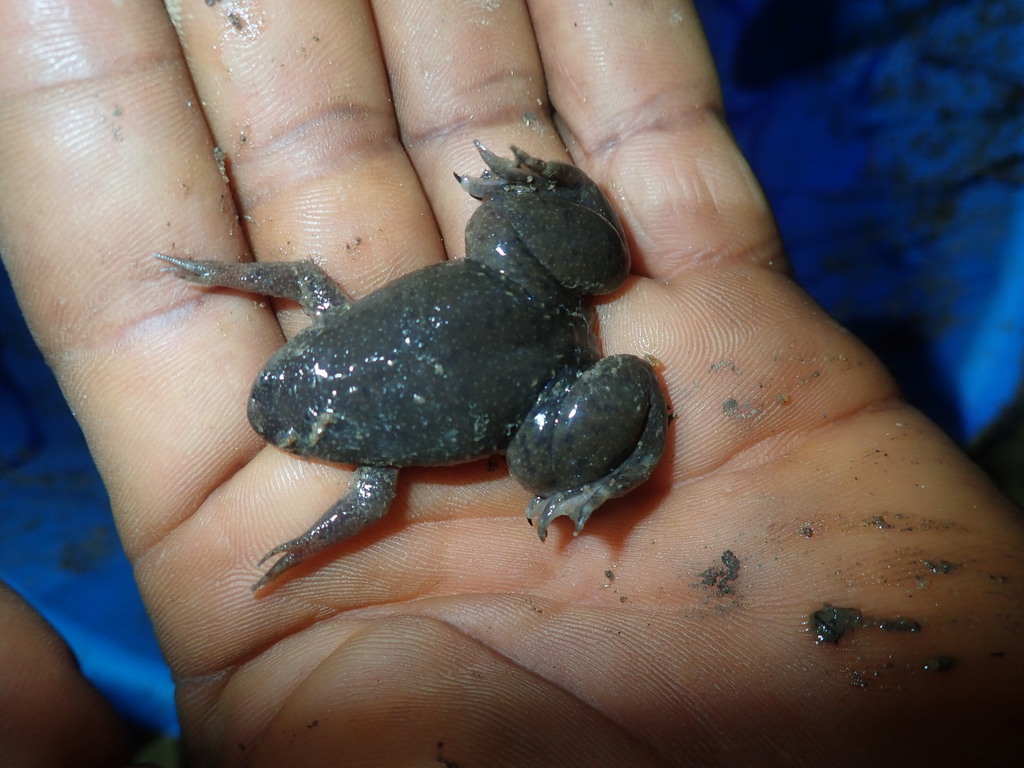
The common Surinam toad, the Suriname toad, or star-fingered toad (Pipa pipa), is a fully-aquatic species of frog, in the family Pipidae, with a widespread range across much of tropical South America and the island of Trinidad.
From Wikipedia: Common Surinam toad, CC BY-SA 4.0 (excerpt)

Care at a glance
Species-specific values
Values researched for this exact species. Air, surface and water temperatures are listed separately, and each source is kept as published rather than averaged.
| Minimum enclosure | A single adult needs at least 75 litres (20 gallons). Source: vetverified.com | |
| Warm side air temperature | 75–82 °F (24–28 °C) Source: vetverified.com | |
| Diet | Suitable foods include earthworms, bloodworms, blackworms, small feeder fish, crickets, and sinking carnivore pellets or amphibian-safe aquatic foods. Source: vetverified.com | |
| Feeding frequency | Adults should be fed 2–3 times weekly; juveniles every 1–2 days. Source: vetverified.com | |
| Substrate | Use a bare bottom or smooth river sand; avoid gravel and small particles. Source: vetverified.com |
Understanding the animal
About this animal
About this animal
The females of this species are well-known for "incubating" their eggs on their backs, in honeycomb-like depressions directly within the skin, releasing fully-formed froglets after a period of 4–5 months. Pipa pipa is an ambush predator, lying in-wait underwater for prey to inevitably wander too close, swiftly inhaling the unsuspecting creature using suction feeding.
From Wikipedia: Common Surinam toad, CC BY-SA 4.0 (excerpt)
In the wild
In the wild
| Overview | The common Surinam toad, the Suriname toad, or star-fingered toad (Pipa pipa), is a fully-aquatic species of frog, in the family Pipidae, with a widespread range across much of tropical South America and the island of Trinidad. The females of this species are well-known for "incubating" their eggs on their backs, in honeycomb-like depressions directly within the skin, releasing fully-formed froglets after a period of 4–5 months. Pipa pipa is an ambush predator, lying in-wait underwater for prey to inevitably wander too close, swiftly inhaling the unsuspecting creature using suction feeding. — From Wikipedia: Common Surinam toad, CC BY-SA 4.0 (excerpt) |
Read about this species in the wild at Animal Diversity Web.
Native climate (measured)
Native climate (measured)
| Warm-season highs | about 89°F (up to 92°F in the hottest sampled areas) |
| Cool-season lows | about 71°F (down to 64°F in the coldest sampled areas) |
| Average temperature | 77–80°F across sampled records |
| Relative humidity | 79–84% on average (driest month about 76%) |
| Rainfall | about 2592 mm a year |
Measured at 97 wild occurrence records sampled against WorldClim 2.1 climate data (1970–2000 averages). Air conditions in the range are ecological context, not enclosure settings: microhabitats such as burrows, leaf litter or basking rocks can be cooler, warmer or more humid.
Data and studies
The numbers
The numbers
Each bar is what one source reports. Where several sources weigh in, the dashed gold band marks their average.
Maximum recorded lifespan
Longest recorded lifespan reported by each database; typical lifespans are usually shorter. The AnAge record comes from an animal in human care.
Sources for this sheet
- AnAge: The Animal Ageing and Longevity Database (Human Ageing Genomic Resources) (CC BY 3.0) Peer-reviewed researchCurated, referenced longevity and life-history records for thousands of species; maximum lifespans are often from zoo animals.
- AmphibiaWeb (University of California, Berkeley) (CC BY-NC) Peer-reviewed researchUniversity-hosted database of amphibian biology and conservation.
- GBIF Backbone Taxonomy (Global Biodiversity Information Facility) (CC BY 4.0) Peer-reviewed researchInternational scientific taxonomy used here for classification. GBIF Secretariat (2023). GBIF Backbone Taxonomy. Checklist dataset https://doi.org/10.15468/39omei, accessed via GBIF.org.
- Wikipedia (species article) (CC BY-SA 4.0) Community referenceFree encyclopedia; useful overviews with their own citations. Short excerpts are quoted under CC BY-SA 4.0, each credited with a link to its article.
- iNaturalist (captive observations) Community referenceCommunity observation platform run by the California Academy of Sciences and National Geographic; observations marked captive show animals living in homes, zoos and aquariums.
More clawed frogs, dwarf frogs, surinam toads

African clawed frog
Xenopus laevis
Pet trade

African dwarf frog
Hymenochirus boettgeri
Pet trade
Dwarf Surinam toad
Pipa parva
Pet trade
Western clawed frog
Xenopus tropicalis
Pet trade