
Home / Reptiles / Snakes / Boidae / Amazon basin emerald tree boa
Some federal rules applyAmazon basin emerald tree boa
Corallus batesii
Reptiles › Snakes (Serpentes) › Boidae (Boas)
Corallus batesii, also known commonly as the Amazon Basin emerald tree boa, is a species of snake in the subfamily Boinae of the family Boidae.

Care at a glance
Species-specific values
Values researched for this exact species. Air, surface and water temperatures are listed separately, and each source is kept as published rather than averaged.
| Minimum enclosure | Adult female enclosures measure 4' x 2' x 2'; males' measure 3' x 2' x 2'. Source: amazonbasinemeraldtreeboa.com | |
| Basking surface temperature | 92 °F Source: amazonbasinemeraldtreeboa.com | |
| Humidity | 60–65 % Source: amazonbasinemeraldtreeboa.com | |
| Diet | Feed quality frozen-thawed rats or mice. Source: amazonbasinemeraldtreeboa.com | |
| Feeding frequency | Neonates every 7–14 days; adults every 3–6 weeks, with smaller prey fed more often. Source: amazonbasinemeraldtreeboa.com | |
| Social housing | Pairs are introduced for breeding in late November or December and monitored. Source: amazonbasinemeraldtreeboa.com | |
| Substrate | Babies use double-layered paper towels; adults use puppy pads sized to their enclosures. Source: amazonbasinemeraldtreeboa.com |
Understanding the animal
About this animal
About this animal
The species is native to the tropical rainforests of South America. This species was revalidated from the synonymy of Corallus caninus by Henderson and colleagues in 2009.
From Wikipedia: Corallus batesii, CC BY-SA 4.0 (excerpt)
In the wild
In the wild
Researched for this exact species, not its family. Wild conditions are context, not enclosure settings.12
| Where it lives | Inhabits lowland rainforest of the Amazon Basin, both unflooded terra-firme and seasonally flooded forest. Often occupies the upper canopy but is also found on saplings and smaller trees. |
| Ground it lives on | arboreal; usually on branches, with occasional ground records after torrential rain |
| Climate | Wet tropical rainforest, including habitats subject to seasonal flooding and torrential rain. Numeric wild temperature and relative humidity ranges were not established. |
| Wild diet | Primarily mammals, including rodents, opossums and bats; documented exceptions include birds, Thecadactylus solimoensis geckos and other snakes. |
| Behavior to plan for | Waits in arboreal ambush for passing prey. Threatened animals may form an S-shaped coil and strike. |
Native climate (measured)
Native climate (measured)
| Warm-season highs | about 88°F (up to 89°F in the hottest sampled areas) |
| Cool-season lows | about 63°F (down to 62°F in the coldest sampled areas) |
| Average temperature | 74–79°F across sampled records |
| Relative humidity | 76–79% on average (driest month about 73%) |
| Rainfall | about 2877 mm a year |
Measured at 94 wild occurrence records sampled against WorldClim 2.1 climate data (1970–2000 averages). Air conditions in the range are ecological context, not enclosure settings: microhabitats such as burrows, leaf litter or basking rocks can be cooler, warmer or more humid.
Profile
Profile
Researched for this exact species. Sources are listed under In the wild above.
History
John Edward Gray originally described the species as Chrysenis batesii in 1860. It was revalidated from synonymy with Corallus caninus by Henderson and colleagues in 2009.
Data and studies
Veterinary & husbandry research
Veterinary & husbandry research
- MYCOLICIBACTERIUM FORTUITUM INFECTION IN EX SITU EMERALD TREE BOA (Corallus batesii) Gonzaga CRR et al., Brazilian journal of microbiology: [publication of the Brazilian Society for Microbiology] 2024
- Diel Activity and Spatial Use of Zoo-Housed Juvenile Amazon Basin Emerald Treeboas (Corallus batesii) Haseltine EL et al., Zoo biology 2025
Peer-reviewed papers that mention this species alongside captivity, zoos, veterinary care or aquaculture. Some cover several species or mention it only in passing, so check the abstract. PubMed
Sources for this sheet
- Species+ (UNEP-WCMC and the CITES Secretariat) Zoo, university or veterinaryThe official database of species listed under CITES. UNEP (2026). The Species+ Website. Nairobi, Kenya. Compiled by UNEP-WCMC, Cambridge, UK. Available at: www.speciesplus.net. [Accessed 04/10/2026].
- USFWS International Affairs: CITES Zoo, university or veterinaryFederal agency that issues CITES permits.
- Clint's Reptiles (YouTube): Emerald Tree Boa, The Best Pet Snake? Expert educator & keeperClint Laidlaw, PhD in Biology Education and MS in Evolutionary Ecology; owner of Clint's Reptile Room and a longtime keeper. His "Best Pet?" series reviews each species' care in depth.
- The Reptile Database Peer-reviewed researchScientist-curated catalog of every reptile species, with taxonomy and literature.
- GBIF Backbone Taxonomy (Global Biodiversity Information Facility) (CC BY 4.0) Peer-reviewed researchInternational scientific taxonomy used here for classification. GBIF Secretariat (2023). GBIF Backbone Taxonomy. Checklist dataset https://doi.org/10.15468/39omei, accessed via GBIF.org.
- Wikipedia (species article) (CC BY-SA 4.0) Community referenceFree encyclopedia; useful overviews with their own citations. Short excerpts are quoted under CC BY-SA 4.0, each credited with a link to its article.
- PubMed (U.S. National Library of Medicine) Peer-reviewed researchIndex of peer-reviewed veterinary, zoo and husbandry research.
- iNaturalist (captive observations) Community referenceCommunity observation platform run by the California Academy of Sciences and National Geographic; observations marked captive show animals living in homes, zoos and aquariums.
More boas
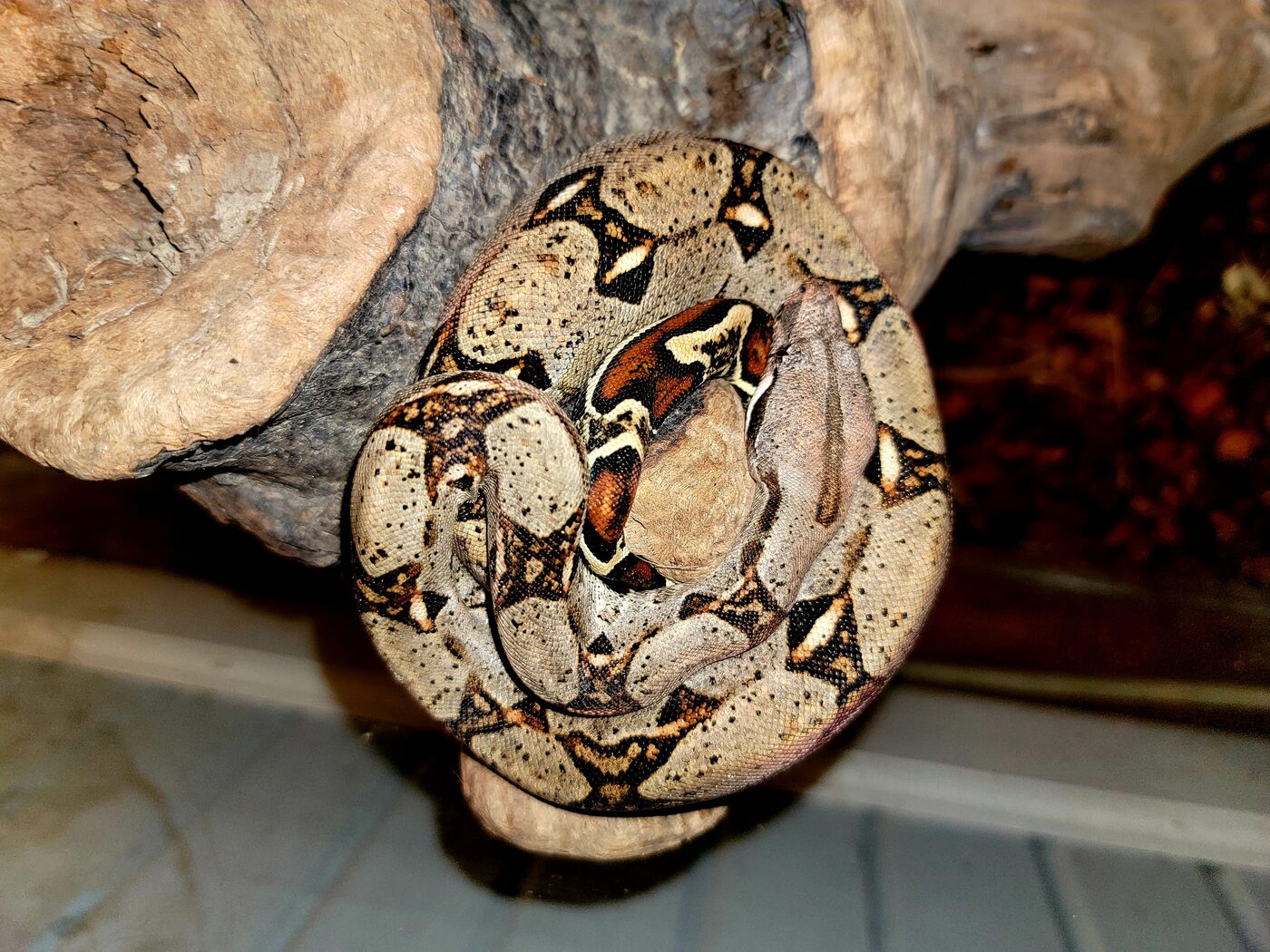
Common boa constrictor (red-tailed boa)
Boa constrictor
A powerful but famously steady big snake.
Pet trade
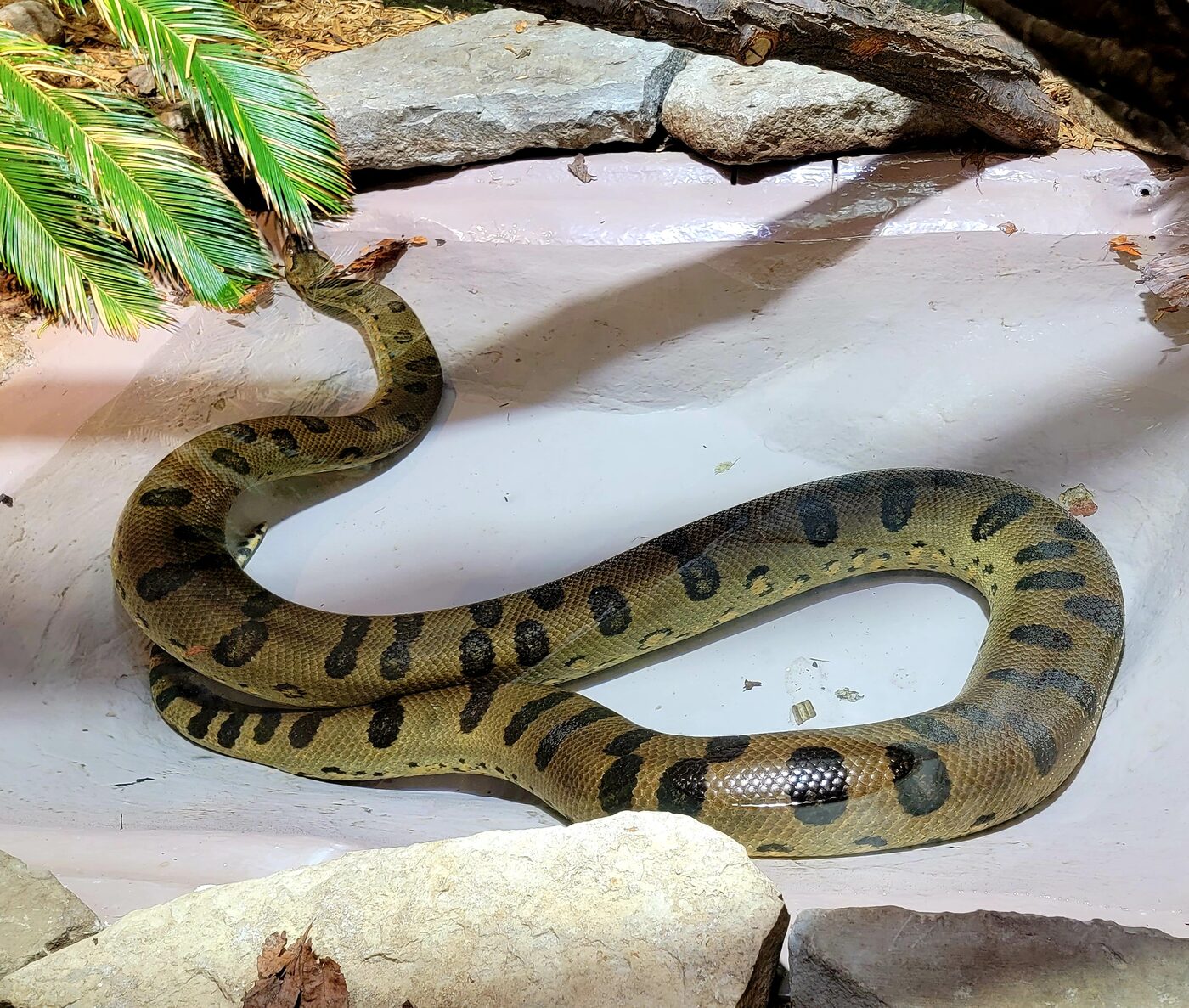
Green anaconda
Eunectes murinus
The heaviest snake on Earth, at home in the water.
Pet trade
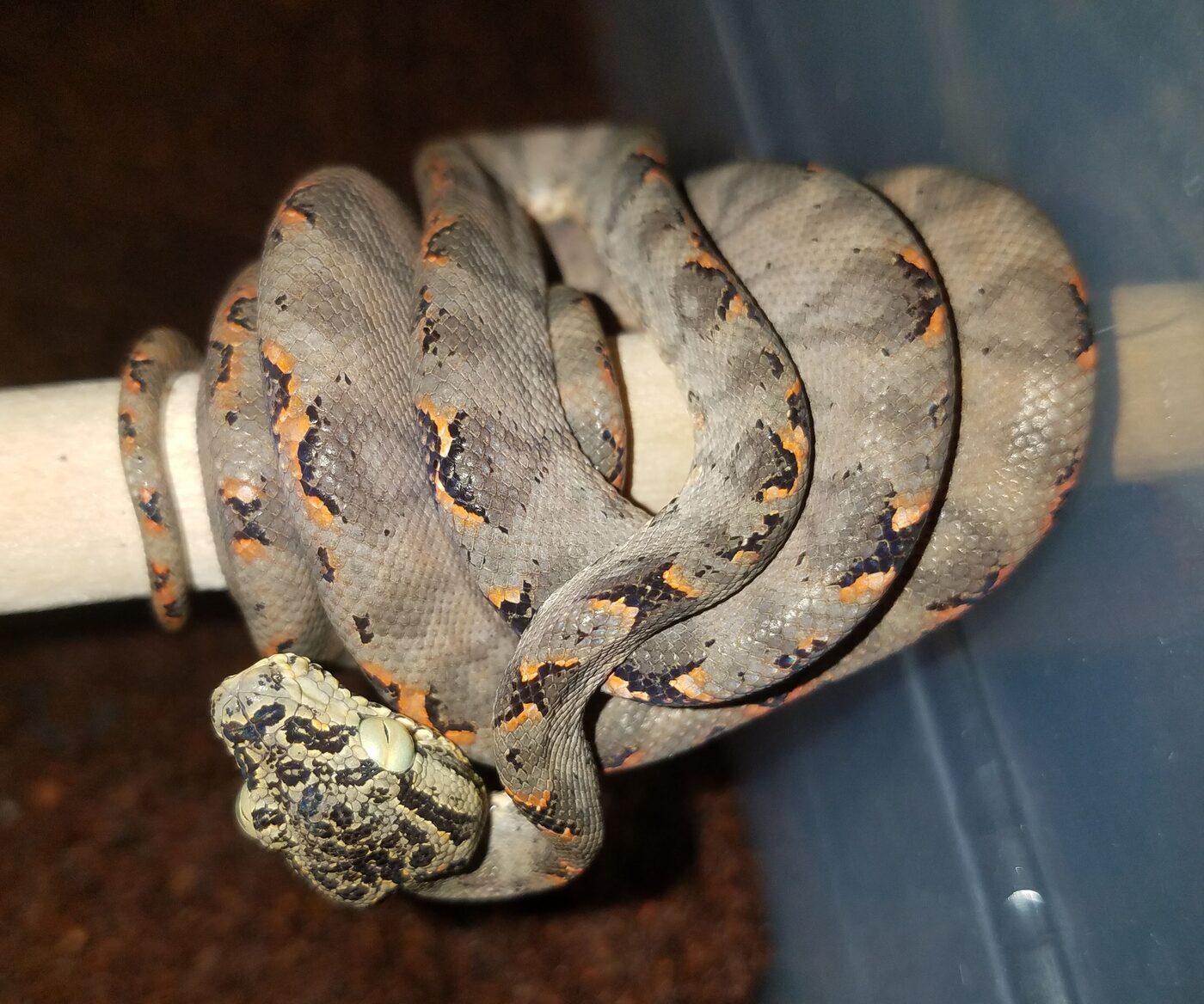
Amazon tree boa
Corallus hortulana
Pet trade

Annulated tree boa
Corallus annulatus
Pet trade

Arabian sand boa
Eryx jayakari
Pet trade

Argentine rainbow boa
Epicrates alvarezi
Pet trade