
Home / Amphibians / Frogs and toads / American green tree frog
No federal permit to keepAmerican green tree frog
Dryophytes cinereus
Amphibians › Frogs and toads (Anura) › Hylidae (Tree frogs)
The American green tree frog (Dryophytes cinereus or Hyla cinerea) is a common arboreal species of New World tree frog belonging to the family Hylidae.

Care at a glance
Species-specific values
Values researched for this exact species. Air, surface and water temperatures are listed separately, and each source is kept as published rather than averaged.
| Warm side air temperature | 70–82 °F Source: reptilesmagazine.com | |
| Diet | Eats worms, crickets, moths, beetles, pillbugs, sowbugs, small spiders, and tiny frogs. Source: reptilesmagazine.com | |
| Social housing | A 10-gallon aquarium can hold up to four frogs; two or three are preferable. Source: reptilesmagazine.com | |
| Substrate | Large natural creek gravel is used as substrate. Source: reptilesmagazine.com | |
| Seasonal cooling | Optional hibernation lasts several months; author keeps frogs in the mid-40s and 50s, avoiding freezing temperatures. Source: reptilesmagazine.com |
Understanding the animal
About this animal
About this animal
This nocturnal insectivore is moderately sized and has a bright green to reddish-brown coloration. Sometimes, light yellowish spots are present on the dorsum.
From Wikipedia: American green tree frog, CC BY-SA 4.0 (excerpt)
In the wild
In the wild
Researched for this exact species, not its family. Wild conditions are context, not enclosure settings.123
| Where it lives | Southeastern United States wetlands, including cypress swamps, willow-lined waterways and vegetated ponds. Adults shelter on leaves, shaded branches, bark and other vertical surfaces. |
| Ground it lives on | Arboreal wetland vegetation; bark, leaves and branch crevices. |
| Climate | Moist temperate/subtropical wetland habitat with geographic winter cooling; numerical wild temperature and humidity ranges were not established. |
| Active | Primarily nocturnal. |
| Social life | Usually solitary; large breeding aggregations form seasonally. Wild territorial organization was not established. |
| Wild diet | Small insects including flies and mosquitoes, plus spiders and snails; moving prey is actively pursued. |
| Behavior to plan for | It relies on foliage and concealed vertical retreats; eggs are attached to vegetation at the water surface. |
Native climate (measured)
Native climate (measured)
| Warm-season highs | about 91°F (up to 95°F in the hottest sampled areas) |
| Cool-season lows | about 38°F (down to 30°F in the coldest sampled areas) |
| Average temperature | 60–71°F across sampled records |
| Relative humidity | 69–72% on average (driest month about 66%) |
| Rainfall | about 1293 mm a year, spread fairly evenly |
| Winters | Cool to cold winters (lows around 38°F) in much of its native range. Seasonal slowdown may be relevant, but species-specific biology determines whether brumation or hibernation occurs. |
Measured at 407 wild occurrence records sampled against WorldClim 2.1 climate data (1970–2000 averages). Air conditions in the range are ecological context, not enclosure settings: microhabitats such as burrows, leaf litter or basking rocks can be cooler, warmer or more humid.
Data and studies
Researched care notes
Researched care notes
Findings checked against veterinary, zoo, welfare, keeper and peer-reviewed sources. Air, basking-surface and water temperatures are kept separate, and where sources disagree both are shown. “Study” notes report what a paper measured, not a universal rule.
American Green Tree Frog
- Provide a tall, secure, ventilated enclosure with connected climbing branches and plants rather than relying on ground area alone.1
- PetMD gives enclosure temperatures of 72–80°F by day and 65–68°F at night; the source does not define these as measured basking-surface or water temperatures.1
- Avoid ingestible gravel or bark pieces and abrasive artificial turf; the source identifies obstruction and skin-injury risks.1
- If keeping same-species frogs together, introduce gradually, monitor compatibility and provide separate hiding resources for each frog.1
- Feed varied suitably sized insects and worms; prey should fit the frog's mouth rather than being oversized.1
Care articles for this species
Care articles for this species
- Green Treefrog Care Sheet (Reptiles Magazine)
Written by keepers, breeders and vets Reptiles MagazineReptiFiles
Sources for this sheet
- Clint's Reptiles (YouTube): Green Tree Frog, The Best Pet Amphibian? Expert educator & keeperClint Laidlaw, PhD in Biology Education and MS in Evolutionary Ecology; owner of Clint's Reptile Room and a longtime keeper. His "Best Pet?" series reviews each species' care in depth.
- AmphibiaWeb (University of California, Berkeley) (CC BY-NC) Peer-reviewed researchUniversity-hosted database of amphibian biology and conservation.
- GBIF Backbone Taxonomy (Global Biodiversity Information Facility) (CC BY 4.0) Peer-reviewed researchInternational scientific taxonomy used here for classification. GBIF Secretariat (2023). GBIF Backbone Taxonomy. Checklist dataset https://doi.org/10.15468/39omei, accessed via GBIF.org.
- Wikipedia (species article) (CC BY-SA 4.0) Community referenceFree encyclopedia; useful overviews with their own citations. Short excerpts are quoted under CC BY-SA 4.0, each credited with a link to its article.
- iNaturalist (captive observations) Community referenceCommunity observation platform run by the California Academy of Sciences and National Geographic; observations marked captive show animals living in homes, zoos and aquariums.
- Reptiles Magazine (care articles) Experienced keeper or breederEstablished reptile and amphibian hobby magazine; care articles are written by breeders, keepers and veterinarians.
More tree frogs

Amazon milk frog
Trachycephalus resinifictrix
Pet trade
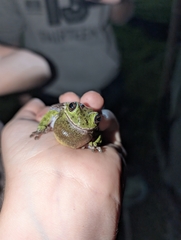
Barking tree frog
Dryophytes gratiosus
Pet trade
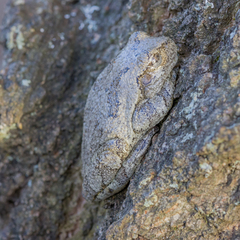
Cope's gray tree frog
Dryophytes chrysoscelis
Pet trade

Cuban tree frog
Osteopilus septentrionalis
Pet trade

European tree frog
Hyla arborea
Zoos & aquariums

Gray tree frog
Dryophytes versicolor
Pet trade