
Home / Amphibians / Frogs and toads / Cope's gray tree frog
No federal permit to keepCope's gray tree frog
Dryophytes chrysoscelis
Amphibians › Frogs and toads (Anura) › Hylidae (Tree frogs)
Cope's gray treefrog (Dryophytes chrysoscelis) is a species of treefrog found in the United States and Canada.
From Wikipedia: Cope's gray treefrog, CC BY-SA 4.0 (excerpt)
Care at a glance
Species-specific values
Values researched for this exact species. Air, surface and water temperatures are listed separately, and each source is kept as published rather than averaged.
| Minimum enclosure | Minimum 45 L; terrarium dimensions are at least 45x45x60 cm. Source: atlarium.bio | |
| Minimum enclosure | Use a vertically oriented terrarium at least 45x45x60 cm. Source: atlarium.bio | |
| Warm side air temperature | 72–79 °F (22–26 °C) Source: atlarium.bio | |
| Humidity | 60–80 % Source: atlarium.bio | |
| Uvb lighting | Provide 5% UVB lighting for calcium synthesis. Source: atlarium.bio | |
| Diet | Provide diverse living prey like roaches, crickets, and flies. Source: atlarium.bio | |
| Feeding frequency | Dust prey with calcium and vitamin D3 supplements three times a week. Source: atlarium.bio | |
| Social housing | Can be safely housed in small groups of the same species. Source: atlarium.bio | |
| Seasonal cooling | 40–50 °F Source: atlarium.bio |
Understanding the animal
About this animal
About this animal
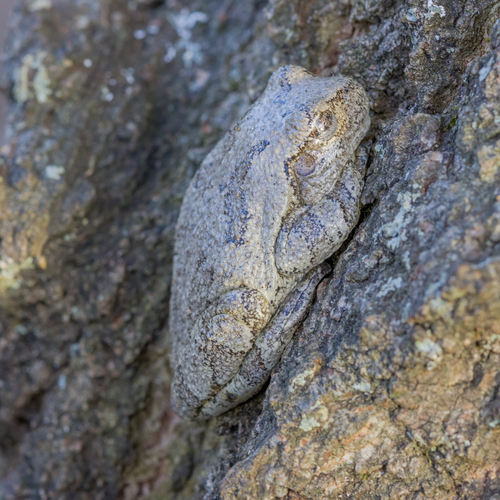
It is almost indistinguishable from the gray treefrog (Dryophytes versicolor), and shares much of its geographic range. Both species are variable in color, mottled gray to gray-green, resembling the bark of trees.
From Wikipedia: Cope's gray treefrog, CC BY-SA 4.0 (excerpt)
In the wild
In the wild
| Overview | Cope's gray treefrog (Dryophytes chrysoscelis) is a species of treefrog found in the United States and Canada. It is almost indistinguishable from the gray treefrog (Dryophytes versicolor), and shares much of its geographic range. Both species are variable in color, mottled gray to gray-green, resembling the bark of trees. These are treefrogs of woodland habitats, though they will sometimes travel into more open areas to reach a breeding pond. — From Wikipedia: Cope's gray treefrog, CC BY-SA 4.0 (excerpt) |
| Where it lives | The range of D. chrysoscelis is more southerly; it is apparently the species found in the lower elevation Piedmont and Coastal Plain of Virginia and the Carolinas. In those areas, D. versicolor may be present only in the Appalachians. While this species is most abundant in the southeast, it can be found as far north as Manitoba. — From Wikipedia: Cope's gray treefrog, CC BY-SA 4.0 (excerpt) |
| Behavior | In the Southeastern United States, Cope's gray treefrog breeds and calls from May to August. Isolated males start calling from woodland areas during warm weather a week or more before migrating to temporary ponds to breed. There they form aggregations (choruses) and call together. — From Wikipedia: Cope's gray treefrog, CC BY-SA 4.0 (excerpt) |
| Appearance and size | D. chrysoscelis (Cope's gray treefrog) is almost indistinguishable from D. versicolor (the gray treefrog). Both species vary in color from mottled gray to gray-green, resembling the bark of trees. Also, both have black-marked bright orange to yellow patches on their hind legs, which distinguishes them from similar-looking species such as the bird-voiced treefrog (D. avivoca). — From Wikipedia: Cope's gray treefrog, CC BY-SA 4.0 (excerpt) |
| History and naming | Edward Drinker Cope described the species in 1880. The specific name, chrysoscelis, is from Greek chrysos, gold, and scelis, leg. Microscopic inspection of the chromosomes of D. chrysoscelis and D. versicolor reveals differences in chromosome number. — From Wikipedia: Cope's gray treefrog, CC BY-SA 4.0 (excerpt) |
Native climate (measured)
Native climate (measured)
| Warm-season highs | about 89°F (up to 92°F in the hottest sampled areas) |
| Cool-season lows | about 29°F (down to 23°F in the coldest sampled areas) |
| Average temperature | 54–66°F across sampled records |
| Relative humidity | 67–71% on average (driest month about 62%) |
| Rainfall | about 1214 mm a year, spread fairly evenly |
| Winters | Cool to cold winters (lows around 29°F) in much of its native range. Seasonal slowdown may be relevant, but species-specific biology determines whether brumation or hibernation occurs. |
Measured at 412 wild occurrence records sampled against WorldClim 2.1 climate data (1970–2000 averages). Air conditions in the range are ecological context, not enclosure settings: microhabitats such as burrows, leaf litter or basking rocks can be cooler, warmer or more humid.
Profile
Profile
Researched for this exact species. Sources are listed under In the wild above.
History
Edward Drinker Cope described the species in 1880. The specific name, chrysoscelis, is from Greek chrysos, gold, and scelis, leg. Microscopic inspection of the chromosomes of D. chrysoscelis and D. versicolor reveals differences in chromosome number.
From Wikipedia: Cope's gray treefrog, CC BY-SA 4.0 (excerpt)
Sources for this sheet
- AmphibiaWeb (University of California, Berkeley) (CC BY-NC) Peer-reviewed researchUniversity-hosted database of amphibian biology and conservation.
- GBIF Backbone Taxonomy (Global Biodiversity Information Facility) (CC BY 4.0) Peer-reviewed researchInternational scientific taxonomy used here for classification. GBIF Secretariat (2023). GBIF Backbone Taxonomy. Checklist dataset https://doi.org/10.15468/39omei, accessed via GBIF.org.
- Wikipedia (species article) (CC BY-SA 4.0) Community referenceFree encyclopedia; useful overviews with their own citations. Short excerpts are quoted under CC BY-SA 4.0, each credited with a link to its article.
- iNaturalist (captive observations) Community referenceCommunity observation platform run by the California Academy of Sciences and National Geographic; observations marked captive show animals living in homes, zoos and aquariums.
More tree frogs

Amazon milk frog
Trachycephalus resinifictrix
Pet trade

American green tree frog
Dryophytes cinereus
Pet trade
Barking tree frog
Dryophytes gratiosus
Pet trade

Cuban tree frog
Osteopilus septentrionalis
Pet trade

European tree frog
Hyla arborea
Zoos & aquariums

Gray tree frog
Dryophytes versicolor
Pet trade