
Home / Amphibians / Frogs and toads / American toad
No federal permit to keepAmerican toad
Anaxyrus americanus
Amphibians › Frogs and toads (Anura) › Bufonidae (Toads)
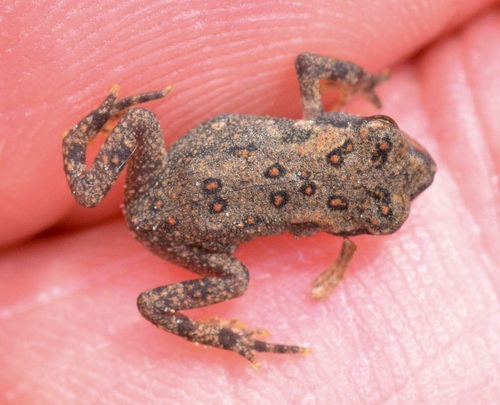
The American toad (Anaxyrus americanus) is a common species of toad found throughout the eastern half of Canada and the United States.
Care at a glance
Species-specific values
Values researched for this exact species. Air, surface and water temperatures are listed separately, and each source is kept as published rather than averaged.
| Minimum enclosure | 20 gallons minimum for one toad Source: reptilesmagazine.com | |
| Social housing | Usually loners; can live with compatible groups, but males together tend to fight. Source: reptilesmagazine.com | |
| Substrate | Use 2–3 inches of moist substrate; coconut fiber or organic dirt mixed with frog moss works. Source: reptilesmagazine.com | |
| Humidity | Mist at least twice daily or use an auto-mister to keep the substrate misty. Source: reptilesmagazine.com |
Understanding the animal
About this animal
About this animal
It is divided into three subspecies: the eastern American toad (A. a. americanus), the dwarf American toad (A. a.
From Wikipedia: American toad, CC BY-SA 4.0 (excerpt)
In the wild
In the wild
Researched for this exact species, not its family. Wild conditions are context, not enclosure settings.12
| Where it lives | Terrestrial forests, fields and gardens across much of eastern and central Canada and the United States. Shelters under logs and stones or in soil and leaf litter, returning to freshwater pools to breed. |
| Ground it lives on | Loose soil and leaf litter under logs, rocks and vegetation. |
| Water it lives in | Freshwater ponds and pools for breeding and tadpoles; adults are primarily terrestrial. Typical chemistry and temperature ranges were not established. |
| Climate | Most active in warm, humid weather; cold-climate populations overwinter underground. Numerical wild temperature and humidity ranges were not established. |
| Active | Primarily nocturnal; winter hibernation/brumation underground in cold regions. |
| Social life | Solitary outside temporary breeding congregations. |
| Wild diet | Adults eat insects, spiders, snails and worms; tadpoles graze algae and other organic material. |
| Behavior to plan for | Digs backward with its hind feet to bury itself. Skin glands release defensive toxic secretions; these are poison rather than injected venom. |
Native climate (measured)
Native climate (measured)
| Warm-season highs | about 89°F (up to 90°F in the hottest sampled areas) |
| Cool-season lows | about 28°F (down to 20°F in the coldest sampled areas) |
| Average temperature | 52–61°F across sampled records |
| Relative humidity | 67–71% on average (driest month about 61%) |
| Rainfall | about 1171 mm a year, spread fairly evenly |
| Winters | Cool to cold winters (lows around 28°F) in much of its native range. Seasonal slowdown may be relevant, but species-specific biology determines whether brumation or hibernation occurs. |
Measured at 108 wild occurrence records sampled against WorldClim 2.1 climate data (1970–2000 averages). Air conditions in the range are ecological context, not enclosure settings: microhabitats such as burrows, leaf litter or basking rocks can be cooler, warmer or more humid.
Data and studies
The numbers
The numbers
Each bar is what one source reports. Where several sources weigh in, the dashed gold band marks their average.
Maximum recorded lifespan
Longest recorded lifespan reported by each database; typical lifespans are usually shorter. The AnAge record comes from an animal in human care.
Typical adult weight
Average adult body mass in each database (FishBase gives the maximum recorded weight).
Incubation
Female maturity
Care articles for this species
Care articles for this species
- American Toad Care And History (Reptiles Magazine)
- American Toad Care And Husbandry (Reptiles Magazine)
Written by keepers, breeders and vets Reptiles MagazineReptiFiles
Veterinary & husbandry research
Veterinary & husbandry research
- A comparison of human chorionic gonadotropin and luteinizing hormone releasing hormone on the induction of spermiation and amplexus in the American toad (Anaxyrus americanus) Kouba AJ et al., Reproductive biology and endocrinology: RB&E 2012
Peer-reviewed papers that mention this species alongside captivity, zoos, veterinary care or aquaculture. Some cover several species or mention it only in passing, so check the abstract. PubMed
Sources for this sheet
- AnAge: The Animal Ageing and Longevity Database (Human Ageing Genomic Resources) (CC BY 3.0) Peer-reviewed researchCurated, referenced longevity and life-history records for thousands of species; maximum lifespans are often from zoo animals.
- AmphibiaWeb (University of California, Berkeley) (CC BY-NC) Peer-reviewed researchUniversity-hosted database of amphibian biology and conservation.
- GBIF Backbone Taxonomy (Global Biodiversity Information Facility) (CC BY 4.0) Peer-reviewed researchInternational scientific taxonomy used here for classification. GBIF Secretariat (2023). GBIF Backbone Taxonomy. Checklist dataset https://doi.org/10.15468/39omei, accessed via GBIF.org.
- Wikipedia (species article) (CC BY-SA 4.0) Community referenceFree encyclopedia; useful overviews with their own citations. Short excerpts are quoted under CC BY-SA 4.0, each credited with a link to its article.
- PubMed (U.S. National Library of Medicine) Peer-reviewed researchIndex of peer-reviewed veterinary, zoo and husbandry research.
- iNaturalist (captive observations) Community referenceCommunity observation platform run by the California Academy of Sciences and National Geographic; observations marked captive show animals living in homes, zoos and aquariums.
- Reptiles Magazine (care articles) Experienced keeper or breederEstablished reptile and amphibian hobby magazine; care articles are written by breeders, keepers and veterinarians.
More toads

Asian common toad
Duttaphrynus melanostictus
Pet trade
Cane toad
Rhinella marina
Pet trade

Colorado river toad
Incilius alvarius
Pet trade

Common European toad
Bufo bufo
Pet trade

Cuban toad
Peltophryne peltocephala
Zoos & aquariums

Great Plains toad
Anaxyrus cognatus
Zoos & aquariums