
Home / Reptiles / Snakes / Boidae / Arabian sand boa
Some federal rules applyArabian sand boa
Eryx jayakari
Reptiles › Snakes (Serpentes) › Boidae (Boas)
Eryx jayakari, known commonly as the Arabian sand boa or Jayakar's sand boa, is a species of snake in the family Boidae.
From Wikipedia: Eryx jayakari, CC BY-SA 4.0 (excerpt)

Care at a glance
Species-specific values
Values researched for this exact species. Air, surface and water temperatures are listed separately, and each source is kept as published rather than averaged.
| Minimum enclosure | Adult sand boas can be kept in a 15–20 gallon aquarium. Source: reptile.guide | |
| Night temperature | Nighttime temperature can drop to the mid-70s. Source: reptile.guide | |
| Humidity | up to 50 % Source: reptile.guide | |
| Uvb lighting | Some keepers believe UVB lighting, though not essential, is beneficial. Source: reptile.guide | |
| Diet | Offer dead prey no larger than the snake's widest part; listed options include hamsters, small rats, mice, and lizards. Source: reptile.guide | |
| Substrate | Suggested substrates include shredded newspaper or paper towels and aspen chips; use enough depth for burrowing. Source: reptile.guide |
Understanding the animal
About this animal
About this animal
The species is endemic to the Arabian Peninsula and Iran where it spends the day buried in the sand.
From Wikipedia: Eryx jayakari, CC BY-SA 4.0 (excerpt)
In the wild
In the wild
| Overview | Eryx jayakari, known commonly as the Arabian sand boa or Jayakar's sand boa, is a species of snake in the family Boidae. The species is endemic to the Arabian Peninsula and Iran where it spends the day buried in the sand. — From Wikipedia: Eryx jayakari, CC BY-SA 4.0 (excerpt) |
| Where it lives | Eryx jayakari is a desert species of snake, living semi-underground in sand or soft soil. — From Wikipedia: Eryx jayakari, CC BY-SA 4.0 (excerpt) |
| Behavior | The Arabian sand boa is largely nocturnal and is tolerant of a wide range of temperatures. During the day it buries itself deep in the sand but moves towards the surface at dusk. Here it remains slightly below the surface with just its eyes projecting, ready to pounce with a sideways flick of its head on any small creature that happens to pass. — From Wikipedia: Eryx jayakari, CC BY-SA 4.0 (excerpt) |
| Reproduction | Unlike other members of the Boidae family, the Arabian sand boa lays eggs instead of giving birth to live young. The only other Boidae species known to do this is the Mullers sand boa. The female lays a small clutch of 5 to 13 eggs which hatch in about 66 days at a temperature of 33 °C. The hatchlings typically weigh between 3 and 7 grams. — From Wikipedia: Eryx jayakari, CC BY-SA 4.0 (excerpt) |
| Appearance and size | The Arabian sand boa is a small snake growing to a total length (including tail) of about 38 cm. The eyes are very small and are located on the top of the head, which has a blunt snout and is wedge-shaped. This snake's colour is yellowish-grey or sandy-brown speckled with white flecks and transversely banded with dark marks. — From Wikipedia: Eryx jayakari, CC BY-SA 4.0 (excerpt) |
| Conservation | The Arabian sand boa is listed by the IUCN as being of "Least Concern". This is because it has a very wide range, is common in at least parts of that range, and no particular threats have been identified. — From Wikipedia: Eryx jayakari, CC BY-SA 4.0 (excerpt) |
Read about this species in the wild at The Reptile Database.
Native climate (measured)
Native climate (measured)
| Warm-season highs | about 108°F (up to 110°F in the hottest sampled areas) |
| Cool-season lows | about 54°F (down to 43°F in the coldest sampled areas) |
| Average temperature | 77–82°F across sampled records |
| Relative humidity | 45–53% on average (driest month about 36%) |
| Rainfall | about 134 mm a year, with strong wet and dry seasons |
Measured at 95 wild occurrence records sampled against WorldClim 2.1 climate data (1970–2000 averages). Air conditions in the range are ecological context, not enclosure settings: microhabitats such as burrows, leaf litter or basking rocks can be cooler, warmer or more humid.
Profile
Profile
Researched for this exact species. Sources are listed under In the wild above.
Sources for this sheet
- Species+ (UNEP-WCMC and the CITES Secretariat) Zoo, university or veterinaryThe official database of species listed under CITES. UNEP (2026). The Species+ Website. Nairobi, Kenya. Compiled by UNEP-WCMC, Cambridge, UK. Available at: www.speciesplus.net. [Accessed 04/10/2026].
- USFWS International Affairs: CITES Zoo, university or veterinaryFederal agency that issues CITES permits.
- The Reptile Database Peer-reviewed researchScientist-curated catalog of every reptile species, with taxonomy and literature.
- GBIF Backbone Taxonomy (Global Biodiversity Information Facility) (CC BY 4.0) Peer-reviewed researchInternational scientific taxonomy used here for classification. GBIF Secretariat (2023). GBIF Backbone Taxonomy. Checklist dataset https://doi.org/10.15468/39omei, accessed via GBIF.org.
- Wikipedia (species article) (CC BY-SA 4.0) Community referenceFree encyclopedia; useful overviews with their own citations. Short excerpts are quoted under CC BY-SA 4.0, each credited with a link to its article.
- iNaturalist (captive observations) Community referenceCommunity observation platform run by the California Academy of Sciences and National Geographic; observations marked captive show animals living in homes, zoos and aquariums.
More boas
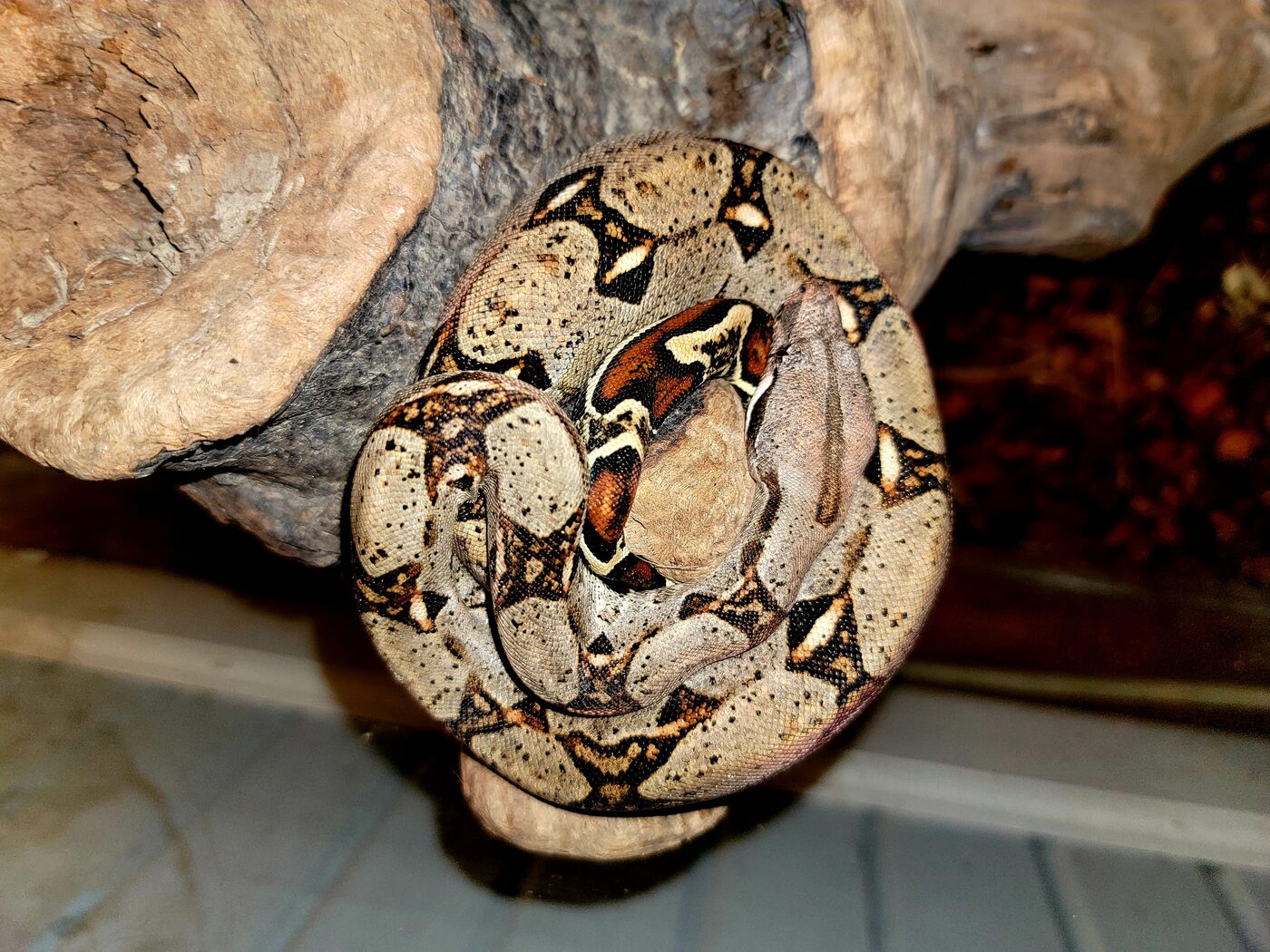
Common boa constrictor (red-tailed boa)
Boa constrictor
A powerful but famously steady big snake.
Pet trade
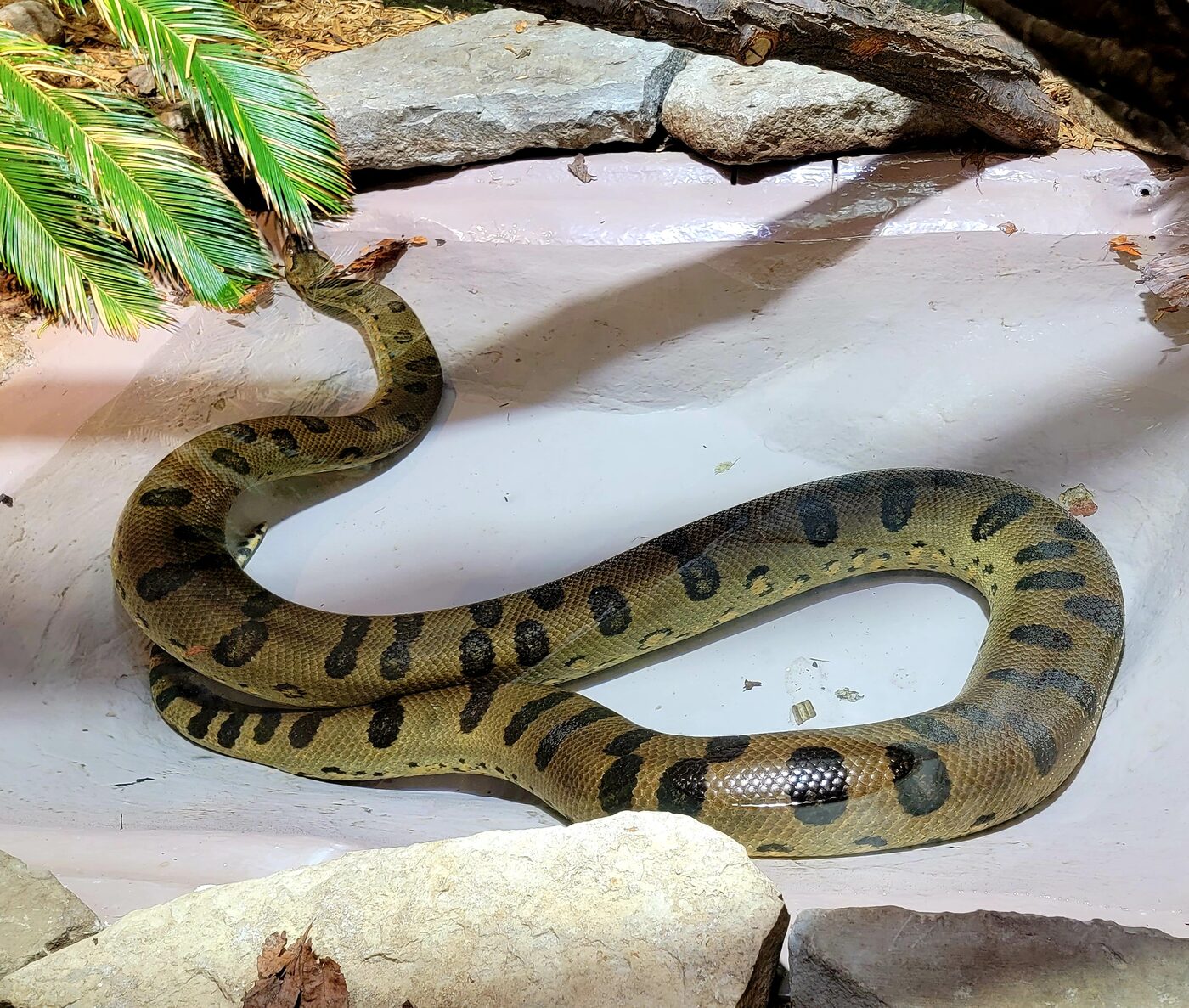
Green anaconda
Eunectes murinus
The heaviest snake on Earth, at home in the water.
Pet trade

Amazon basin emerald tree boa
Corallus batesii
Pet trade
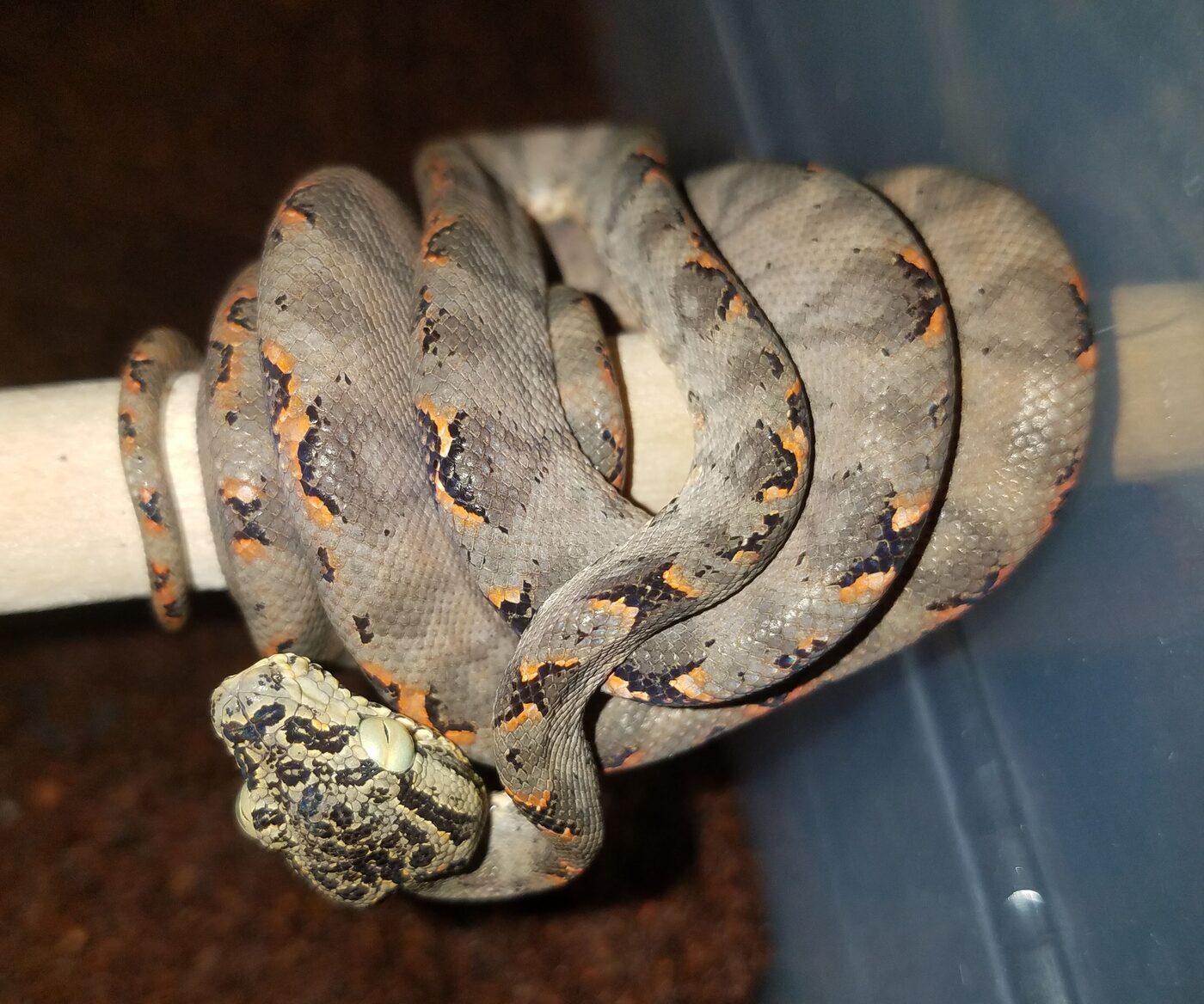
Amazon tree boa
Corallus hortulana
Pet trade

Annulated tree boa
Corallus annulatus
Pet trade

Argentine rainbow boa
Epicrates alvarezi
Pet trade