
Home / Invertebrates / Scorpions / Asian forest scorpion
No federal permit to keepAsian forest scorpion
Heterometrus spinifer
Invertebrates › Scorpions (Scorpiones) › Scorpionidae (Emperor and forest scorpions)
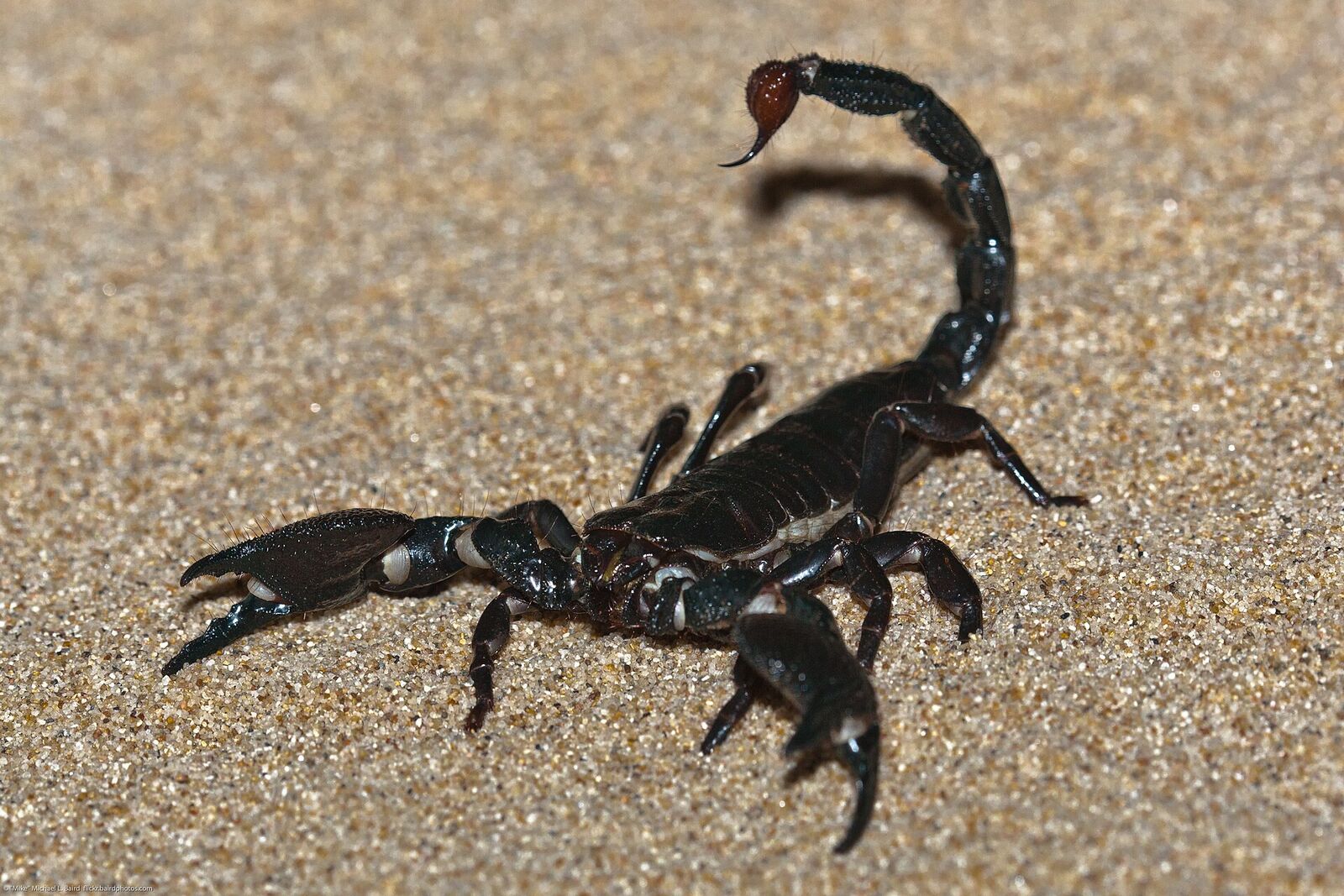
Heterometrus spinifer, or its common name, Malaysian forest scorpion, is a species of scorpions belonging to the family Scorpionidae.
From Wikipedia: Heterometrus spinifer, CC BY-SA 4.0 (excerpt)

Care at a glance
Species-specific values
Values researched for this exact species. Air, surface and water temperatures are listed separately, and each source is kept as published rather than averaged.
| Enclosure temperature | 75–80 degF Veterinary sheet gives enclosure temperatures with IR measurement advice; not a proven air-versus-surface optimum. Applied from genus-level Heterometrus guidance; not a species-specific trial. | exoticpetvet.com |
| Substrate moisture | Deep burrowable substrate with one moist end; avoid soggy conditions. Asian forest scorpion husbandry; differs from desert species. Applied from genus-level Heterometrus guidance; not a species-specific trial. | exoticpetvet.com |
| Minimum enclosure | At least 45 × 30 × 30 cm for an adult enclosure. Source: academy.herpeton.net | |
| Warm side air temperature | 82–86 °F (28–30 °C) Source: academy.herpeton.net | |
| Cool side air temperature | 72–75 °F (22–24 °C) Source: academy.herpeton.net | |
| Night temperature | 70–75 °F (21–24 °C) Source: academy.herpeton.net | |
| Humidity | 75–85 % Source: academy.herpeton.net | |
| Uvb lighting | UVB is not required. Source: academy.herpeton.net | |
| Diet | Give captive-bred locusts, crickets, or roaches of appropriate size. Source: academy.herpeton.net | |
| Social housing | Keep one adult per enclosure. Source: academy.herpeton.net | |
| Substrate | Provide 15–20 cm of compactable organic topsoil mixed with coco fibre and leaf litter. Source: academy.herpeton.net |
Understanding the animal
In the wild
In the wild
| Overview | Heterometrus spinifer, or its common name, Malaysian forest scorpion, is a species of scorpions belonging to the family Scorpionidae. — From Wikipedia: Heterometrus spinifer, CC BY-SA 4.0 (excerpt) |
| Where it lives | This species can be found in Southeast Asia, including Malaysia, Thailand, Indonesia, Cambodia, Vietnam, Sri Lanka, India, and other Southeast Asian countries. Generally, these terrestrial scorpions live in moist forests in the dark undergrowth under logs or other debris, and they burrow into the ground where they hide during the day. — From Wikipedia: Heterometrus spinifer, CC BY-SA 4.0 (excerpt) |
| Appearance and size | H. spinifer can reach a length around 10 to 12 cm. The body is shiny black with gray-green reflections. The pincers are highly developed. — From Wikipedia: Heterometrus spinifer, CC BY-SA 4.0 (excerpt) |
Native climate (measured)
Native climate (measured)
| Warm-season highs | about 88°F (up to 91°F in the hottest sampled areas) |
| Cool-season lows | about 70°F (down to 64°F in the coldest sampled areas) |
| Average temperature | 73–81°F across sampled records |
| Relative humidity | 81–84% on average (driest month about 78%) |
| Rainfall | about 2496 mm a year, spread fairly evenly |
Measured at 120 wild occurrence records sampled against WorldClim 2.1 climate data (1970–2000 averages). Air conditions in the range are ecological context, not enclosure settings: microhabitats such as burrows, leaf litter or basking rocks can be cooler, warmer or more humid.
Sources for this sheet
- GBIF Backbone Taxonomy (Global Biodiversity Information Facility) (CC BY 4.0) Peer-reviewed researchInternational scientific taxonomy used here for classification. GBIF Secretariat (2023). GBIF Backbone Taxonomy. Checklist dataset https://doi.org/10.15468/39omei, accessed via GBIF.org.
- Wikipedia (species article) (CC BY-SA 4.0) Community referenceFree encyclopedia; useful overviews with their own citations. Short excerpts are quoted under CC BY-SA 4.0, each credited with a link to its article.
- iNaturalist (captive observations) Community referenceCommunity observation platform run by the California Academy of Sciences and National Geographic; observations marked captive show animals living in homes, zoos and aquariums.
More emperor and forest scorpions
Emperor scorpion
Pandinus imperator
A big, shy scorpion with a mild sting.
Pet trade

Asian giant forest scorpion
Heterometrus laoticus
Pet trade
Heterometrus longimanus
Heterometrus longimanus
Pet trade

Heterometrus silenus
Heterometrus silenus
Pet trade

Tanzanian red-clawed scorpion
Pandinus cavimanus
Pet trade
Scorpion
Pandinus dictator
Pet trade