
Home / Invertebrates / Scorpions / Heterometrus silenus
No federal permit to keepHeterometrus silenus
Heterometrus silenus
Invertebrates › Scorpions (Scorpiones) › Scorpionidae (Emperor and forest scorpions)

Care at a glance
Species-specific values
Values researched for this exact species. Air, surface and water temperatures are listed separately, and each source is kept as published rather than averaged.
| Minimum enclosure | Adult minimum enclosure dimensions are 30 x 30 x 30 cm. Source: academy.herpeton.net | |
| Warm area temperature | 82–86 °F (28–30 °C) Source: academy.herpeton.net | |
| Warm side air temperature | 75–82 °F (24–28 °C) Source: academy.herpeton.net | |
| Cool side air temperature | 72–75 °F (22–24 °C) Source: academy.herpeton.net | |
| Night temperature | 70–75 °F (21–24 °C) Source: academy.herpeton.net | |
| Humidity | 70–85 % Source: academy.herpeton.net | |
| Uvb lighting | UVB is not required; use ambient room light for a steady day-night rhythm. Source: academy.herpeton.net | |
| Diet | Feed crickets, roaches, locusts, or similar safe insects. Source: academy.herpeton.net | |
| Feeding frequency | Most adults take one suitable prey item every 7-14 days. Source: academy.herpeton.net | |
| Social housing | Keep one adult per enclosure; communal housing risks cannibalism and stress. Source: academy.herpeton.net | |
| Substrate | Use 10-15 cm of moisture-holding substrate, such as coco fiber, soil, leaf litter, and some clay. Source: academy.herpeton.net | |
| Minimum enclosure | 10 litres is stated as plenty for one adult. Source: geoscorps.co.uk | |
| Warm side air temperature | 75–82 °F (24–28 °C) Source: geoscorps.co.uk | |
| Humidity | 80 % Source: geoscorps.co.uk | |
| Substrate | Use water-retentive soil. Source: geoscorps.co.uk | |
| Feeding frequency | Feed once every week. Source: geoscorps.co.uk | |
| Social housing | The stats section rates the species as communal. Source: geoscorps.co.uk |
Understanding the animal
Native climate (measured)
Native climate (measured)
| Warm-season highs | about 91°F (up to 95°F in the hottest sampled areas) |
| Cool-season lows | about 68°F (down to 60°F in the coldest sampled areas) |
| Average temperature | 75–82°F across sampled records |
| Relative humidity | 75–79% on average (driest month about 69%) |
| Rainfall | about 1848 mm a year |
Measured at 43 wild occurrence records sampled against WorldClim 2.1 climate data (1970–2000 averages). Air conditions in the range are ecological context, not enclosure settings: microhabitats such as burrows, leaf litter or basking rocks can be cooler, warmer or more humid.
Sources for this sheet
- GBIF Backbone Taxonomy (Global Biodiversity Information Facility) (CC BY 4.0) Peer-reviewed researchInternational scientific taxonomy used here for classification. GBIF Secretariat (2023). GBIF Backbone Taxonomy. Checklist dataset https://doi.org/10.15468/39omei, accessed via GBIF.org.
- iNaturalist (captive observations) Community referenceCommunity observation platform run by the California Academy of Sciences and National Geographic; observations marked captive show animals living in homes, zoos and aquariums.
More emperor and forest scorpions
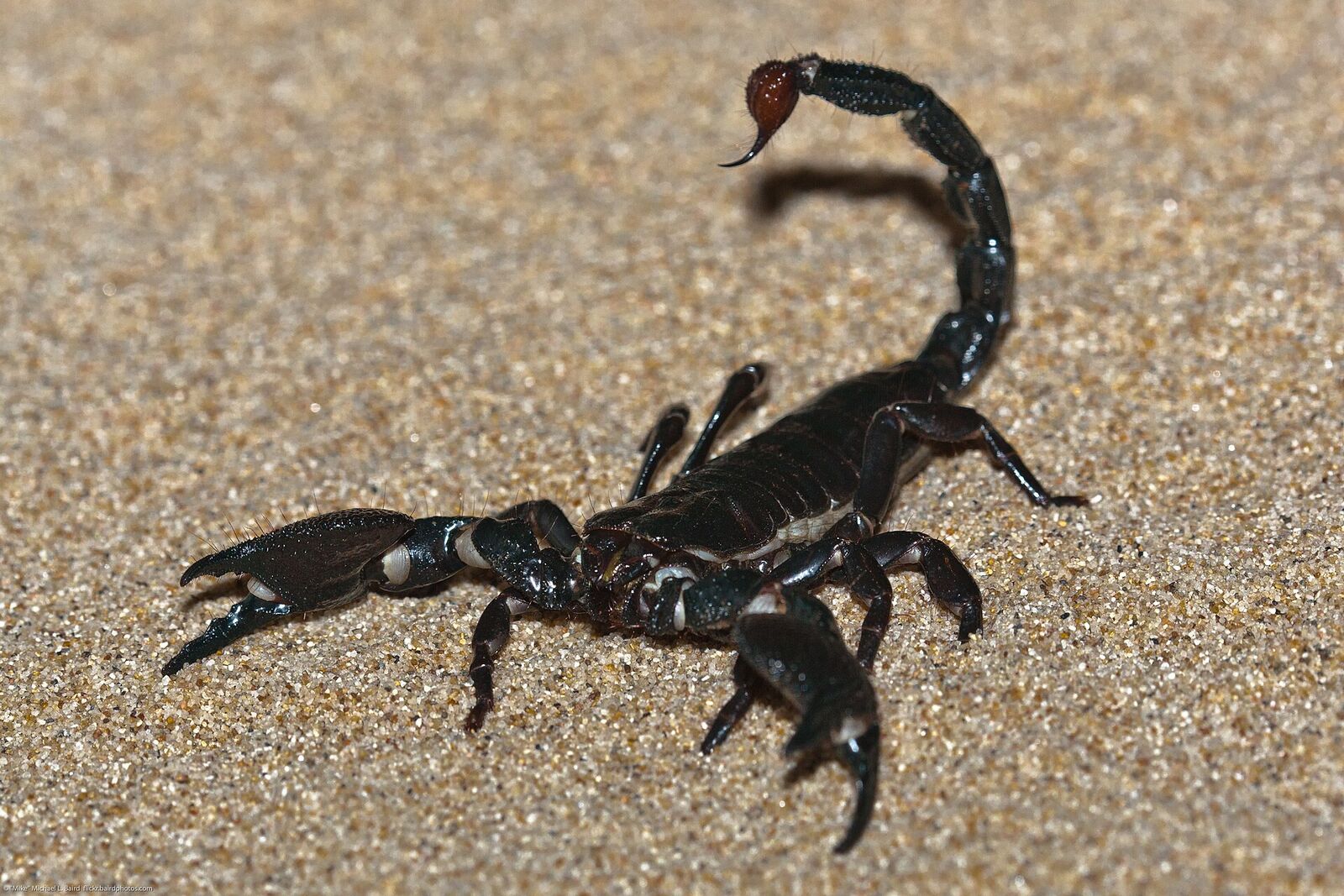
Emperor scorpion
Pandinus imperator
A big, shy scorpion with a mild sting.
Pet trade

Asian forest scorpion
Heterometrus spinifer
Pet trade

Asian giant forest scorpion
Heterometrus laoticus
Pet trade
Heterometrus longimanus
Heterometrus longimanus
Pet trade

Tanzanian red-clawed scorpion
Pandinus cavimanus
Pet trade
Scorpion
Pandinus dictator
Pet trade