
Home / Amphibians / Salamanders and newts / Chinese warty newt
Federal restrictions applyChinese warty newt
Paramesotriton chinensis
Amphibians › Salamanders and newts (Caudata) › Salamandridae (Newts and fire salamanders)
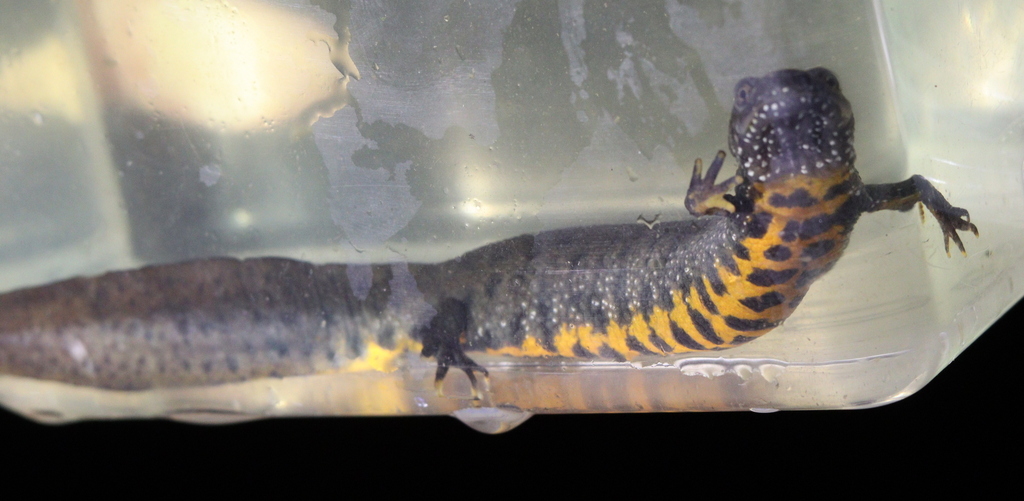
The Chinese warty newt (Paramesotriton chinensis) is a species of salamander in the family Salamandridae.
From Wikipedia: Chinese warty newt, CC BY-SA 4.0 (excerpt)

Care at a glance
Species-specific values
Values researched for this exact species. Air, surface and water temperatures are listed separately, and each source is kept as published rather than averaged.
| Minimum enclosure | A standard 10-gallon aquarium is the minimum for one newt. Source: reptilesmagazine.com | |
| Water temperature | up to 72 °F Source: reptilesmagazine.com | |
| Uvb lighting | Strong lighting is not required; one fluorescent tube can provide a regular day and night cycle. Source: reptilesmagazine.com | |
| Diet | Accepts live foods including earthworms, crickets, waxworms, mealworms, and roaches, plus shrimp sections and turtle sticks. Source: reptilesmagazine.com | |
| Feeding frequency | Adults: twice weekly; juveniles: three to four times weekly; larvae: daily live food. Source: reptilesmagazine.com | |
| Substrate | Substrate may be sand, large-grade gravel, or omitted; wash it thoroughly first. Source: reptilesmagazine.com |
Warnings
Understanding the animal
About this animal
About this animal
It is found only in China, with a range extending from Chongqing to Hunan, Anhui, Zhejiang, Fujian, Guangdong, and Guangxi Provinces in Central China. Its natural habitats are subtropical or tropical moist lowland forests, rivers, and freshwater marshes.
From Wikipedia: Chinese warty newt, CC BY-SA 4.0 (excerpt)
In the wild
In the wild
| Overview | The Chinese warty newt (Paramesotriton chinensis) is a species of salamander in the family Salamandridae. It is found only in China, with a range extending from Chongqing to Hunan, Anhui, Zhejiang, Fujian, Guangdong, and Guangxi Provinces in Central China. Its natural habitats are subtropical or tropical moist lowland forests, rivers, and freshwater marshes. It is not considered threatened by the IUCN. — From Wikipedia: Chinese warty newt, CC BY-SA 4.0 (excerpt) |
Native climate (measured)
Native climate (measured)
| Warm-season highs | about 86°F (up to 89°F in the hottest sampled areas) |
| Cool-season lows | about 34°F (down to 31°F in the coldest sampled areas) |
| Average temperature | 58–63°F across sampled records |
| Relative humidity | 77–78% on average (driest month about 70%) |
| Rainfall | about 1478 mm a year |
| Winters | Cool to cold winters (lows around 34°F) in much of its native range. Seasonal slowdown may be relevant, but species-specific biology determines whether brumation or hibernation occurs. |
Measured at 26 wild occurrence records sampled against WorldClim 2.1 climate data (1970–2000 averages). Air conditions in the range are ecological context, not enclosure settings: microhabitats such as burrows, leaf litter or basking rocks can be cooler, warmer or more humid.
Data and studies
The numbers
The numbers
Each bar is what one source reports. Where several sources weigh in, the dashed gold band marks their average.
Maximum recorded lifespan
Longest recorded lifespan reported by each database; typical lifespans are usually shorter. The AnAge record comes from an animal in human care.
Sources for this sheet
- AnAge: The Animal Ageing and Longevity Database (Human Ageing Genomic Resources) (CC BY 3.0) Peer-reviewed researchCurated, referenced longevity and life-history records for thousands of species; maximum lifespans are often from zoo animals.
- 50 CFR Part 16: Injurious wildlife (Lacey Act) Zoo, university or veterinaryCurrent federal regulation, read from eCFR.
- U.S. Association of Reptile Keepers v. Zinke (D.C. Cir. 2017) Zoo, university or veterinaryAppeals ruling that the Lacey Act's shipping ban does not cover moves between the continental states.
- Species+ (UNEP-WCMC and the CITES Secretariat) Zoo, university or veterinaryThe official database of species listed under CITES. UNEP (2026). The Species+ Website. Nairobi, Kenya. Compiled by UNEP-WCMC, Cambridge, UK. Available at: www.speciesplus.net. [Accessed 04/10/2026].
- USFWS International Affairs: CITES Zoo, university or veterinaryFederal agency that issues CITES permits.
- AmphibiaWeb (University of California, Berkeley) (CC BY-NC) Peer-reviewed researchUniversity-hosted database of amphibian biology and conservation.
- Wikipedia (species article) (CC BY-SA 4.0) Community referenceFree encyclopedia; useful overviews with their own citations. Short excerpts are quoted under CC BY-SA 4.0, each credited with a link to its article.
- iNaturalist (captive observations) Community referenceCommunity observation platform run by the California Academy of Sciences and National Geographic; observations marked captive show animals living in homes, zoos and aquariums.
More newts and fire salamanders

Algerian newt
Pleurodeles poireti
Zoos & aquariums

Algerian ribbed newt
Pleurodeles nebulosus
Pet trade

Alpine newt
Ichthyosaura alpestris
Pet trade

California newt
Taricha torosa
Pet trade

Chinese fire-bellied newt
Hypselotriton orientalis
Pet trade
Danube crested newt
Triturus dobrogicus
Pet trade