
Home / Amphibians / Salamanders and newts / Algerian ribbed newt
Federal restrictions applyAlgerian ribbed newt
Pleurodeles nebulosus
Amphibians › Salamanders and newts (Caudata) › Salamandridae (Newts and fire salamanders)
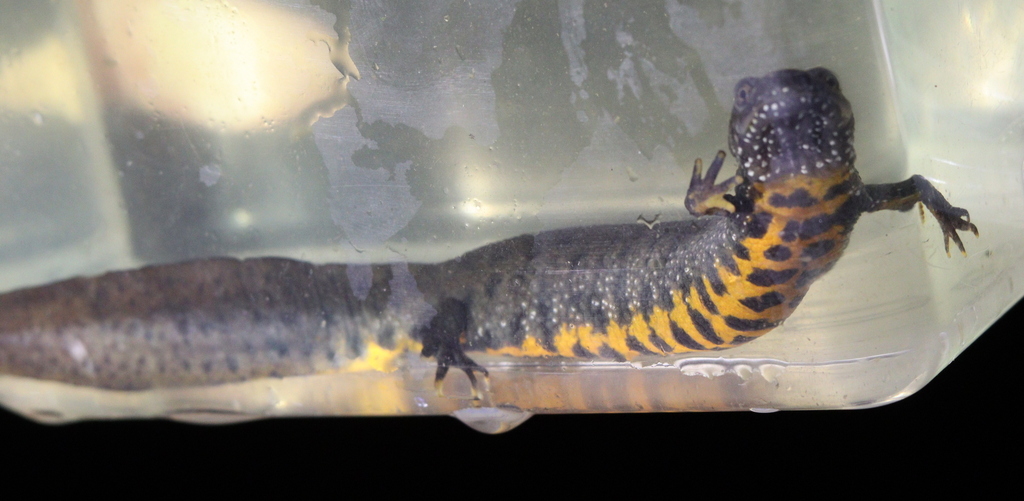
The Algerian ribbed newt (Pleurodeles nebulosus) is a species of salamander in the family Salamandridae found in Algeria and Tunisia.
From Wikipedia: Algerian ribbed newt, CC BY-SA 4.0 (excerpt)

Care at a glance
Species-specific values
Values researched for this exact species. Air, surface and water temperatures are listed separately, and each source is kept as published rather than averaged.
| Minimum enclosure | An aquarium of 100–120 litres accommodates a small group of 5–9 individuals. Source: salamanderland.com | |
| Minimum enclosure | Smaller tanks of 70 or 80 litres are sufficient for a couple or trio. Source: salamanderland.com | |
| Humidity | Maintain average humidity at substrate and air levels; keep substrate humid but not soaked. Source: salamanderland.com | |
| Substrate | The substrate may be fine-grained sand, large pebbles, or bare; avoid intermediate-sized gravel. Source: salamanderland.com | |
| Uvb lighting | Lighting is not essential; 5–8 hours of light are recommended, depending on season. Source: salamanderland.com | |
| Basking surface temperature | Optimal temperatures should not exceed 25–27 C°. Source: salamanderland.com | |
| Night temperature | 50–59 °F (10–15 °C) Source: salamanderland.com | |
| Diet | Adults/subadults may eat earthworms and frozen Chironomus larvae as staples, with other listed prey to vary the diet. Source: salamanderland.com | |
| Feeding frequency | Feed adult/subadult prey 2–3 times weekly; less often in winter, more often during reproduction; feed young more often. Source: salamanderland.com | |
| Social housing | An aquarium of 100–120 litres can house a small group of 5–9 individuals. Source: salamanderland.com | |
| Seasonal cooling | In winter, temperatures should drop below 20°C to encourage reproduction and gonad maturation. Source: salamanderland.com |
Warnings
Understanding the animal
About this animal
About this animal
The natural habitats of this newt are rivers, intermittent rivers, swamps, cisterns, freshwater marshes, intermittent freshwater marshes, and ponds. It is threatened by habitat destruction.
From Wikipedia: Algerian ribbed newt, CC BY-SA 4.0 (excerpt)
In the wild
In the wild
| Overview | The Algerian ribbed newt (Pleurodeles nebulosus) is a species of salamander in the family Salamandridae found in Algeria and Tunisia. The natural habitats of this newt are rivers, intermittent rivers, swamps, cisterns, freshwater marshes, intermittent freshwater marshes, and ponds. It is threatened by habitat destruction. — From Wikipedia: Algerian ribbed newt, CC BY-SA 4.0 (excerpt) |
| Appearance and size | The Algerian ribbed newt is a medium-sized species growing to a length of about 23 cm. The head is flattened and has small eyes and a rounded snout. The body is somewhat flattened and the tail of the male is longer than that of the female. — From Wikipedia: Algerian ribbed newt, CC BY-SA 4.0 (excerpt) |
| History and naming | Formerly, this species was confused with Pleurodeles poireti. Carranza and Wade (2004) found out that most North African Pleurodeles species that had previously been referred to as P. poireti were in fact Pleurodeles nebulosus, an altogether different species. The true P. poireti newts are found only on the Edough Massif, in northeast Algeria. — From Wikipedia: Algerian ribbed newt, CC BY-SA 4.0 (excerpt) |
Native climate (measured)
Native climate (measured)
| Warm-season highs | about 89°F (up to 94°F in the hottest sampled areas) |
| Cool-season lows | about 41°F (down to 35°F in the coldest sampled areas) |
| Average temperature | 59–64°F across sampled records |
| Relative humidity | 64–71% on average (driest month about 56%) |
| Rainfall | about 712 mm a year |
| Winters | Cool to cold winters (lows around 41°F) in much of its native range. Seasonal slowdown may be relevant, but species-specific biology determines whether brumation or hibernation occurs. |
Measured at 12 wild occurrence records sampled against WorldClim 2.1 climate data (1970–2000 averages). Air conditions in the range are ecological context, not enclosure settings: microhabitats such as burrows, leaf litter or basking rocks can be cooler, warmer or more humid.
Profile
Profile
Researched for this exact species. Sources are listed under In the wild above.
History
Formerly, this species was confused with Pleurodeles poireti. Carranza and Wade (2004) found out that most North African Pleurodeles species that had previously been referred to as P. poireti were in fact Pleurodeles nebulosus, an altogether different species. The true P. poireti newts are found only on the Edough Massif, in northeast Algeria.
From Wikipedia: Algerian ribbed newt, CC BY-SA 4.0 (excerpt)
Sources for this sheet
- 50 CFR Part 16: Injurious wildlife (Lacey Act) Zoo, university or veterinaryCurrent federal regulation, read from eCFR.
- U.S. Association of Reptile Keepers v. Zinke (D.C. Cir. 2017) Zoo, university or veterinaryAppeals ruling that the Lacey Act's shipping ban does not cover moves between the continental states.
- AmphibiaWeb (University of California, Berkeley) (CC BY-NC) Peer-reviewed researchUniversity-hosted database of amphibian biology and conservation.
- GBIF Backbone Taxonomy (Global Biodiversity Information Facility) (CC BY 4.0) Peer-reviewed researchInternational scientific taxonomy used here for classification. GBIF Secretariat (2023). GBIF Backbone Taxonomy. Checklist dataset https://doi.org/10.15468/39omei, accessed via GBIF.org.
- Wikipedia (species article) (CC BY-SA 4.0) Community referenceFree encyclopedia; useful overviews with their own citations. Short excerpts are quoted under CC BY-SA 4.0, each credited with a link to its article.
- iNaturalist (captive observations) Community referenceCommunity observation platform run by the California Academy of Sciences and National Geographic; observations marked captive show animals living in homes, zoos and aquariums.
More newts and fire salamanders

Algerian newt
Pleurodeles poireti
Zoos & aquariums

Alpine newt
Ichthyosaura alpestris
Pet trade

California newt
Taricha torosa
Pet trade

Chinese fire-bellied newt
Hypselotriton orientalis
Pet trade

Chinese warty newt
Paramesotriton chinensis
Zoos & aquariums
Danube crested newt
Triturus dobrogicus
Pet trade