
Home / Reptiles / Turtles and tortoises / Blanding's turtle
Some federal rules applyBlanding's turtle
Emydoidea blandingii
Reptiles › Turtles and tortoises (Testudines) › Emydidae (Pond turtles and box turtles)
Blanding's turtle (Emydoidea blandingii) is a species of semi-aquatic turtle of the family Emydidae.
From Wikipedia: Blanding's turtle, CC BY-SA 4.0 (excerpt)

Care at a glance
Species-specific values
Values researched for this exact species. Air, surface and water temperatures are listed separately, and each source is kept as published rather than averaged.
| Minimum enclosure | Hatchlings should be kept in a 20-gallon long aquarium. Source: theturtlesource.com | |
| Water temperature | 78–80 °F Source: theturtlesource.com | |
| Diet | Commercial turtle diets with earthworms, superworms, crickets, and fish pieces are accepted. Source: theturtlesource.com | |
| Social housing | The article does not state a social-housing recommendation. Source: theturtlesource.com |
Understanding the animal
About this animal
About this animal
This species is native to central and eastern parts of Canada and the United States. It is considered to be an endangered species throughout much of its range.
From Wikipedia: Blanding's turtle, CC BY-SA 4.0 (excerpt)
In the wild
In the wild
| Overview | Blanding's turtle (Emydoidea blandingii) is a species of semi-aquatic turtle of the family Emydidae. This species is native to central and eastern parts of Canada and the United States. It is considered to be an endangered species throughout much of its range. Blanding's turtle is of interest in longevity research, as it shows few or no common signs of aging and is physically active and capable of reproduction into eight or nine decades of life. — From Wikipedia: Blanding's turtle, CC BY-SA 4.0 (excerpt) |
| Behavior | Blanding's turtle overwinters under or near water, in mud, or under vegetation or debris. This is known as brumation. During the nesting season, a female Blanding's turtle may be found more than a kilometer from where it hibernated. — From Wikipedia: Blanding's turtle, CC BY-SA 4.0 (excerpt) |
| Conservation | The primary threat to Blanding's turtle is habitat fragmentation and destruction as well as nest predation by unnaturally large populations of predators. It is listed as an endangered species on the IUCN Red List as endangered in some U.S. states, and as either threatened or endangered throughout Canada, though in the U.S. it has no federal status. — From Wikipedia: Blanding's turtle, CC BY-SA 4.0 (excerpt) |
Read about this species in the wild at Animal Diversity Web · The Reptile Database.
Profile
Profile
Researched for this exact species. Sources are listed under In the wild above.
History
Named after Dr. William Blanding (1772-1857), American naturalist.
Data and studies
The numbers
The numbers
Each bar is what one source reports. Where several sources weigh in, the dashed gold band marks their average.
Maximum recorded lifespan
Longest recorded lifespan reported by each database; typical lifespans are usually shorter.
Typical adult weight
Average adult body mass in each database (FishBase gives the maximum recorded weight).
Clutch size
Average per litter or clutch.
Incubation
Female maturity
Veterinary & husbandry research
Veterinary & husbandry research
- Hematology and plasma biochemistries in the Blanding's turtle (Emydoidea blandingii) in Lake County, Illinois Mumm LE et al., PloS one 2019
- COMPARING THE EFFECTS OF DIPOTASSIUM ETHYLENEDIAMINETETRAACETIC ACID AND LITHIUM HEPARIN ON HEMATOLOGIC VALUES IN BLANDING'S TURTLES (EMYDOIDEA BLANDINGII), PAINTED TURTLES (CHRYSEMYS PICTA), AND COMMON SNAPPING TURTLES (CHELYDRA SERPENTINA) Davidson A et al., Journal of zoo and wildlife medicine: official publication of the American Association of Zoo Veterinarians 2024
- CHARACTERIZING THE EPIDEMIOLOGY OF HISTORIC AND NOVEL PATHOGENS IN BLANDING'S TURTLES (EMYDOIDEA BLANDINGII) Winter JM et al., Journal of zoo and wildlife medicine: official publication of the American Association of Zoo Veterinarians 2020
- Physiological Health and Survival of Captive-Reared and Released Juvenile Blanding's Turtles Cann AA et al., Physiological and biochemical zoology: PBZ 2021
Peer-reviewed papers that mention this species alongside captivity, zoos, veterinary care or aquaculture. Some cover several species or mention it only in passing, so check the abstract. See all 10 on PubMed → PubMed
Sources for this sheet
- AnAge: The Animal Ageing and Longevity Database (Human Ageing Genomic Resources) (CC BY 3.0) Peer-reviewed researchCurated, referenced longevity and life-history records for thousands of species; maximum lifespans are often from zoo animals.
- Myhrvold et al. (2015). An amniote life-history database. Ecology 96: 3109 Peer-reviewed researchPeer-reviewed compilation of life-history data for over 21,000 birds, mammals and reptiles.
- Species+ (UNEP-WCMC and the CITES Secretariat) Zoo, university or veterinaryThe official database of species listed under CITES. UNEP (2026). The Species+ Website. Nairobi, Kenya. Compiled by UNEP-WCMC, Cambridge, UK. Available at: www.speciesplus.net. [Accessed 04/10/2026].
- USFWS International Affairs: CITES Zoo, university or veterinaryFederal agency that issues CITES permits.
- 21 CFR 1240.62: Turtles under 4 inches (FDA) Zoo, university or veterinaryFederal ban on selling small turtles.
- The Reptile Database Peer-reviewed researchScientist-curated catalog of every reptile species, with taxonomy and literature.
- GBIF Backbone Taxonomy (Global Biodiversity Information Facility) (CC BY 4.0) Peer-reviewed researchInternational scientific taxonomy used here for classification. GBIF Secretariat (2023). GBIF Backbone Taxonomy. Checklist dataset https://doi.org/10.15468/39omei, accessed via GBIF.org.
- Wikipedia (species article) (CC BY-SA 4.0) Community referenceFree encyclopedia; useful overviews with their own citations. Short excerpts are quoted under CC BY-SA 4.0, each credited with a link to its article.
- PubMed (U.S. National Library of Medicine) Peer-reviewed researchIndex of peer-reviewed veterinary, zoo and husbandry research.
- iNaturalist (captive observations) Community referenceCommunity observation platform run by the California Academy of Sciences and National Geographic; observations marked captive show animals living in homes, zoos and aquariums.
More pond turtles and box turtles
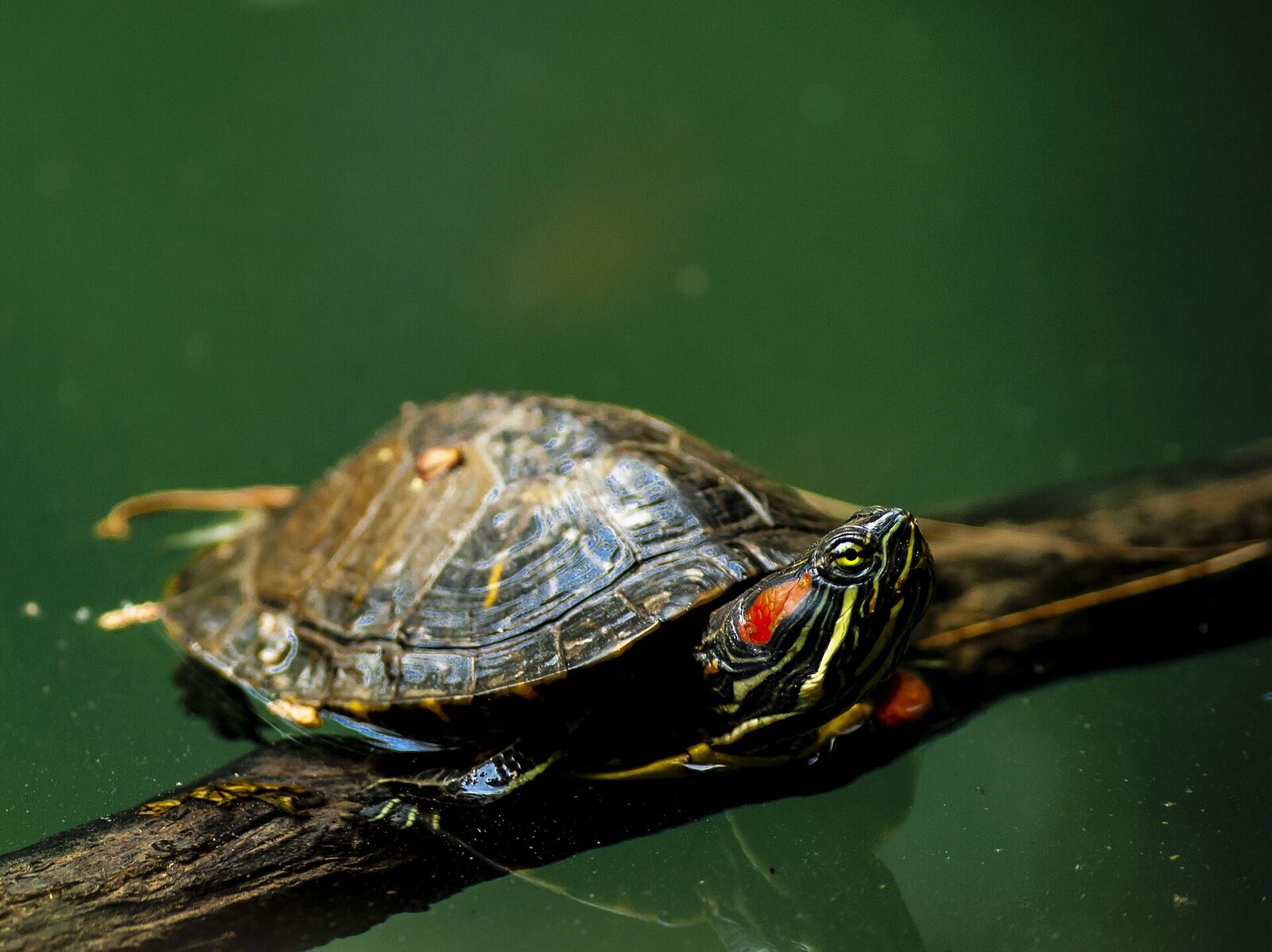
Red-eared slider
Trachemys scripta elegans
America's classic pet turtle, built to last decades.
Pet trade

Alabama map turtle
Graptemys pulchra
Zoos & aquariums

Baja California slider
Trachemys nebulosa
Pet trade

Barbour's map turtle
Graptemys barbouri
Zoos & aquariums

Black-knobbed map turtle
Graptemys nigrinoda
Pet trade

Bog turtle
Glyptemys muhlenbergii
Pet trade