
Home / Invertebrates / Spiders / Mexican Orange Beauty
Some federal rules applyMexican Orange Beauty
Brachypelma baumgarteni
Invertebrates › Spiders (Araneae) › Theraphosidae (Tarantulas)
Brachypelma baumgarteni (also called Mexican orange beauty) is a tarantula endemic to Pacific coast of Michoacan, Mexico.
From Wikipedia: Brachypelma baumgarteni, CC BY-SA 4.0 (excerpt)
Care at a glance
Species-specific values
Values researched for this exact species. Air, surface and water temperatures are listed separately, and each source is kept as published rather than averaged.
| Minimum enclosure | Spiderlings under about 1–1 1/4″: terrestrial spiderling kit; larger specimens use the enclosure sizes specified by their size. Source: jamiestarantulas.com | |
| Basking surface temperature | No separate basking surface temperature is stated. | jamiestarantulas.com |
| Warm side air temperature | No warm-side air temperature is stated. | jamiestarantulas.com |
| Cool side air temperature | No cool-side air temperature is stated. | jamiestarantulas.com |
| Night temperature | No night temperature is stated. | jamiestarantulas.com |
| Humidity | Humidity is described as low to medium; one corner can be kept lightly misted. Source: jamiestarantulas.com | |
| Uvb lighting | No UVB lighting recommendation is stated. | jamiestarantulas.com |
| Diet | Adults may eat crickets, mealworms, or roaches; small spiderlings can eat small prey such as pinhead crickets, flightless fruit flies, and newly hatched roaches. Source: jamiestarantulas.com | |
| Feeding frequency | Adults eat every 6–14 days; spiderlings every 5–10 days. Source: jamiestarantulas.com | |
| Social housing | No social housing recommendation is stated. Source: jamiestarantulas.com | |
| Substrate | Suitable substrate includes cocofiber, vermiculite, peat moss, potting soil, or a mix; spiderlings are encouraged to burrow in semi-moist substrate. Source: jamiestarantulas.com | |
| Seasonal cooling | No seasonal cooling recommendation is stated. | jamiestarantulas.com |
| Minimum enclosure | Use an enclosure at least three times the spiderling’s leg span. Source: thetarantulacollective.com | |
| Minimum enclosure | Use a juvenile enclosure at least 3–4 times the tarantula’s leg span. Source: thetarantulacollective.com | |
| Minimum enclosure | Use an adult enclosure at least 3 times leg span, ideally 4 times. Source: thetarantulacollective.com | |
| Minimum enclosure | General minimum is 3× leg span for spiderlings and 3–4× for juveniles and adults. Source: thetarantulacollective.com | |
| Warm side air temperature | 68–76 °F Source: thetarantulacollective.com | |
| Warm side air temperature | 68–75 °F (20–24 °C) Source: thetarantulacollective.com | |
| Humidity | Keep lower substrate moist and let the top layers dry between waterings. Source: thetarantulacollective.com | |
| Feeding frequency | Feed spiderlings twice a week. Source: thetarantulacollective.com | |
| Feeding frequency | Feed juveniles every 7–10 days. Source: thetarantulacollective.com | |
| Feeding frequency | Feed adults every 2–3 weeks, or as needed. Source: thetarantulacollective.com | |
| Substrate | Fill spiderling enclosures at least two-thirds with substrate. Source: thetarantulacollective.com | |
| Substrate | Fill juvenile enclosures one-half to two-thirds with substrate. Source: thetarantulacollective.com | |
| Substrate | Fill adult enclosures one-half to two-thirds with substrate. Source: thetarantulacollective.com | |
| Substrate | Provide deep, well-draining substrate for burrowing. Source: thetarantulacollective.com | |
| Note: more detail at jamiestarantulas.com. | ||
Understanding the animal
In the wild
In the wild
| Overview | Brachypelma baumgarteni (also called Mexican orange beauty) is a tarantula endemic to Pacific coast of Michoacan, Mexico. — From Wikipedia: Brachypelma baumgarteni, CC BY-SA 4.0 (excerpt) |
| Where it lives | The eastern border for its distribution is the river Balsas; the northern border is the Sierra Madre del Sur. It has a preference for tropical forest. — From Wikipedia: Brachypelma baumgarteni, CC BY-SA 4.0 (excerpt) |
| Appearance and size | It is similar to B. klaasi, but it has more reddish patellae. B. baumgarteni was thought to be a captive hybrid of B. smithi crossed with B. boehmei, because for a long time no specimen had been reported successfully bred in captivity. According to genetic analyses, its closest relative is B. boehmei. — From Wikipedia: Brachypelma baumgarteni, CC BY-SA 4.0 (excerpt) |
| Conservation | In 1985, Brachypelma smithi (then not distinguished from B. hamorii) was placed on CITES Appendix II, and in 1994, all remaining Brachypelma species were added, thus restricting international trade. Nevertheless, large numbers of tarantulas caught in the wild continue to be smuggled out of Mexico, including species of Brachypelma. — From Wikipedia: Brachypelma baumgarteni, CC BY-SA 4.0 (excerpt) |
Data and studies
Researched care notes
Researched care notes
Findings checked against veterinary, zoo, welfare, keeper and peer-reviewed sources. Air, basking-surface and water temperatures are kept separate, and where sources disagree both are shown. “Study” notes report what a paper measured, not a universal rule.
Terrestrial Tarantulas (beginner housing module)
Researched for this whole family or group; check species differences before applying.
- Use a secure terrestrial enclosure with refuge, appropriate substrate, and available water. Arboreal and deep-burrowing species require separate designs.1
- The keeper essay recommends managing substrate moisture, drinking water, and ventilation rather than chasing a generic RH number. Keeper experience; confidence LOW.2
Terrestrial Tarantulas
Researched for this whole family or group; check species differences before applying.
- A spider lying on its back may be molting; do not turn it upright or disturb the molt.1,3
- Remove loose living prey when a tarantula stops feeding before a molt, because prey insects can injure or kill the vulnerable spider.1
- Resume feeding only after the new exoskeleton has hardened; the BTS notes that newly molted adults can need more than a week.1
- Minimize fall risk and routine handling; the BTS recommends no handling because even a short fall can seriously injure a tarantula.1
- Arrange rocks and other heavy furnishings so they cannot fall onto the spider or create hazardous falls.3
Sources for this sheet
- Species+ (UNEP-WCMC and the CITES Secretariat) Zoo, university or veterinaryThe official database of species listed under CITES. UNEP (2026). The Species+ Website. Nairobi, Kenya. Compiled by UNEP-WCMC, Cambridge, UK. Available at: www.speciesplus.net. [Accessed 04/10/2026].
- USFWS International Affairs: CITES Zoo, university or veterinaryFederal agency that issues CITES permits.
- GBIF Backbone Taxonomy (Global Biodiversity Information Facility) (CC BY 4.0) Peer-reviewed researchInternational scientific taxonomy used here for classification. GBIF Secretariat (2023). GBIF Backbone Taxonomy. Checklist dataset https://doi.org/10.15468/39omei, accessed via GBIF.org.
- Wikipedia (species article) (CC BY-SA 4.0) Community referenceFree encyclopedia; useful overviews with their own citations. Short excerpts are quoted under CC BY-SA 4.0, each credited with a link to its article.
More tarantulas
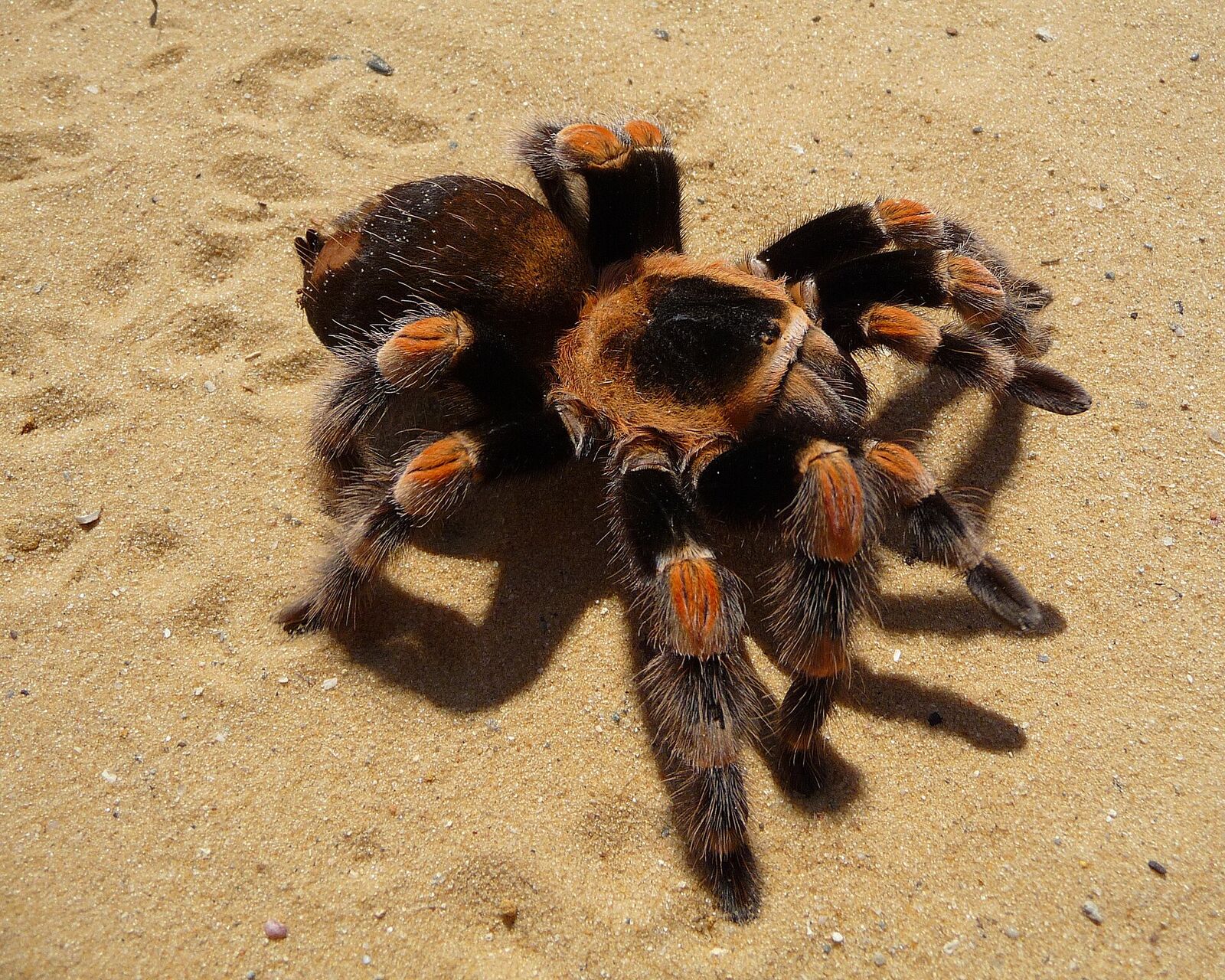
Mexican redknee tarantula
Brachypelma hamorii
A docile spider where females live 25–30 years.
Pet trade

African Horned Baboon Tarantula
Ceratogyrus darlingi
Pet trade
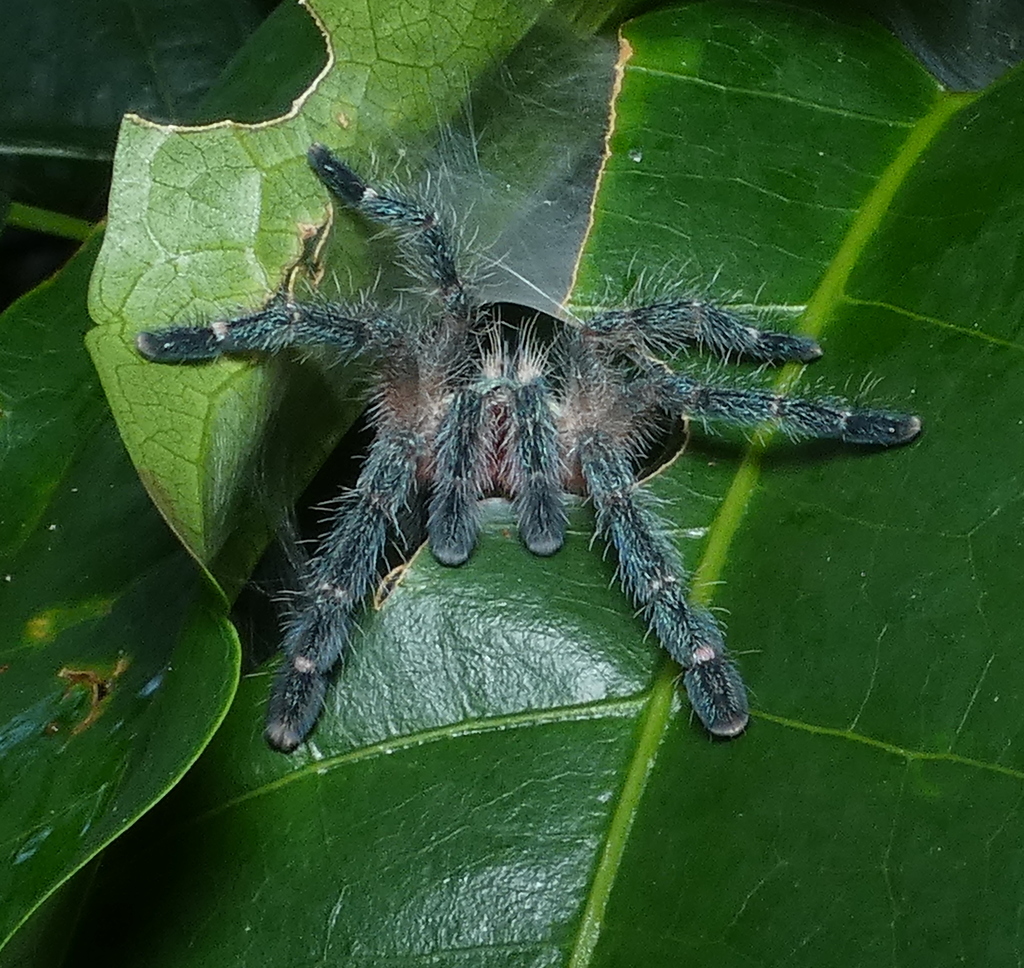
Amazon Ribbed Tarantula
Iridopelma hirsutum
Pet trade

Amula Redrump Tarantula
Brachypelma albiceps
Pet trade

Anantagiri’s Parachute Spider
Poecilotheria tigrinawesseli
Pet trade

Antilles pinktoe tarantula
Caribena versicolor
Pet trade