Care at a glance
Species-specific values
Values researched for this exact species. Where they differ from the group guide below, follow these. Air, surface and water temperatures are listed separately, and each source is kept as published rather than averaged.
| Minimum enclosure dimensions | length: 6 ft; width: 3 ft; height: 3 ft Brazilian form; increase length for snakes exceeding six feet. | 231 |
| Basking surface temperature | 86–90 °F | 231 |
| Day air temperature | 78–84 °F | 231 |
| Night air temperature | 72–75 °F | 231 |
| Day relative humidity | 70 % Older Brazilian rainbow boas. | 231 |
| Night relative humidity | 90–100 % | 231 |
| Relative humidity | 90–100 % Under one year; not all Epicrates species. | 231 |
| Adult total length | 5–6.5 ft Typical Brazilian form. | 231 |
| Lifespan | possible max: 30 years Care-sheet estimate. | 231 |
Care guide
Rainbow boas
Applies to most species in this group. Habitat: Humid South American forests and savannas. Individual species can differ, so compare with the species numbers above and the linked sources.
Housing & setup
- Humidity is the key to rainbow boas: keep a humid hide and moisture-holding substrate such as cypress mulch or coco husk.
- Brazilian rainbow boas need floor and climbing space; RF recommends at least 6 x 3 x 3 ft for a typical adult, enlarged for longer individuals.
Climate & lighting
Starting point only: Brazilian juveniles need a different humidity regime; the guide covers multiple Epicrates species. Check the species-specific values for this animal where shown.
| Warm side / daytime | 84–88°F |
| Cool side | 75–78°F |
| Humidity | 70–90% |
Diet
- Rodents every 7–14 days for young snakes, every 2–3 weeks for adults.
Social life
- Solitary.
Health watch
- Low humidity causes bad sheds and dehydration in neonates.
- Neonates can be nippy but usually settle down.
Understanding the animal
About this animal
About this animal
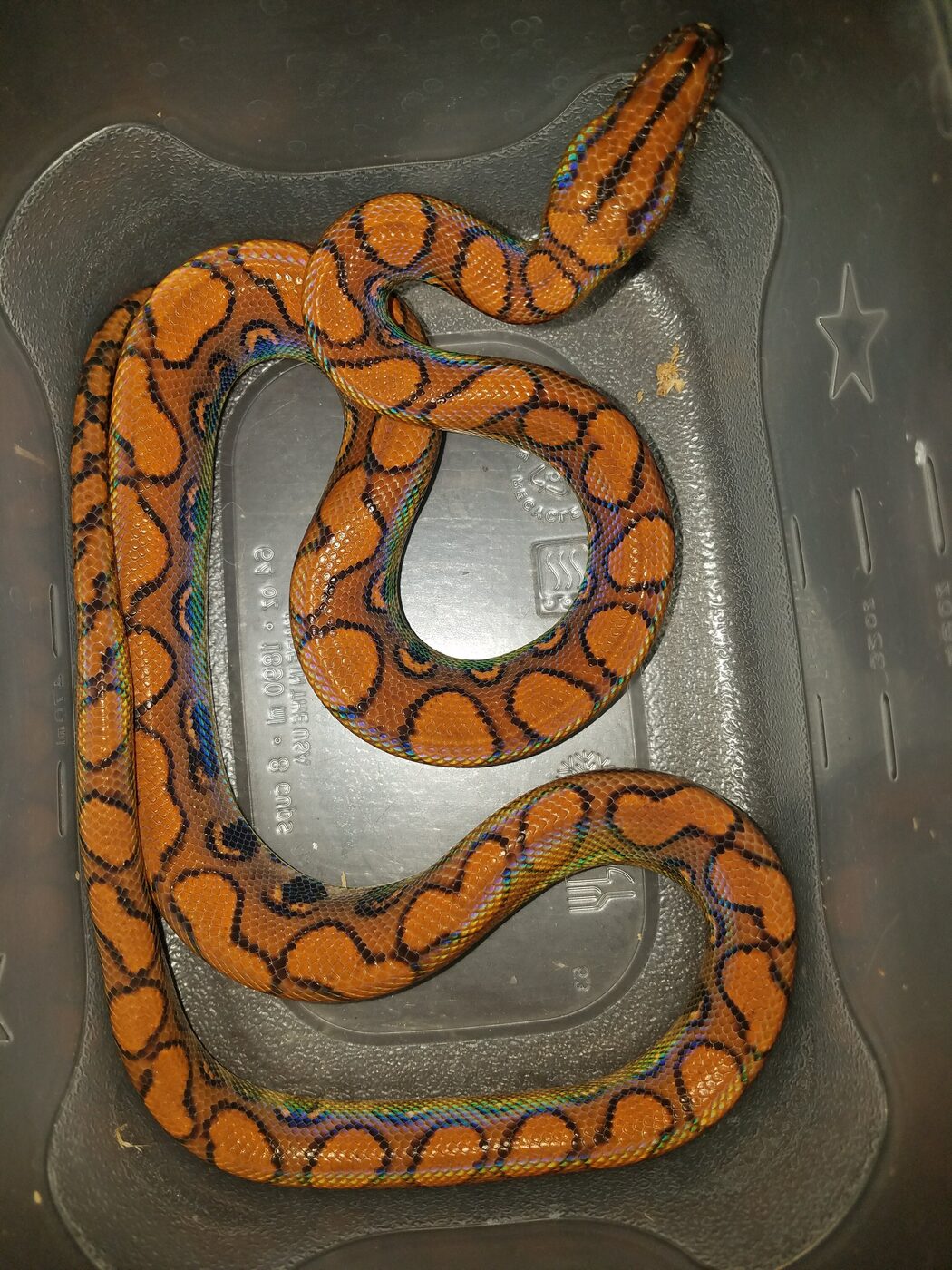
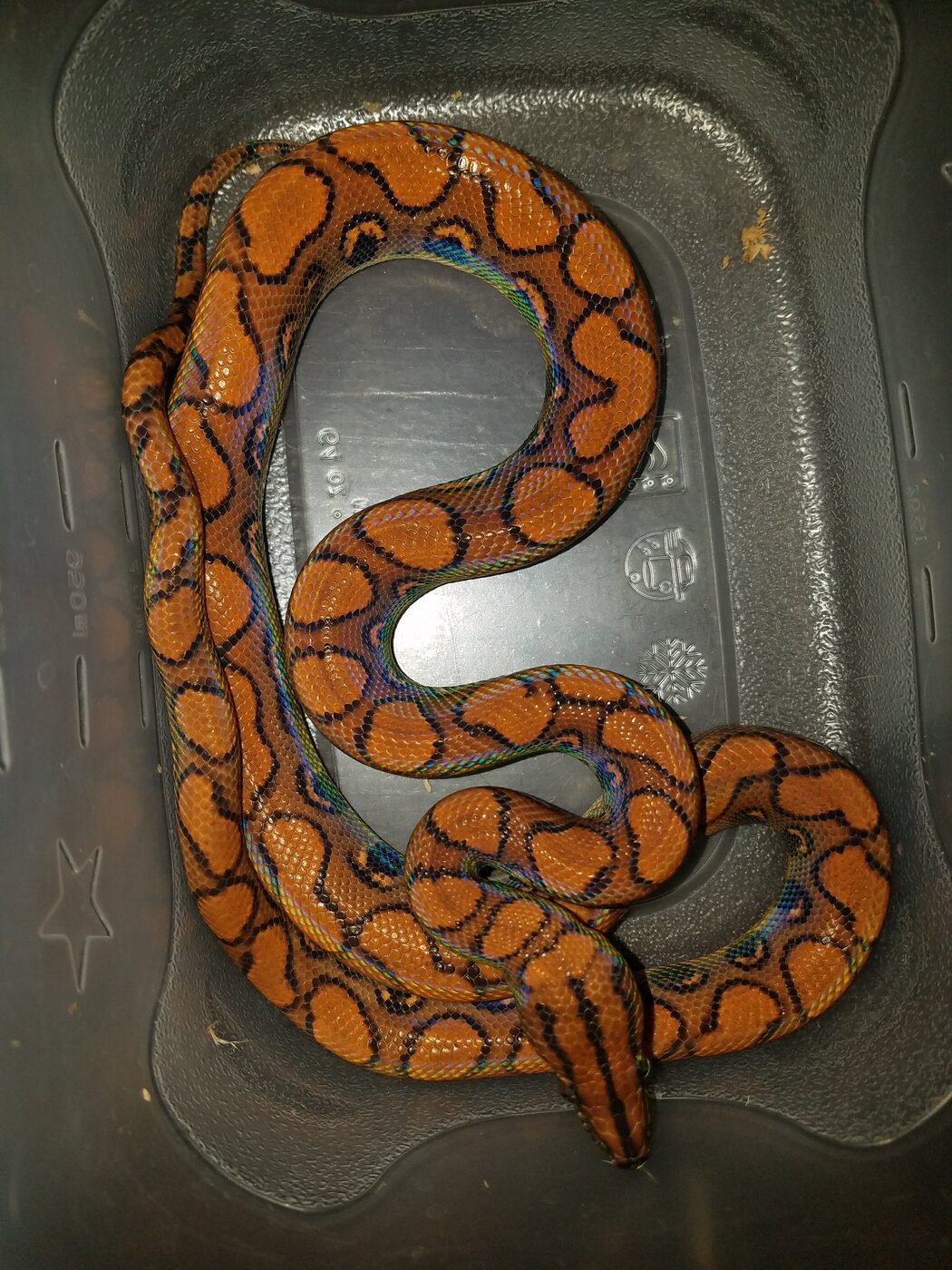
A semi-arboreal species (not only do they climb in the wild but also proven in captivity), it is known for its attractive iridescent/holographic sheen caused by structural coloration. Five subspecies are currently recognized, including the nominate subspecies described here.
Quoted from the Wikipedia article “Rainbow boa” (CC BY-SA 4.0) 174
In the wild
In the wild
Researched for this exact species, not its family. Good care copies these conditions.123
| Where it lives | Amazonian South America, where it uses terrestrial forest habitat. It also rests or hunts in bushes and low branches. |
| Ground it lives on | Forest floor; also low vegetation and branches. |
| Climate | Tropical Amazonian habitat; numerical wild microhabitat temperature and humidity ranges were not established. |
| Active | Nocturnal. |
| Wild diet | Documented Amazonian prey include rodents, bats, frogs and birds' eggs; a wild feeding observation records an Amazonian squirrel. |
| Behavior to plan for | A terrestrial constrictor that also uses low branches, so ground space alone does not cover its habitat use. |
What this means for care
- Provide extensive floor cover and low sturdy climbing branches.
- Use a whole-prey carnivore diet.
- Verify locality before applying climate figures from other rainbow boa species.
Native climate (measured)
Native climate (measured)
| Warm-season highs | about 89°F (up to 92°F in the hottest sampled areas) |
| Cool-season lows | about 67°F (down to 59°F in the coldest sampled areas) |
| Average temperature | 69–80°F across sampled records |
| Relative humidity | 79–85% on average (driest month about 80%) |
| Rainfall | about 2949 mm a year, spread fairly evenly |
Measured at 105 wild occurrence records sampled against WorldClim 2.1 climate data (1970–2000 averages). Air conditions in the range are ecological context, not enclosure settings: microhabitats such as burrows, leaf litter or basking rocks can be cooler, warmer or more humid.
Profile
Profile
Researched for this exact species. Sources are listed under In the wild above.
Keeper tips
- Maintain consistently humid conditions without eliminating ventilation.
- Provide terrestrial hides and sturdy climbing opportunities.
- Allow nighttime temperatures to fall below daytime levels.
- Juveniles require especially high humidity according to the cited husbandry source.
Behaviors reported
- Primarily active at night.
- Uses both the forest floor and elevated structures.
Unique adaptations
- Iridescent scales produce the characteristic rainbow sheen.
- The body form supports both terrestrial movement and climbing.
Remarkable facts
- Adults commonly reach about 5-6.5 ft.
- A potential captive lifespan of about 30 years is reported.
- The species is native to tropical South America.
From the sources
From the sources
Quoted from the matching sections of reputable sources for this exact species. Specialist databases are used first; Wikipedia (community-edited, CC BY-SA 4.0) only fills gaps. Other sources are short credited quotes.
| Overview | The rainbow boa (Epicrates cenchria) is a boa species endemic to South America. A semi-arboreal species (not only do they climb in the wild but also proven in captivity), it is known for its attractive iridescent/holographic sheen caused by structural coloration. — Wikipedia (community-edited) |
| Where it lives | Rainbow boas mainly occupy Amazonian rainforests and coastal rainforests along the Atlantic. — Animal Diversity Web |
| Social life and communication | Rainbow boas can recognize members of their own species through chemical cues. — Animal Diversity Web |
| Wild diet | Rainbow boas are carnivores. — Animal Diversity Web |
| Behavior | Rainbow boas are solitary and aggressive. — Animal Diversity Web |
| Reproduction | ovoviviparous; there is evidence for parthenogenesis in this species (BOOTH et al. 2015). — The Reptile Database |
| Lifespan | Rainbow boas can live between 20 and 25 years in captivity. — Animal Diversity Web |
| Appearance and size | Diagnosis: Distinguished from all continental species of Epicrates by having: (1) noncollapsed lateral ocelli, (2) dorsal ground color pale to yellow reddish, (3) SVL. 1500 mm, (4) lateral process of surangular much expanded latero-posteriorly. — The Reptile Database |
| History and naming | Named after Latin cenchris, Latin n. cenchris, a kind of snake. Cited by Lucano (1469), who characterizes it as having the belly tinged with "more points than the Theban ophites" and always moving in a straight line. Cenchris may come, in turn, from Latin cenchros or cenchrites, an unidentified type of gemstone mentioned by Pliny (XXXVII; 11). — The Reptile Database |
| Conservation | Rainbow boa populations are stable and not of concern to the conservation community. — Animal Diversity Web |
More photos
Data and studies
The numbers
The numbers
Each bar is what one source reports. Where several sources weigh in, the dashed gold band marks their average.
Maximum recorded lifespan
Longest recorded lifespan reported by each database; typical lifespans are usually shorter. The AnAge record comes from an animal in human care.
Typical adult weight
Average adult body mass in each database (FishBase gives the maximum recorded weight).
Basking spot
Species-specific values from keeper care sheets. Basking figures are often surface readings taken with an infrared thermometer, which run hotter than air.
Daytime air temperature
Species-specific values from keeper care sheets. Basking figures are often surface readings taken with an infrared thermometer, which run hotter than air.
Night temperature
Species-specific values from keeper care sheets. Basking figures are often surface readings taken with an infrared thermometer, which run hotter than air.
Humidity
Species-specific values from keeper care sheets. Basking figures are often surface readings taken with an infrared thermometer, which run hotter than air.
Care articles for this species
Care articles for this species
- Brazilian Rainbow Boa Care Sheet (ReptiFiles)
- Rainbow Boa Care Sheet (Reptiles Magazine)
Veterinary & husbandry research
Veterinary & husbandry research
- Reproductive cycles of neotropical boid snakes evaluated by ultrasound Garcia VC et al., Zoo biology 2022
- Molecular Identification of Cryptosporidium Species from Pet Snakes in Thailand Yimming B et al., The Korean journal of parasitology 2016
- Detection and prevalence of boid inclusion body disease in collections of boas and pythons using immunological assays Chang L et al., Veterinary journal (London, England: 1997) 2016
- RETROSPECTIVE REVIEW OF OPHIDIOMYCOSIS (OPHIDIOMYCES OPHIODIICOLA) AT THE SMITHSONIAN'S NATIONAL ZOOLOGICAL PARK (1983-2017) Anderson KB et al., Journal of zoo and wildlife medicine: official publication of the American Association of Zoo Veterinarians 2021
Peer-reviewed papers that mention this species alongside captivity, zoos, veterinary care or aquaculture. Some cover several species or mention it only in passing, so check the abstract. See all 8 on PubMed → 170
Sources for this sheet
- AnAge: The Animal Ageing and Longevity Database (Human Ageing Genomic Resources) Peer-reviewed researchCurated, referenced longevity and life-history records for thousands of species; maximum lifespans are often from zoo animals.
- Myhrvold et al. (2015). An amniote life-history database. Ecology 96: 3109 Peer-reviewed researchPeer-reviewed compilation of life-history data for over 21,000 birds, mammals and reptiles.
- ReptiFiles (care guides) Experienced keeper or breederWell-researched reptile care guides that cite herpetological literature and experienced keepers.
- Species+ (UNEP-WCMC and the CITES Secretariat) Zoo, university or veterinaryThe official database of species listed under CITES.
- USFWS International Affairs: CITES Zoo, university or veterinaryFederal agency that issues CITES permits.
- Merck Veterinary Manual: Management and husbandry of reptiles Zoo, university or veterinaryThe Merck Veterinary Manual: a standard veterinary reference written and reviewed by veterinary specialists.
- Merck Veterinary Manual: Nutritional, metabolic and endocrine diseases of reptiles Zoo, university or veterinaryThe Merck Veterinary Manual: a standard veterinary reference written and reviewed by veterinary specialists.
- ReptiFiles: Brazilian rainbow boa care sheet Zoo, university or veterinaryAdded in the 2026 source-checked care-guide review.
- Clint's Reptiles (YouTube): Brazilian Rainbow Boa, The Best Pet Snake? Expert educator & keeperClint Laidlaw, PhD in Biology Education and MS in Evolutionary Ecology; owner of Clint's Reptile Room and a longtime keeper. His "Best Pet?" series reviews each species' care in depth.
- The Reptile Database Peer-reviewed researchScientist-curated catalog of every reptile species, with taxonomy and literature.
- GBIF Backbone Taxonomy (Global Biodiversity Information Facility) Peer-reviewed researchInternational scientific taxonomy used here for classification.
- Wikipedia (species article) Community referenceFree encyclopedia; useful overviews with their own citations. Intro text is quoted under CC BY-SA 4.0.
- PubMed (U.S. National Library of Medicine) Peer-reviewed researchIndex of peer-reviewed veterinary, zoo and husbandry research.
- iNaturalist (captive observations) Community referenceCommunity observation platform run by the California Academy of Sciences and National Geographic; observations marked captive show animals living in homes, zoos and aquariums.
- Reptiles Magazine (care articles) Experienced keeper or breederEstablished reptile and amphibian hobby magazine; care articles are written by breeders, keepers and veterinarians.